The Anchor in Jewelry: Meaning, Symbolism and History
Introduction: a symbol that holds
In the middle of a North Atlantic gale, when every rope is straining and the coastline has long since disappeared, the anchor is the last argument between a ship and the sea. It bites into the seabed and holds. Everything else is negotiation.
That function, absolute and unglamorous, is what turned the anchor into one of the most enduring motifs in jewelry. Not borrowed mythology, not invented sentiment. A real object that really works, translated over centuries into a symbol of stability, hope and the stubborn refusal to drift.
In the United States the anchor carries its own particular weight. The US Navy, one of the largest in history, has used it as a central emblem since the country's founding. New England whaling communities, Gulf Coast fishing families, Great Lakes sailors, Pacific Coast shipbuilders: the anchor runs through American maritime identity across both coasts and through the inland waterways. The tattoo parlors of port cities from San Diego to New Orleans fixed the anchor as a symbol of the working sailor before it became a fashion motif. When an anchor pendant hangs in an American context, it carries that history.
The anchor also speaks to something beyond the sea. People who have never been near saltwater wear it because the metaphor is honest: there are things in a life that hold you in place when everything else shifts. Home, family, faith, a person you trust, a set of values that does not change with the news cycle. That is what the anchor means when it works at full depth.
What the anchor symbolizes
The anchor has accumulated several distinct layers of meaning across two thousand years. They do not contradict each other; they stack.
Stability. An anchor does not move. It holds the vessel in place regardless of current, tide or wind. In daily life, your anchors are the things that keep you in place when everything else shifts: home, family, faith, a person you trust, a set of values that does not change with the season. The object lends its function to the metaphor without any stretch.
Hope. The connection between anchor and hope is older than most people realize, and it comes from a specific source. The Epistle to the Hebrews, chapter six, verse nineteen, written in the first century: "We have this hope as an anchor for the soul, firm and secure." For early Christians hiding from Roman persecution in the catacombs beneath the city, the anchor was a safe image for the cross. Its visual structure was close enough to a cross that initiated readers understood it, distant enough from a cross that Roman authorities would not flag it. The anchor carried the meaning when the direct symbol was dangerous. That association, anchor equals hope, has never fully untangled itself from the symbol.
Faithfulness. American and British sailors tattooed the anchor as a promise: I will come back. Often paired with a name, often placed on the forearm where it would be visible when the sailor returned. The anchor said in one image what was hard to say in words before a long voyage.
Profession. The direct, literal meaning for anyone who has worked at sea. Sailors, fishermen, Navy veterans, Coast Guard crew, harbor pilots. The anchor as a professional mark, not an aesthetic choice.
Safety and safe harbor. In port, at anchor, the ship is secure. The anchor reads as safety, as the end of a passage, as the moment when effort gives way to rest. For people who spend most of their lives moving, the anchor represents the right to stop. To drop anchor is to say: I am here, the search is over, this is where I stay.
Staying grounded. The anchor as the opposite of drifting. In times when life becomes too fluid, too unpredictable, too stripped of reference points, the anchor functions as a reminder that a fixed point exists. This is not superstition; it is a practical psychological anchor in exactly the same way the physical object provides a physical one.
Arrival. To drop anchor is to have arrived. Not still searching, not still at sea. For some people that is the whole point of wearing the symbol: the arrival, not the journey.
A short history of the anchor: from Phoenician stone to Admiralty pattern
Before it became a piece of jewelry, the anchor spent three thousand years as a working tool. Understanding that history explains why the symbol carries the weight it does.
Phoenician and Greek anchors
Phoenician traders in the eastern Mediterranean (roughly the second millennium BC) used stone anchors with wooden shanks: heavy enough to hold a merchant vessel off the coast of Tyre or Carthage, simple enough to be cut from local rock. The Greeks refined the design considerably. By the classical period they were using wooden-shanked anchors with lead crossbars (stocks) that caused the anchor to settle correctly on the seabed. The Seleucid dynasty of ancient Syria stamped the anchor on coins as a mark of maritime power; it appears on Antiochene mosaics, Roman oil lamps and stone grave markers as the straightforward sign of a seafaring life.
Roman lead and iron
Roman anchors added iron arms to the wooden or lead stock design, approaching something close to the modern principle of operation. The word itself, "ancora," passed into Latin from the Greek and then into every major European language. The Romans also pressed the anchor into decorative use: on clay lamps found across the empire, it indicated a sailor's trade or a family's connection to the sea.
Medieval Y-anchor
Medieval chronicles and manuscript illustrations from the thirteenth and fourteenth centuries show a simplified form: a straight shank with two diverging arms and no separate stock. Sometimes called the Y-anchor in historical writing. Practical for rapid manufacture when a port needed to outfit dozens of vessels at once.
1820: the Admiralty pattern
The British Admiralty standardized what is now the immediately recognizable anchor shape around 1820: a straight shank, a folding stock across the top, two symmetrical curved arms and two flukes at their ends. This is the anchor everyone pictures. It is also the anchor that became the definitive jewelry form. The silhouette on a pendant or signet ring today is, almost universally, the Admiralty pattern anchor. The stock is the part that gives the anchor its visual character: without it, the shape reads as abstract. That is why jewelry has kept the 1820 version even as modern vessels moved to stockless designs.
1933: the CQR
Scottish engineer Geoffrey Taylor patented the plow anchor, known as the CQR, in 1933. It was designed for small yachts and became standard on recreational sailing vessels throughout the twentieth century. It never became a jewelry icon: by 1933 the Admiralty form was already so established in decorative use that no new design could displace it.
The anchor in early Christianity: the Roman catacombs
This is the oldest and least-known layer of the symbol's history.
During the Roman persecution of Christians, particularly between the first and fourth centuries, displaying the cross openly was dangerous. The anchor provided a solution. Its visual structure is genuinely similar to a cross: a vertical shaft, a horizontal crossbar, two curved arms below. It was close enough for the initiated to read, distant enough from the cross to avoid official attention.
The catacombs of San Callisto on the Via Appia and San Domitilla on the Via Ardeatina in Rome preserve hundreds of burial inscriptions from the first through fourth centuries. Many of them show the anchor, sometimes alone, sometimes paired with a dolphin or the Greek letters IHS, sometimes scratched into white plaster with the simplest possible tool. In the Domitilla catacombs the anchor appears alongside a fish and the letters alpha-omega: three symbols forming a complete profession of faith without a single word.
These are the earliest examples of the anchor as a religious symbol anywhere in the world. The persecutions under Emperor Diocletian from 303 to 313 were particularly severe. During this period hidden symbolism was a survival question, not an aesthetic one. When someone scratched an anchor into a catacomb wall in Rome in the second century, they were not decorating. They were stating a position under dangerous conditions.
After the Edict of Milan in 313, when Christianity was legalized, the cross returned to open use and the anchor stepped back. But it did not disappear. It remained in liturgical iconography, in the dedications of port churches, and in the attributes of Saint Clement.
Saint Clement I, an early Bishop of Rome and martyr, was by tradition drowned with an anchor tied to his neck. He became the patron saint of sailors and the anchor became his permanent attribute. Port churches bearing his name appear across Europe and in American coastal cities, particularly those with Catholic traditions, carrying his anchor as part of their identity.
Saint Brendan the Navigator, an Irish monk of the sixth century, was said by tradition to have made Atlantic voyages long before the Norse. In Celtic Christian tradition his image is associated with the search for firm ground after a long crossing: the anchor after the storm.
Stella Maris, Star of the Sea, is one of the honorific titles of the Virgin Mary in Catholic tradition, and her patronage of sailors links directly to the anchor as a symbol of the hope she represents for those at sea.
The anchor and the phrase about hope
The specific phrase that binds anchor and hope in Western culture comes from Hebrews 6:19. The passage in full reads: "We have this hope as an anchor for the soul, firm and secure." The theological logic is exact and elegant: an anchor works precisely because it is invisible beneath the surface. You cannot see it from the deck; you trust that it is holding. Hope in God works the same way: invisible from where the believer stands, but the thing that prevents the drift.
This text was read aloud in the first Christian communities while persecution was ongoing. The anchor image carried weight because it was lived, not theoretical.
The phrase "hope anchors the soul" became a common engraving on memorial jewelry in the nineteenth century. It appears on mourning brooches, on headstones, on the backs of lockets. In modern jewelry it is a popular inscription for pendants, particularly as a gift for someone navigating a difficult passage.
In Latin the phrase is rendered as "Spes Anchora Vitae," meaning "hope is the anchor of life." This motto appears on the gravestones of sea captains, on maritime chapels, on old ships' flags. Today it is a meaningful engraving choice for anchor jewelry worn by people who want a personal motto that carries genuine historical weight.
The secular reading of hope-as-anchor is equally valid for those who do not hold a religious frame. Hope as a psychological anchor: the thing that keeps a situation from becoming irreversible, the conviction that there is a way through even when it is not visible. The metaphor is honest precisely because an anchor works whether or not you can see it.
The anchor in American sailor tattoo tradition
The American tattoo tradition of the late nineteenth and early twentieth centuries fixed the visual language of the anchor that most people carry in their heads today. The classic form: a bold outline, a length of rope wrapped around the shank, a scroll or ribbon, a name written on it. This is the aesthetic of Sailor Jerry Collins in Honolulu and of the tattoo parlors that lined the waterfronts of New York, Boston, San Francisco and New Orleans.
In this tradition the anchor tattoo meant something specific: the sailor had crossed the Atlantic. It was an earned mark, not a decorative one. A man with an anchor tattoo had done something. The name added on the ribbon or scroll was the name of the person waiting at home, turning a professional mark into a personal promise.
This visual language moved from tattoo parlors into mass culture during the mid-twentieth century, entering advertising, packaging design, clothing and eventually jewelry. By the 2010s the anchor was one of the most recognizable motifs in American consumer jewelry, worn by people who had never been near the sea alongside people for whom it carried the original professional meaning.
The tattoo tradition also reinforced one specific quality of the anchor symbol: earned meaning. The tattoo was not given freely; it was worn because something had been done. Anchor jewelry carries a trace of that idea even today. The most honest way to wear it is to know what your anchor is.
Forms of the anchor in jewelry
The anchor appears in several distinct versions, each with a different history and register.
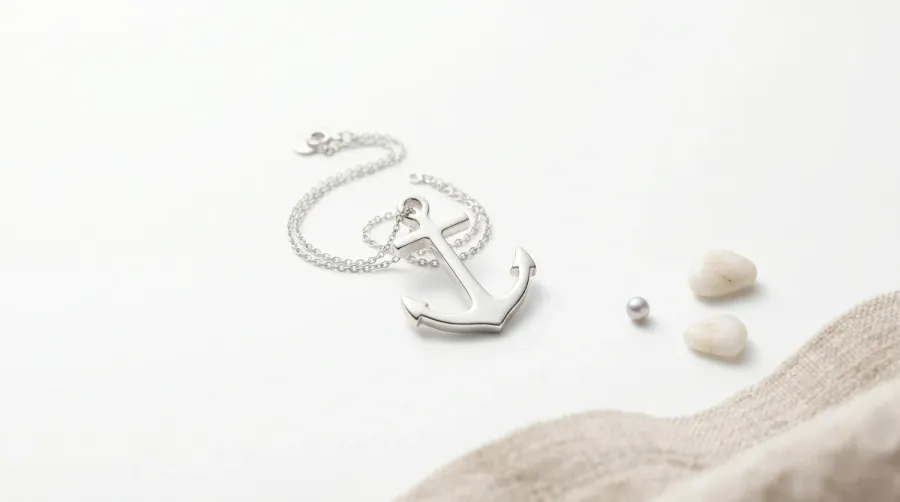
The Admiralty pattern anchor. The classic form: straight shank, crossbar at top, two curved arms below. The universal choice. Suits any wearer, any context. This is the anchor that became a jewelry icon in the nineteenth century and has held that position since.
The stockless anchor. The modern form without the crossbar, used widely on commercial vessels from the twentieth century. Simpler visually, reads as minimalist. Suits fine jewelry and women's pieces particularly well.
The foul anchor. An anchor with a rope or chain coiled around the shank. Used on naval officers' buttons, badges and seals since the eighteenth century. More complex visually, with a distinctly professional naval quality. For wearers who want the maritime register explicit.
The Jerusalem or Crusader anchor-cross. An anchor integrated with a cross, used on Crusader seals and in medieval pilgrim jewelry. Carries a very specific historical weight.
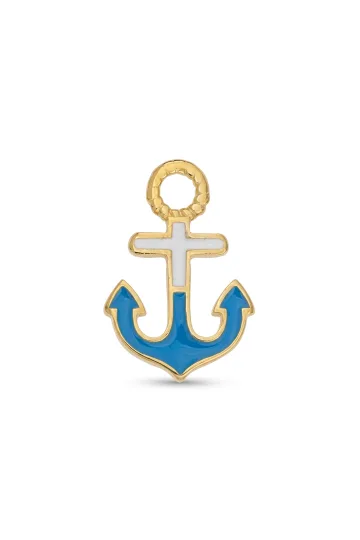
The hope anchor with cross. The early Christian form: an anchor with a cross at the top of the shank, referencing Hebrews 6:19 directly. For wearers who want the theological layer explicit.
Anchor and heart. The romantic combination. Very old as a paired symbol; common in Victorian memorial and friendship jewelry as well as modern couples' pieces. The reading is immediate: love as anchor. One of the oldest maritime romantic motifs.
Anchor and compass. Stability and direction together. A modern pairing that reads as philosophical: I know where I am and I know where I am going.
Symbol combinations
The anchor pairs naturally with other maritime and navigational symbols.
Anchor and compass. Stability and direction together. For travelers, for people with a clear sense of destination, for those who know where they are headed even when the journey is difficult.
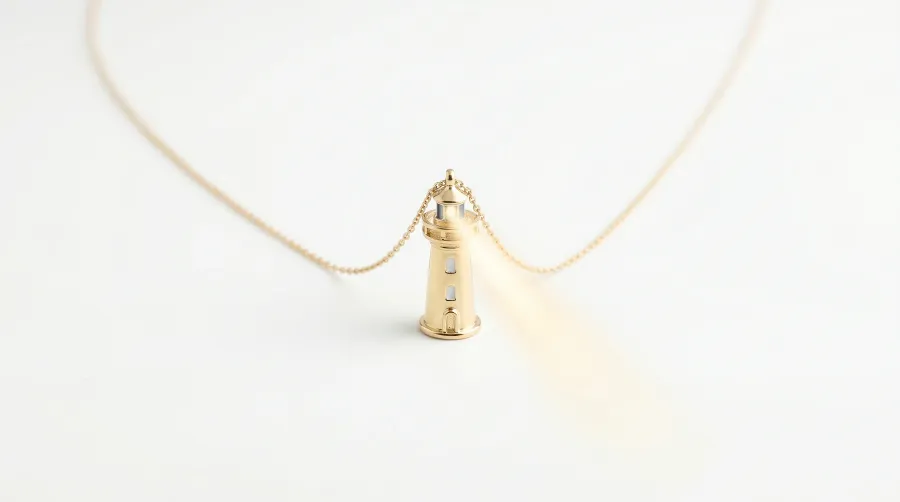
Anchor and lighthouse. The lighthouse guides the way in; the anchor holds the vessel once arrived. A complementary pair, well suited to two-piece sets. Reading what the lighthouse carries as a symbol of its own makes the pairing far richer.
Anchor and sailor's knot. Stability paired with the binding of two lives. The sailor's knot in jewelry carries its own history of fidelity and connection, and worn alongside an anchor it reads as a quiet promise.
Anchor and helm. Stability and course. A classic pairing for two people: one wears the anchor, one wears the helm.
Anchor and heart. The most romantic pairing. A long history in naval families and maritime communities of gifting this combination before a sailor's departure.
Anchor and cross. The early Christian tradition made explicit. Two very old symbols that have always been read together.
Anchor and pearl. The sea in its full dimension: what is drawn from the depths (the pearl) and what holds at the depths (the anchor). A feminine combination with a double maritime theme.
Anchor jewelry: what to choose
Pendant
The most popular form by a considerable margin. Sizes range from the discreet (around half an inch to one inch, easily worn under a shirt collar) to the deliberately bold (two to three inches, worn as a statement piece over a sweater).
Small minimalist, around half an inch on a fine chain. The everyday option. Works under a collar, survives the office, adds nothing intrusive. For wearers who want the meaning without the display.
Medium with detailing: the crossbar, a length of chain, perhaps a rope. The maritime reference becomes legible. A step up in presence.
Large, worn openly. The choice for someone who identifies with the sea and wants that identity visible. Works best with heavier fabrics: a navy sweater, a waxed cotton jacket, a peacoat.
The pendant can be worn under clothing as a personal symbol, or openly over it as a visible statement. That difference in how it is carried says as much as the piece itself.
Ring
More common as a men's piece, though women's versions exist.
Signet ring with an engraved anchor. A naval classic; has been given as a commission gift, a retirement piece, a family heirloom across generations. In New England and Mid-Atlantic families with seafaring traditions, the signet ring with anchor was worn as a professional mark.
Fine ring with a small anchor figure, for women who prefer a discreet statement.
Double ring with a chain link, where the anchor and chain read as a single design.
Earrings
Small anchor studs, worn as a pair. Understated; works well alongside a pendant.
Drop earrings on a fine chain, where the anchor moves. The maritime reference is deliberate.
Bracelet
Leather cord with a metal anchor clasp, the nautical bohemian style that works across genders. The most accessible price point.
Stainless steel or silver chain with an anchor pendant. A more formal nautical look.
Layered bracelet combining anchor, helm and shell. A set of maritime symbols worn together.
Cufflinks
The men's formal option. For a suit that needs a maritime aside, a gift for a sailor, yachtsman or someone whose family has a long connection to the sea.
Engraving
Engraving transforms a piece from a beautiful object into a personal document. The anchor suits engraving particularly well because the symbol already provides the context.
Coordinates. Latitude and longitude of a home port, a favorite anchorage, a place that matters. The format has become as standard as a date: 37°49'N 122°28'W for San Francisco Bay, 41°21'N 71°58'W for Newport, Rhode Island.
A date. Wedding anniversary, the date a voyage ended, the date someone came through a difficult period.
A ship's name. For serving sailors or in memory of a significant passage.
A quotation. "Hope anchors the soul" from Hebrews, or the shorter biblical reference Heb. 6:19. Readable to those who know the source, decorative to those who do not.
A name. In the tradition of naval tattooing: the name of the person waiting at home.
A Latin phrase. "Spes Anchora Vitae" (Hope is the anchor of life). A classical motto that reads as a personal statement.
Materials and finishes
Sterling silver. The most common choice. Works at every price point, suits any occasion, ages well. Near the coast, silver tarnishes faster than inland due to salt air. A soft cloth after a day at the waterside prevents the worst of it.
14-karat gold. The premium choice. Does not tarnish in salt air. If the piece is going to see regular coastal use, gold is the more practical option. The color reads warmer and more formal than silver.
Oxidized silver. A deliberately darkened surface that gives the effect of old ship metal. Particularly effective on larger pendants with relief detail. Suits the aesthetic of something found and worn rather than newly purchased.
Bronze. Historically accurate: anchors in antiquity were bronze. Modern bronze jewelry carries the same quality of looking genuinely old, not artificially aged. For those who value documentary authenticity over shine.
PVD-coated steel. For active wear. Resistant to salt water, requires almost no maintenance. The right choice for a bracelet worn every day through a summer on the water.
Who it suits
Anyone connected to the sea professionally. Sailors, fishermen, Navy veterans, Coast Guard crew, harbor masters. The anchor is their professional mark.
People from port cities and coastal communities. Boston, Charleston, San Francisco, Seattle, New Orleans, Annapolis, Newport. The anchor is part of local identity, not imported symbolism, and sits naturally within a broader ocean-themed jewelry collection for those who want the whole maritime register.
Those who value stability. People who have genuinely been through difficult periods and emerged on the other side. The anchor as evidence that they held.
People navigating loss or change. Bereavement, divorce, relocation. The anchor as a reminder that an anchor exists, even when it does not feel like it.
Christians. The anchor as the oldest Christian symbol of hope, older than the fish symbol and the visible cross.
Couples. Paired anchor and helm, or anchor and heart. A long tradition of maritime symbolism used in romantic contexts.
Anyone drawn to tattoo heritage. The anchor crossed from skin to metal in the twentieth century and has not looked back.
Those who have survived a hard passage. The anchor of survival: I held when the storm was worst. The piece worn not as decoration but as evidence.
People who identify as steady. The anchor as a self-description. If you are the person others come to for grounding, the anchor is an accurate reflection.
Young adults starting out. The first piece of jewelry with intentional meaning. The anchor says: I know what holds me, or I am choosing what will hold me.
How to style anchor jewelry
Anchor jewelry sits naturally within a specific visual register, but it is not limited to it. Understanding how the piece reads lets you place it accurately.
The maritime look, done properly. Anchor pendant over a navy or white linen shirt, canvas sneakers, a canvas tote. This is the look that references the sea without irony. It works because the anchor is not the only maritime signal in the outfit; it belongs to a coherent visual language. Adding a second maritime piece, a sailor's knot bracelet, a compass earring, deepens the effect rather than cluttering it.
Minimalist, city wear. A small anchor on a very fine chain, tucked under a clean white t-shirt or a crisp button-down. Not visible from the outside, but present. This is anchor jewelry at its most interior: the meaning is private, the appearance is neutral. This approach works in any professional setting without raising questions.
The tattoo-aesthetic look. A larger, more graphic anchor pendant, in oxidized or blackened silver, worn visibly over a dark knit or a plain tee. This reads clearly as a reference to the tattoo tradition. Bold, direct. Pairs well with other graphic pieces or worn alone as the single accent.
Dressy occasion. A small gold anchor pendant or earrings with a dress or suit. The maritime reference becomes subtle when the metal is gold and the scale is small. It adds interest without looking out of place in a formal context.
Layering. An anchor pendant at one length paired with a plain chain at a shorter or longer length. The layering draws attention to the anchor as the anchor of the arrangement, which is its own quiet visual joke. Do not layer with pieces that fight for attention; the anchor works better when it is the most meaningful element, not the loudest one.
The anchor as a gift
The anchor works well as a gift precisely because its meaning is legible but not intrusive. It speaks clearly without making demands.
For someone going through a hard time. Not "things will get better" but "you have something holding you." That is more honest. The anchor does not promise an outcome; it names what is currently holding.
Before a long journey. The tradition of gifting an anchor before departure runs through port families on both coasts. It carries the meaning directly: I am holding you here even when you are far away.
For a partner. The anchor and heart combination. "You are my anchor."
For someone defined by their reliability. If someone in your life is the person others turn to for steadiness, the anchor is an accurate image.
For a person of faith. A piece with the hope anchor design carries a layer of meaning that goes back eighteen centuries.
For a wedding. The anchor and heart, or a paired set of pendants. "You are my anchor" in a context where that means something specific. This is one of the oldest maritime romantic gestures: the sailor's wife pinning an anchor brooch on his lapel before departure.
For a graduation. Starting out on an independent life requires knowing what holds you. The anchor is an honest image for that moment. Not a wish for success, but an acknowledgment that the person has what it takes to navigate open water.
Care
Silver and sea air are not natural allies. Salt spray accelerates tarnishing noticeably. If you live on the coast or spend regular time near the sea, a soft cloth after each day at the waterside will prevent the worst of it. A mild soapy wash and a thorough dry with a lint-free cloth restores luster when tarnishing sets in. For the crevices of a detailed anchor, between the flukes and around the stock, a soft toothbrush does the work.
After a beach vacation, saltwater and sunscreen residue will have accumulated in the relief details. A gentle warm water rinse with a drop of neutral soap, followed by careful drying, is enough to restore the piece.
Gold does not tarnish in salt air. If the piece is going to see regular coastal use, gold is the more practical choice. Stainless steel is the most resistant of all: for a bracelet or pendant worn constantly through summer by the sea, it requires almost no maintenance.
Store silver in a closed box or a sealed bag. Contact with air accelerates oxidation. Do not store with other metal pieces that might scratch. An anchor with pointed flukes can scratch softer surfaces if stored loose.
The anchor for someone going through a hard passage
There is a specific kind of person who comes to anchor jewelry not through any maritime connection, but through necessity. Someone who has been through a genuinely difficult period: a serious illness, the death of someone central, a divorce, the loss of work, a move that dismantled a life. For this person the anchor is not decorative. It is functional.
The piece serves as physical evidence. Not of victory, not of a promise that things will improve, but of the simpler fact: I held. The anchor did not let go during the storm, and neither did I. Wearing it is a way of carrying that fact through the days that come after.
Mental health professionals who work with grief and recovery note that concrete objects with personal meaning help people stay connected to their own resilience. A piece of jewelry worn every day becomes a tactile reminder of something real. The anchor suits this role particularly well because its meaning is clear without explanation. The people who see it understand the symbol. Those who do not know the story see a handsome maritime piece. Nothing needs to be explained.
This is one of the most honest uses of the anchor in jewelry. Not performance, not fashion, not nostalgia. Evidence, worn close to the body.
The anchor across American maritime communities
The anchor's meaning in the United States is inseparable from its geography. A country with two major coastlines, a Great Lakes system the size of a small inland sea, the Mississippi River system cutting through the interior, and a Gulf Coast with its own distinct maritime culture: the anchor has local roots in all of these.
New England whaling communities in the nineteenth century, particularly in New Bedford and Nantucket, understood the anchor in concrete terms. These were communities where men went to sea for years at a time. The anchor pendant given by a wife before her husband's departure carried specific content: come back to me.
The Navy town tradition runs through Annapolis, Norfolk, San Diego, Bremerton, Pearl Harbor, Jacksonville. In these cities the anchor is a professional emblem, part of local visual identity, present on storefronts and public art, worn without self-consciousness because it simply belongs to the place.
The Gulf Coast fishing communities of Louisiana, Alabama and the Florida panhandle have their own relationship to the anchor. Working boats, shrimpers, recreational fishing: the anchor as a practical object that shapes how people think about the sea.
Pacific Northwest maritime culture, from the shipping industry of Seattle and Tacoma to the salmon fishing traditions of the coast, adds another layer. The anchor in this context is also about the inland waterways, about the rivers that carry goods from the mountains to the sea.
All of these regional traditions feed into what the anchor means when someone wears it in an American context. The symbol carries a lot of specific ground.
History of the anchor as symbol
Antiquity
Anchors as practical objects appear from the Bronze Age. Phoenician, Greek and Roman traders all used them. The Seleucid dynasty struck the anchor on coins as a mark of maritime power. The symbol predates its symbolism by several centuries.
Early Christianity
The critical moment. During the Roman persecution of Christians, the anchor became a covert sign of the cross. Anchor imagery appears in the Roman catacombs on burial inscriptions. The text from Hebrews provided the theological logic: hope as anchor.
The Middle Ages
Saint Clement, an early Bishop of Rome and martyr, was by legend thrown into the sea with an anchor tied to his neck. He became the patron saint of sailors and the anchor his attribute.
The Age of Discovery
The fifteenth to seventeenth centuries. Spanish, Portuguese, Dutch and English fleets moved across oceans previously uncharted. The anchor became the visual shorthand for the entire enterprise.
The nineteenth century: tattooing
The modern anchor tattoo tradition crystallized in the nineteenth century. The anchor was the entry-level mark of the working sailor, earned by crossing the Atlantic.
The twentieth century: from skin to jewelry
American tattooing formalized the visual language of the anchor in the early twentieth century. This aesthetic moved from tattoo parlors into mass culture and eventually into fashion and jewelry.
FAQ
Is the anchor only a maritime symbol?
No. The Christian use of the anchor as a symbol of hope predates modern maritime associations by well over a thousand years. The anchor works equally as a symbol of stability, hope and faithfulness in entirely non-nautical contexts.
Does it suit women?
Entirely. The anchor has no fixed gender in jewelry. Fine anchor studs, small pendants on delicate chains and narrow rings with an anchor motif are popular women's pieces across the range.
Anchor jewelry and anchor tattoos: do they work together?
Well. If you have an anchor tattoo, a pendant in the same motif reinforces rather than duplicates. Many people wear both deliberately.
What does an anchor with a heart mean?
"Love as anchor." The oldest romantic reading of the symbol. A popular choice for paired jewelry or as a gift between partners.
What is the anchor and cross combination?
An early Christian form. The anchor conceals the cross when the cross is dangerous; after legalization, it reads as Christ as anchor of the soul. A piece with this design carries a very old layer of meaning.
What did sailors' anchor tattoos mean specifically?
In the classic naval tradition, the anchor tattoo indicated that the sailor had crossed the Atlantic. With a name added, it was a memorial: this person is waiting for me at home.
Is it traditional to give an anchor piece before a voyage?
Yes. The tradition of gifting an anchor pendant or brooch before a sailor's departure runs through port families on both coasts and in Europe. The gift carried the meaning directly: I am holding you here even when you are at sea.
Is an anchor appropriate for a funeral?
Yes. As a Christian symbol of hope the anchor is entirely appropriate. Particularly so if the person who died was connected to the sea, or if the anchor had personal meaning for them.
Can an anchor pendant be a wedding gift?
Yes. The anchor and heart combination, or a paired set of pendants, carries the meaning directly: you are my anchor.
Silver, steel or gold?
Silver is the universal choice: versatile, durable, works at every occasion. Steel reads as maritime and robust, the honest material of working boats. Gold reads as formal, romantic or devotional. Near the coast, silver tarnishes faster than inland: a soft cloth after sea air keeps it right.
Can an anchor pendant be worn in the office?
Yes. A small pendant on a fine chain works in any professional setting. A large decorative anchor competes with a formal outfit.
What is "Spes Anchora Vitae"?
Latin for "hope is the anchor of life." A classical motto with roots in the same tradition as Hebrews 6:19. A common inscription on memorial jewelry from the eighteenth and nineteenth centuries, and a meaningful engraving choice today.
What is the difference between wearing an anchor pendant and an anchor tattoo?
Mainly flexibility. A pendant can be changed, given away, worn sometimes and not others. A tattoo is permanent. Many people wear both: the tattoo as the original commitment, the pendant as the daily visible version of the same statement.
Conclusion
The anchor has survived as a symbol for over two thousand years because what it represents has not changed. Stability is always needed. Hope is always needed. The point of holding has always mattered. An anchor pendant does not require a seafaring backstory to carry weight. It requires only the understanding of what an anchor does.
The symbol works for different people for different reasons: for one person it is a professional mark, for another a personal talisman, for a third a religious image, for a fourth simply a beautiful piece of maritime jewelry. None of these readings is wrong. The anchor is old enough and layered enough to hold all of them at once, and simple enough that its core meaning does not require explanation.
The most honest way to wear an anchor is to know what yours is. The piece then carries that knowledge quietly, every day, in the crevices of the flukes and along the shank, invisible to everyone but you. That is, after all, exactly how an anchor works: below the surface, out of sight, holding nonetheless.
About Zevira
Zevira makes jewelry by hand in Albacete, Spain, a city with a centuries-long tradition of metalwork and craft. Each piece is made by a craftsperson, with personal engraving available on request.
In our collections the anchor occupies a particular place. Spain is a seafaring country: from the Phoenician ports of Cadiz to the fishing villages of Galicia, the anchor has been a working symbol for as long as there have been boats. The anchors in our jewelry continue that tradition.
Available:
- Small minimalist anchor pendants for daily wear
- Paired anchor and heart pieces as gifts between partners
- Anchor with cross in an early Christian aesthetic
- Men's signet rings and cufflinks with engraved anchor
Sterling silver 925 and 14-18K gold throughout. Personal engraving available on request, including coordinates, dates, names and the Spes Anchora Vitae motto.