Beach Jewellery Guide: What Survives Sea, Sand and Sun
Introduction: the seaside is hostile to jewellery
Salt water is corrosive and slightly alkaline. Pool chlorine is worse. Sand scratches every surface it touches. Sun cream leaves a filmy residue. Lotions, sweat, shells, and sheer mechanical wear all hit your jewellery at the same time.
Taking valuable pieces to the beach is, in most cases, a mistake. But bare wrists and empty necks feel wrong when you are sitting on the shingle at Brighton or watching the waves roll in at Cornwall, or settling into a sun lounger on a Greek island holiday. The solution is not to leave jewellery behind entirely. It is to know which pieces survive the seaside and which ones do not.
This guide covers everything you need to make sensible choices: materials, styles, specific types of beach jewellery, aftercare, and a few words about the very real risk of theft on busy tourist beaches.

Materials: what to wear and what to leave behind
Before talking about style, it helps to understand the chemistry. The beach is a chemically hostile environment, and metals respond to it in predictable ways.
Best materials for the beach
PVD steel. Physical vapour deposition creates a surface that is genuinely hard, hypoallergenic and colour-stable. PVD steel does not react to salt water, pool chlorine or sweat. The colour holds for years. One of the two best beach materials available.
316L surgical steel. The same grade of stainless steel used in medical implants. Does not rust in sea water. A sensible default for serious beach pieces.
Titanium. The most inert metal in common use. Does not react with salt, chlorine, acids or alkalis. Lightweight and exceptionally durable. The best beach material by any measure, though the range of designs is narrower than silver or gold.
Solid gold 14K-18K. Gold does not corrode. Salt water and sunshine leave no chemical trace. The risk is entirely practical: gold is expensive and easy to lose in water or sand. Only take solid gold to the beach if you have made peace with that possibility.
Gold-fill 14K. Not the same as gold plating. Gold-fill has a layer of gold fifty to one hundred times thicker than electroplated pieces. It handles regular water contact for several years without lifting.
Platinum. Identical to gold in terms of water resistance and rather more expensive. Not a practical choice for a day on the beach, but it will not be damaged if you forget to take it off.
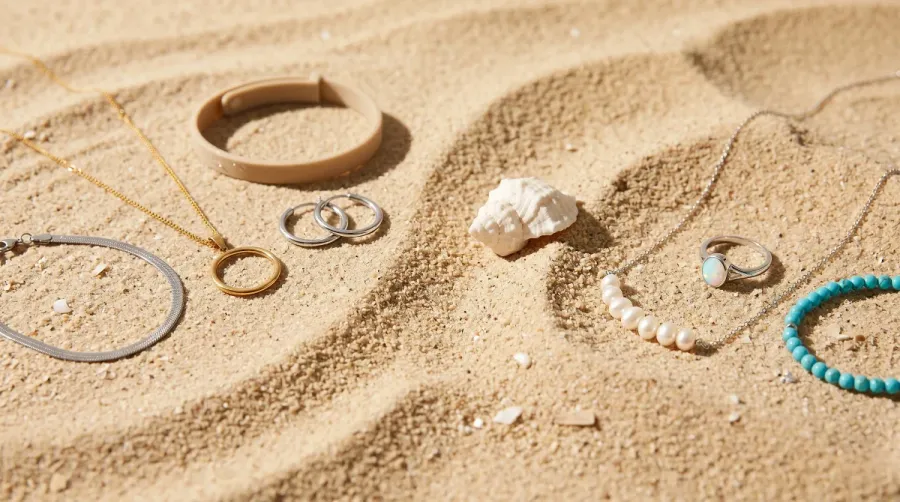
Sterling silver 925 (if you are willing to clean it). Silver handles water but tarnishes. After a holiday it will need a polish, but the tarnish is cosmetic, not structural.
Silicone rings. Flexible, scratch-resistant, and they stay on the finger in water better than metal. Ideal for active beach holidays: surfing at Malibu, beach volleyball in Miami, snorkelling in the Florida Keys or the Caribbean.
What not to wear at the beach
Thin gold plating or flash plating. A layer a few microns thick. It lifts within one holiday, exposing the base metal beneath.
Brass. Oxidises visibly in salt water within hours, leaving a green mark on the skin.
Unprotected silver. Technically not damaged structurally, but tarnishes quickly and noticeably.
Pearl. An organic material. Salt water dries it out and makes it brittle. Chlorine is more damaging still. Even a single session in a chlorinated pool can cause irreversible surface damage.
Opal. Contains water in its crystal structure. Heat and dry sea air dehydrate it. It can crack, and even a hairline fracture destroys the play of colour permanently.
Turquoise. A porous stone that absorbs whatever it contacts. Sun cream turns it green. Salt water darkens it over time.
Coral. Also organic. The combination of salt water, UV light and chemical interaction with other marine organisms damages the surface rapidly.
Gemstones in open settings. Salt crystals and sand grains work their way beneath the stone over a season and loosen the prongs gradually. A stone that feels secure in spring can fall out by August.
Sentimental or irreplaceable pieces. Family heirlooms, engagement rings, gifts from people you have lost. If it cannot be replaced, it should not be on a beach. Leave it in the hotel safe.
Very fine chains. Fine chains snag on shells, get caught in swimwear, and break under light tension.
Silver vs gold in the water: what actually happens
The practical difference between silver and gold in sea water matters for anyone deciding what to pack.
What happens to silver 925 in the ocean
Sterling silver contains 92.5 percent pure silver and 7.5 percent copper or another alloying metal. Sea water contains chlorides and sulphur compounds from organic matter. Chloride ions react with silver at the surface, forming silver chloride: a whitish grey compound. Sulphur compounds form silver sulphide: the dark, almost black tarnish most people recognise. Both reactions happen within hours in sea water.
The reassuring part: neither reaction damages the piece structurally. The tarnish is surface-level. A thorough cleaning with a silver polishing cloth or a paste of bicarbonate of soda and water restores the original appearance completely. The discouraging part: in an environment like the East Coast in July or the Gulf of Mexico in August, those reactions happen fast.
What happens to solid gold in the ocean
Gold is chemically inert in sea water. It does not form chlorides, does not oxidise, does not change colour from chemical exposure. The only visible change after swimming with gold is a superficial film of organic matter, sun cream residue and dissolved salts on the surface. That is not a chemical reaction. It is physical contamination, and it rinses off with dish soap and warm water in a few minutes.
The practical takeaway: solid gold wears through an entire holiday without any change that cannot be cleaned off in minutes. Silver wears through the same holiday but needs a meaningful clean afterwards.
Choosing based on your travel style
If you swim daily for two weeks and want to put jewellery on and forget about it, solid gold or PVD steel are the right choice. If you swim occasionally and are willing to polish after the trip, sterling silver is a perfectly workable option that costs considerably less.
Sunscreen, skin oils and metal: the chemistry on your skin
Most people do not think about this interaction, but it is real and affects jewellery noticeably.
Avobenzone and chemical UV filters
Avobenzone is one of the most common chemical UV filters in American sunscreens. It is photoreactive and has a documented tendency to form complexes with metal ions on the skin surface, particularly silver ions. The result is accelerated tarnishing wherever a silver piece sits against skin that has been coated in sunscreen. The effect is stronger in heat and humidity, which describes most beach conditions precisely.
Other chemical filters like oxybenzone are less reactive with metals but still create a greasy film under which salt concentrates against the metal surface.
The application order that reduces damage
When jewellery goes on before sunscreen, the lotion gets trapped under the chain or bracelet and stays in direct contact with the metal all day. The smarter order:
- Shower and dry the skin
- Moisturiser if used
- Sunscreen across the whole body
- Wait three to five minutes
- Fragrance, away from where jewellery will sit
- Jewellery last
This sequence does not eliminate the contact between sunscreen chemistry and metal, but it reduces how much product is trapped under each piece.
Mineral vs chemical filters
Sunscreens using zinc oxide as their UV filter interact less aggressively with silver than chemical filter formulas. If you are wearing silver jewellery and want to reduce tarnishing speed, a mineral-based sunscreen is marginally better for the jewellery. Practically, the difference is modest. Rinsing after swimming matters more.
Types of beach jewellery
Body chains: waist and bralette styles
A body chain worn over a swimsuit has been a summer staple along American coastal cities and throughout the Caribbean for several years. A waist chain or hip chain over a bikini reads as considered rather than trying too hard, whether you are on the Outer Banks of North Carolina, the beaches of Cape Cod, or the Florida Gulf Coast.
What to look for:
- Adjustable length (the body swells slightly in heat)
- Steel, titanium or gold-fill only. Not brass, not plated without clear specification
- Medium-weight links, as very fine chains snag and break against wet fabric and shells
Styling options:
- A simple gold-tone chain over a bikini at a beach bar in the Keys or a Santa Monica beach house
- Layered chains with small pendants for a bohemian finish
- A hip chain worn over a sarong or cover-up for evening walks along the boardwalk
Body chain styling: building the look
A single delicate chain just below the waist reads as minimal and polished. Multiple layers of different lengths, especially with a small pendant, shifts the look toward a more relaxed, festival aesthetic. A wider link chain or a mesh panel makes a bolder statement.
For swimming, simpler chains without pendants are safer: less chance of snagging on swimwear fabric or hair.
Anklets
The anklet enters the water first and therefore takes the hardest chemical hit. Material choice matters particularly here.
In beach culture, the anklet carries associations of freedom and coastal living. In Indian tradition, ankle bracelets have been worn as part of bridal jewellery for centuries, and from there they spread into Western beach fashion through the bohemian trails of the 1970s and the resort culture of the 1990s. On the beaches of Bali, the Greek islands, and the Caribbean they became part of the landscape.
Good choices:
- Thin chains in PVD steel or sterling silver with willingness to clean
- Plaited cord with small metal elements
- Plain bands without stones for a minimalist look
If wearing two anklets at once, keep them at different heights so they do not knock against each other while walking. The friction between pieces is the same problem as stacking bracelets of mixed quality.
Toe rings
A traditional element of Indian bridal jewellery that has found its way into beach boho style. Particularly common at beach resorts in Florida, California, and throughout the Caribbean.
Important: a toe ring should fit slightly more loosely than a finger ring. Feet swell in heat and in water. A ring that fits correctly in the morning may need to be removed uncomfortably by afternoon.
Material: silver 925, PVD steel or titanium. Plain smooth bands without stones. Open or adjustable rings are more practical than fixed sizes.
Bracelets that handle sand and water
Not all bracelets perform equally under beach conditions.
Delicate chain bracelets. Risk of snagging on shells, coral, and rough sand. PVD steel performs better than silver under mechanical stress.
Braided and textile bracelets. Absorb salt and sand readily. They need a thorough rinse after every swim. Nylon dries quickly; cotton retains moisture and can irritate the skin.
Rigid cuff bracelets. The best option for the beach. No clasp to fail. Slide on and forget. Stays on the wrist through surfing and swimming without any risk of falling open. Choose cuffs in PVD steel, surgical steel or solid gold.
Bracelet stacking. Two or three thin bands together reads as effortlessly rich and coastal. Key rule for the beach: keep the metals consistent. Stacking electroplated pieces against surgical steel means the softer coating wears against the harder metal and deteriorates fast.
Summer earrings: what actually works in the water
Small studs are the best beach earring. They do not catch on wet hair, they do not fall out when you dive under a wave, and they do not create drag when you swim. A pair of small gold or PVD steel studs, geometric or with a simple motif, covers both swimming and dinner at the waterfront restaurant without changing anything.
Small hoops in the 15 to 25 millimetre range are workable for beach days when you are mostly on a lounger or walking the shore. For active swimming, the hoop can snag or apply force to the ear. Remove before getting in the water and put back when you are done.
Large drop earrings are not for the ocean. The weight plus water resistance creates leverage on the earlobe. In surf or strong waves, that becomes a real risk of injury. Save them for the evening.
Ear cuffs without piercings are worth considering for beach styling. They grip without a post and back, reduce the chance of losing a butterfly backing in the sand, and look distinctive against an open summer hairstyle or loose waves.
Shell necklaces and the return of coastal jewellery
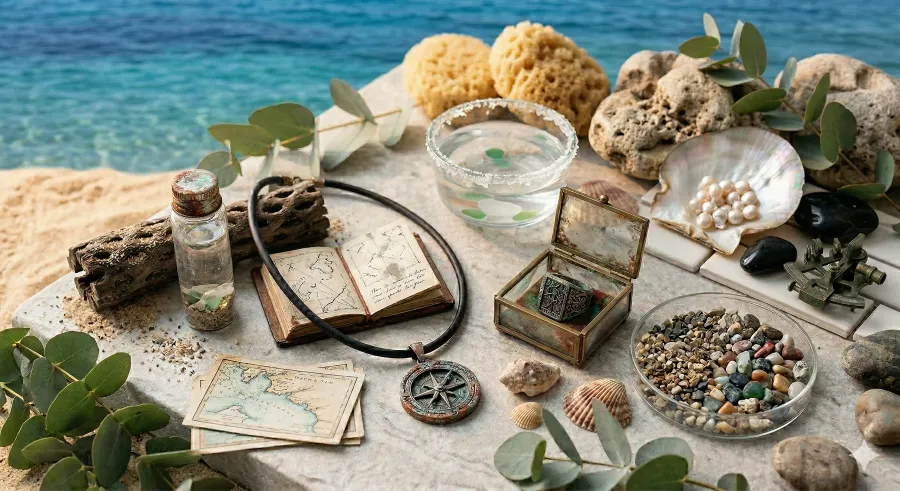
Shell jewellery peaked in the 1990s and is firmly back. The revival is not a nostalgic joke. It is a genuine aesthetic statement, found at independent jewellers in Brooklyn and Charleston, at surf shops in California, and on resort collections from designers who grew up near the water. Thematically these pieces sit inside the wider ocean jewellery collection, alongside anchors, ship wheels and coral motifs.
The shells themselves handle sea water without issue. What matters is the cord, chain or wire holding them: nylon, waxed cord or PVD steel all work well. A shell necklace on a cotton cord from a tourist market will last one holiday. One on a steel chain will last a decade.
Hair beads and hair jewellery
Wooden beads, plaited threads, small metal rings threaded onto braids. A tradition rooted in Afro-Caribbean, South Asian and Mediterranean beach cultures, now thoroughly mainstream on American coastlines from Miami to Malibu. Wood and cord handle salt and water without trouble, provided any metal elements are steel or silver.
The dangers of beach conditions
The beach combines several aggressive factors simultaneously. Understanding them separately helps you make better choices.
Salt corrodes silver
Sodium chloride reacts with silver and accelerates the formation of silver sulphide, the dark tarnish. One day in the sea and a piece will darken noticeably. A week of heavy wear at the seaside calls for a proper clean afterwards.
Sun cream and skin oils
Avobenzone and other organic filters in sun cream react mildly with metal surfaces. They do not cause structural damage, but they create a greasy residue under which oxidisation accelerates. The effect is particularly visible on the underside of a piece worn against skin.
Hot sand and thermal expansion
A piece left on hot sand heats up significantly. The metal expands. If a stone is set with adhesive rather than prongs, the cycle of heating and cooling as you enter the water creates microstrains in the joint. Over time the stone can work loose.
Do not leave jewellery lying on hot sand or a sun-baked towel while you swim. Take it in the water with you or put it in a pouch in your bag.
Pool chlorine and hot tubs
Chlorine is more chemically aggressive than sea water. It reacts with silver faster than salt and can cause irreversible dulling in a single session. It is particularly damaging to gold-plated pieces.
A heated pool or hot tub is the worst combination: elevated temperature accelerates every chemical reaction. Remove jewellery before getting in.
Hotel pools in warm climates often run higher chlorine concentrations than municipal lap pools, because warmer water encourages algae growth. The jewellery risk in a resort pool is meaningfully higher than in a regular gym pool.
Pearls at the beach: what is possible, what is not
Real pearl at the beach: a firm no, without exception.
But a pearl aesthetic suits the beach very well. The solution is alternatives.
Freshwater pearl. More resistant than sea pearl to environmental damage, but still not designed for swimming. Fine on a sun lounger, at the beach bar, on a harbour walk. Not in the water.
Tahitian pearl. Dark, large, dramatic. Also an organic material, also not for swimming. But its visual impact justifies including it in a beach look provided you are not planning to swim.
Majorcan pearl. A Spanish technology producing a shell-based bead far more resistant than natural pearl. One of the few pearl-look options that handles brief water contact without lasting damage.
Crystal and glass pearl imitations. Handle water and salt without trouble. Some dulling is possible over time, but nothing catastrophic.
Caring for pearls in sun and heat
Even if pearl never touches the water, sun exposure damages it. UV light and elevated temperature break down the organic nacre layer. Wearing pearl jewellery in direct sun for several hours causes the nacre to yellow slowly over time.
Storage matters: keep pearl in a dark, opaque pouch or case. Do not leave pearl jewellery on a windowsill, a hotel bathroom shelf, or the dashboard of a car. The last of these, a car in summer sun, can reach internal temperatures that damage the nacre in a single afternoon.
Pearl also needs a small amount of ambient humidity to stay stable. Very dry air conditioning or winter heating can dry it out over months. A lightly damp cloth placed in the same drawer or case helps. Alternatively, simply wearing pearl regularly maintains it: the skin oils that pearl absorbs are actually good for the nacre.
Pearl etiquette for beach weddings
Beach weddings are increasingly common along the East Coast, in the Florida Keys, and in the Caribbean. A few notes on jewellery choices when the setting involves salt air, sand and potentially the actual ocean.
Pearl earrings and a pearl necklace look beautiful in the coastal ceremony context, but only if the wearer is not planning to enter the water. For the photo session near the waterline, pearl is fine. For the post-ceremony swim or the impromptu jump into the ocean, it absolutely is not.
For rings worn during the ceremony, platinum and solid gold are the sensible materials. The greatest risk is loss rather than damage: a ring on a cold, wet finger slips off more easily than most people expect. Taking rings off before any actual swimming and handing them to a trusted person onshore is the practical approach.
Styles at the beach
Look 1: Bikini with minimal layered chains
The cleanest beach look. Two or three chains of different lengths, a waist chain, stud earrings, a plain ring or two. Everything in the same metal family, or a deliberate mix of gold-tone and silver.
This works at the water's edge and transfers directly to a waterfront restaurant without changing anything.
Look 2: Kaftan with bold pieces
A kaftan, cover-up or loose sundress opens space for larger jewellery. Statement earrings, layered necklaces, a stack of bracelets. The aesthetic of someone who is on holiday and means it. A whale tail pendant works as a useful anchor: a small Maori-rooted symbol that ties a beach look to a real tradition.
The materials still need to handle humidity and heat, even if you are not planning to swim. Acrylic or resin earrings plus PVD steel bracelets is a practical combination for this look.
Look 3: Sundress with delicate everyday pieces
A thin gold-tone necklace, small earrings, one ring. The elegant low-key option. Works for a morning walk along the seafront at Rehoboth Beach, lunch with a sea view in Savannah, an evening stroll after dinner on the Charleston waterfront.
Resort layering: building up from a base
The principle of resort layering is simple. Start with what you wear in the water and add from there.
Base layer for swimming: anklet, stud earrings, a chain necklace. Three pieces that go in the water with you.
Add for the beach bar: waist chain, one or two extra necklace lengths. The image shifts to deliberate and considered.
Add for evening on the water: medium hoops or drop earrings, a cuff bracelet. The base stays the same; the additions read as dressed without looking like you changed.
The logic: anchor the look with what you are willing to get wet, then build upward with pieces you take off before swimming.
Clasp types and chain structures: what holds up in the water
The construction of a piece matters as much as the material when you are taking it into the ocean.
Clasp comparison
Lobster clasp. The most reliable option for beach jewellery. Opens only with deliberate pressure on the lever. Does not accidentally unfasten in water or from fabric friction.
Spring ring clasp. Slightly less secure. The small trigger can be caught by swimwear or hair. Functional for most beach wear but less reliable for active swimming.
Magnetic clasp. Not suitable for the beach. Magnetic force weakens over time, and water pressure from waves can pop a magnetic clasp open unexpectedly. The piece is lost before you notice.
Toggle clasp. Secure but bulk at the closure point. Practical for thick chains. The toggle can snag on fabric.
For beach pieces, lobster clasp is the standard to look for.
Chain types and their beach performance
Anchor chain or marine chain. The strongest common chain style. Each link crosses its neighbour in a way that distributes load across multiple connections. Designed for marine use, which is somewhat on the nose for beach jewellery.
Box chain. Holds up well. If a single link fails, the chain does not unravel completely.
Figaro chain. Popular and attractive. Less resistant to mechanical stress than anchor chain. The longer links are prone to snagging.
Singapore or twisted box chain. Delicate and elegant. Not suited for active beach wear or swimming. Fine for wearing while sitting on the beach, not for swimming or surfing.
Open vs closed stone settings
Stones set with prongs are vulnerable at the beach. Sand and salt crystals work under the prongs gradually, and the heating and cooling cycle from swimming and sunbathing weakens the adhesive in glued settings. A closed bezel setting, where a rim of metal surrounds the stone completely, is far more secure under beach conditions. If you are buying beach jewellery with stones, look for closed or flush settings over open prong work.
Hot sand, thermal expansion and what it does to your jewellery
In full summer sun, dry sand reaches 60 to 65 degrees Celsius in hot coastal climates. Wet sand at the water's edge runs closer to 40 to 50 degrees. Metal jewellery left on sand or a dark towel in direct sun heats to similar temperatures.
Metal expands when heated. For most metals this expansion is too small to see, but for pieces where a stone is bonded with adhesive, the repeated cycle of heating in the sun and rapid cooling when you enter the water creates microstrains at the adhesive bond. Over one season this effect is minor. Over several seasons, stones in glued settings can loosen noticeably.
The lesson for beach packing: if a piece has stones you care about, do not leave it baking on the sand while you swim. Take it in the water with you in a small waterproof pouch, or put it in your bag in the shade. Five seconds of forethought protects years of wear.
What to leave at home and why each item is a genuine risk
This is worth going through in more detail than a simple list, because the reason matters.
Pearl. Nacre is a layered calcium carbonate structure produced by molluscs. Salt water and chlorinated water both penetrate the nacre layers and cause them to dry, separate and eventually flake. The damage is often invisible after one swim but cumulative. By the end of a beach holiday wearing pearl daily in the water, the surface degradation can be permanent and irreversible.
Opal. Natural opal contains between six and ten percent water in its microscopic silica sphere structure. That water content is what creates the play of colour. When opal is exposed to heat and dry air, it loses that moisture. When the moisture loss is uneven across the stone, internal stress builds and the stone cracks. A hairline crack destroys the colour play in the affected area permanently.
Turquoise. Turquoise is porous and accepts whatever liquid it contacts. Sun cream, sweat and salt water all absorb into the stone and change its colour. The green tinge that develops from copper-based impurities reacting with absorbed chemicals cannot be reversed by cleaning. It is a permanent change.
Antique and vintage pieces. Older pieces were often constructed with softer metal alloys, earlier adhesive formulas, and joinery techniques that do not hold up to the stress of repeated wetting, drying and temperature cycling. The piece may look fine after one beach day but show accelerated wear by the following summer.
Anything with sentimental value. This is the simplest risk to state: beaches are where jewellery gets lost. It falls off in the surf, drops in deep sand, slides off a cold finger in cold water. No material quality protects against loss. If the piece has irreplaceable meaning, it stays in the hotel safe.
Keeping your jewellery safe at the beach
A small zipped pouch
A small zip-close pouch or wash bag is the ideal solution for a beach collection. Pieces do not mix with sand, do not get lost in a tote bag, and cannot scratch each other. Easy to tuck into any beach bag, and the same logic carries through the wider jewellery travel tips for the rest of the trip.
Never leave jewellery on the sun lounger
Going into the water? Take the pouch with you or stow it in a locked bag. Professional thieves operate quickly on busy tourist beaches, particularly in popular spots along the Florida beaches, at the Jersey Shore, and throughout the Caribbean. The same applies at resort pools, where thefts happen in the thirty seconds it takes to swim one length.
Hotel safe for valuable pieces
Expensive pieces, family jewellery, engagement rings: in the safe. To the beach, only what you can afford to lose.
After the beach: care routine
Any piece that has been in salt water, pool water or heavy sweat needs attention before storage.
The basic routine:
- Rinse in clean fresh water for ten to fifteen seconds under the tap
- Pat dry with a soft cloth. Not a rough towel
- Leave to air-dry briefly, then store in the pouch
- Check clasps and prongs visually: nothing loose, nothing bent
If silver has tarnished:
- A paste of bicarbonate of soda and water, applied with a soft toothbrush or cloth
- Alternatively, a proprietary silver polishing cloth
- Rinse thoroughly and dry completely
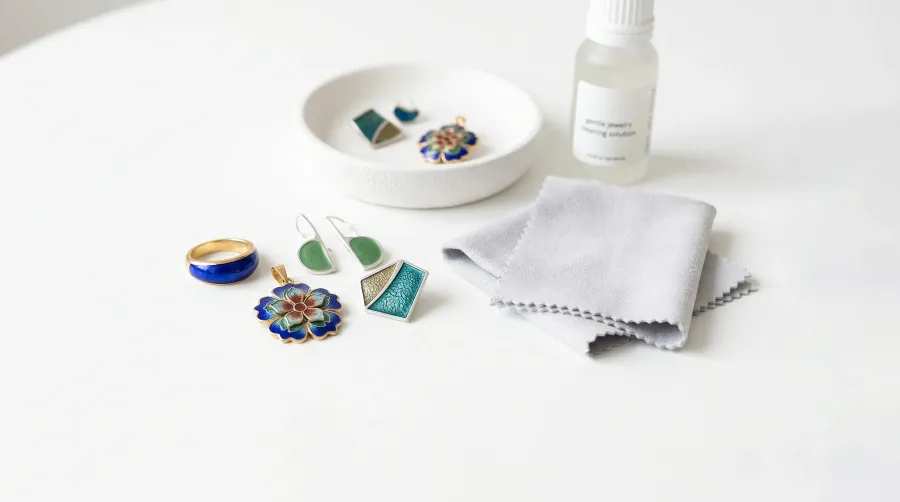
If there are enamel sections or stones: Warm water and a soft cloth only. No abrasives.
Between seasons:
- Keep beach pieces separate from everyday jewellery to avoid scratching
- Store in a dry place, not a sealed plastic bag (humidity builds inside)
- A small fabric pouch is ideal
- A silica gel packet in the same drawer absorbs residual moisture and slows silver tarnishing significantly
Engraving on beach jewellery
Engraving turns a piece into a personal document.
What people engrave:
- The coordinates of a favourite beach (latitude and longitude). Stylish, personal, only legible to those who know
- The date of a holiday worth remembering
- The name of a boat or yacht
- The name of a bay, cove or island
- A phrase in the local language of the place that mattered
Nautical engraving sits particularly naturally on anklets, waist chains, plain bands and PVD steel or silver pieces.
What to pack for a cruise
A cruise is its own context: several days at sea, different ports, different beaches. Space in the cabin is limited and the bag needs to work across swimming, casual days in port and formal dinners on board.
A working cruise kit:
- Two or three pairs of earrings (studs and small hoops)
- One or two chains in different lengths
- A waist chain or anklet
- Two or three rings in steel or silver
- One bracelet for formal evenings
Everything in a zip pouch that passes security checks easily.
What not to bring on a cruise:
- Expensive pieces with large gemstones. They are appropriate for formal dinners, but everywhere else they create unnecessary anxiety
- Anything with sentimental value that cannot be replaced
Frequently Asked Questions
Can I wear silver in the sea?
Yes, but it will tarnish. If you are willing to polish it after the holiday, sterling silver is a perfectly workable beach material. If not, leave it in the room.
Does pool chlorine damage silver faster than sea water?
Considerably. Chlorine is more chemically aggressive than salt water and can cause irreversible dulling in a single session. Remove silver before getting into a chlorinated pool.
What if I only go in the water once?
Once is fine for sterling silver 925 and steel. Pearl and opal should not go in the water even once.
What should I buy if all my jewellery is valuable?
A small set of beach pieces in PVD steel or sterling silver costs roughly what a decent dinner out costs. They pay for themselves within a season or two by protecting the pieces you actually care about.
Will sterling silver be ruined after a week at the beach?
Ruined in the sense of broken or structurally damaged, no. Tarnished, yes. Regular cleaning restores it fully. It will serve for many seasons with basic maintenance.
Which materials are genuinely best for the beach?
Titanium and PVD steel. Surgical steel 316L and gold-fill 14K are also reliable. Silicone for active swimming. Sterling silver with cleaning.
Can I wear a watch in the sea?
Only one with a water resistance rating of 100m or greater. A watch marked 30m is not designed for swimming. Remove any watch before a shower unless you know its rating.
What should I leave at home no matter what?
Pearl, opal, turquoise, coral, brass pieces, thin plating, antique pieces, family heirlooms, and anything with significant sentimental or financial value.
How do I tell whether a piece is beach-safe in a shop?
Ask directly: does this hold up in salt water? A good retailer will tell you honestly that sterling silver tarnishes but does not break, and that PVD steel is fully water-resistant. If the answer is vague, treat that as a no.
Why do I sometimes get a skin reaction to metal in the sun?
This is photoallergy: a reaction triggered by the combination of UV light and metal ions on the skin. Nickel is the most common culprit. At the beach it tends to be more pronounced because skin is warm, pores are open, and the contact between metal and skin is more sustained. The solution is hypoallergenic materials: titanium, PVD steel, solid gold 14K.
Can I wear pearls swimming?
No. Even freshwater pearl is not designed for swimming. Even a single session in a chlorinated pool can cause irreversible surface damage.
What about a beach wedding?
Plan carefully. Stainless steel, platinum or solid gold are the sensible choices for rings worn in the water. The greatest risk is not corrosion but loss: a ring on a cold, wet finger can come off very easily.
Are there jewellery types designed specifically for surfing?
Silicone rings and PVD steel or titanium anklets without pendants are suitable for surfing. No necklaces in serious surf: a chain caught in a wipeout can cause injury. Earrings should come out before paddling out. The principle for surfing is the same as for any high-impact water sport: the fewer pieces, the better.
How do I clean jewellery after the beach if I am travelling without my cleaning kit?
A few drops of hand soap, a soft toothbrush from the hotel bathroom toiletries kit, and a thorough rinse under the tap handle the basics. For silver tarnish, if there is no polishing cloth, a small amount of white toothpaste on a soft cloth works as a mild abrasive. Rinse thoroughly afterwards. Not ideal, but functional.
Conclusion
The seaside asks different things of jewellery than the office or a dinner party does. The best approach is a small, dedicated collection chosen for the conditions: materials that handle water, sand and sun without complaint, styles that feel right in a swimsuit as much as a sundress, and pieces whose loss, if it comes to that, will not hurt.
That is not an invitation to be boring. A beach collection can be bolder, more layered and more playful than anything you would wear on a Tuesday at home. Waist chains, anklets, toe rings, shells in your hair: these are not childish things. They have a long cultural history and a real visual logic when worn at the water's edge.
The difference is that the confidence is earned by the choice of material, not gambled on sentiment.
Silver, gold, rings, symbolic pieces and matching sets.
About Zevira
Zevira is a jewellery workshop based in Albacete, Spain. The Spanish coast, from the Costa Brava to the Costa del Sol, shapes the way we think about jewellery: it needs to survive sun, salt water and sun cream without fuss.
What we make for the beach:
- Pieces in 316L surgical steel that does not rust in sea water
- Pendants on rubber cords suitable for swimming
- Body chains and waist chains in water-resistant materials
- Anklets in PVD steel with adjustable fit
- Ear cuffs that do not require a piercing, suited to open hairstyles
- Compact maritime symbols: anchor, shell, sea star
- Plain bands without stones that are not a loss if left in the sand
- Pieces with the option of engraved coordinates, dates or names
Every piece is made by hand in our workshop, with the option of a personal engraving. We work in sterling silver 925 and solid gold 14-18K.