Damascene from Toledo: the Spanish art of gold on black steel
Introduction: a craft that outlived empires
Toledo is a city that looks as though time forgot to move forward. Perched on a rocky promontory above the Tagus river, its medieval skyline has barely changed since the sixteenth century. The city is famous internationally for its swords. But the craftspeople of Toledo produce something equally extraordinary and far more wearable than a ceremonial blade.
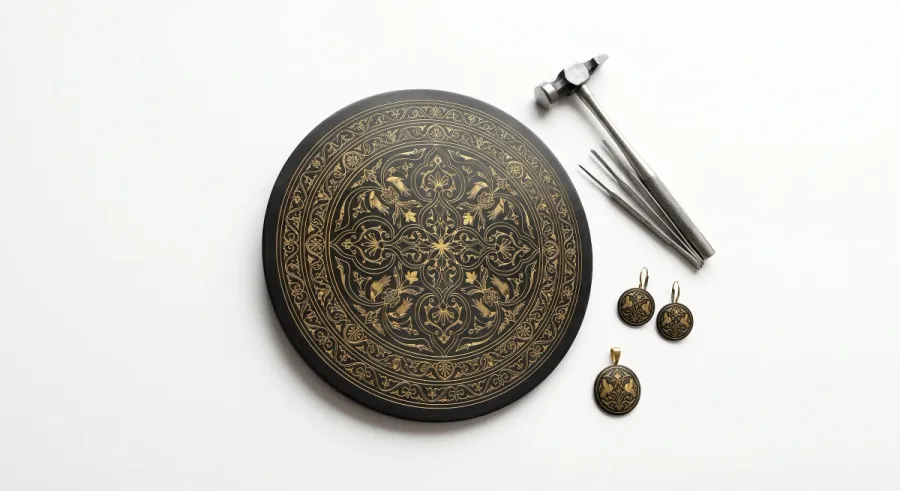
In the workshops clustered around the old city, artisans still practice a technique that arrived in Spain with the Moors in the eighth century. They take a plate of blackened steel, engrave microscopic channels into its surface, and then hammer in threads of gold or silver wire no thicker than a human hair. The result is a piece of jewelry unlike anything made anywhere else in Europe: a dense pattern of luminous lines against a deep black ground, as precise as manuscript illumination and as durable as the steel beneath it.
This is damasquinado, known in English as damascene work. It is one of Spain's most distinctive craft traditions, protected today as intangible cultural heritage, and almost entirely concentrated in Toledo and the surrounding region of Castilla-La Mancha.
What makes damascene unusual in the world of decorative arts is its permanence. The gold wire is not applied to the surface: it is physically driven into channels cut in the steel and held there by compression. This is not a coating or a plating. The wire will not flake, peel, or fade the way any surface treatment eventually does. Historical pieces from the nineteenth century look today as though they were made last year. That tells you something about what the technique is capable of.
This guide explains what damascene jewelry is, how it is made step by step, what the traditional motifs mean, what the different styles look like, why the real thing feels and looks so different from the tourist-stall imitations, and what to look for if you are thinking of buying a piece.





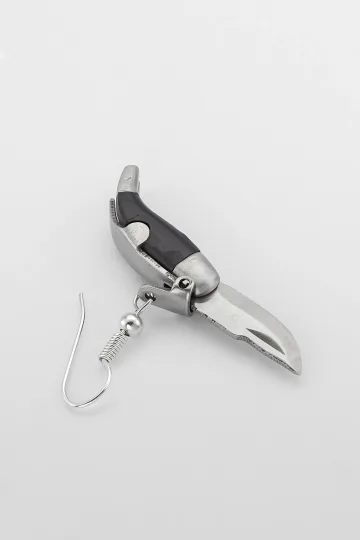
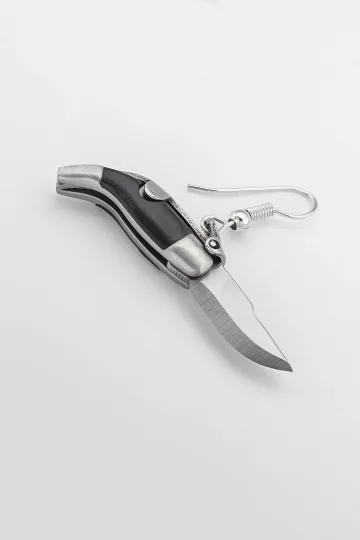
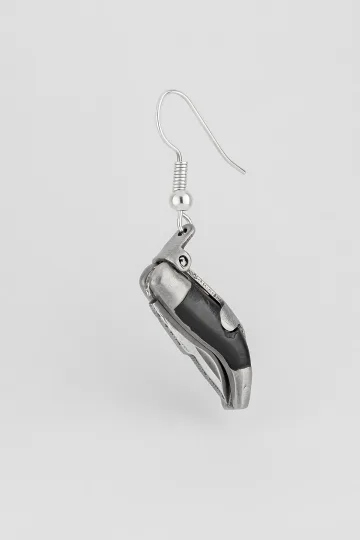
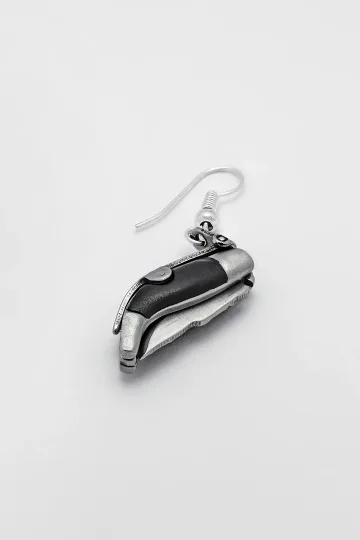

What damascene actually is
The technical term is metal inlay: threads or sheets of one metal pushed into channels cut into a different metal base. The base is almost always steel or bronze, darkened to a deep, matte black through controlled oxidation. The inlay is gold, silver, or both together.
The process, step by step:
- A flat plate or three-dimensional object is made from steel or bronze.
- A craftsman uses a fine burin to engrave a network of tiny channels across the surface. In the finest pieces these channels are narrower than a millimeter.
- Gold or silver wire, sometimes as thin as 0.1 mm, is hammered into the channels. The metal flows into the engraving and grips the walls by friction and compression.
- The wire is polished flush with the surface.
- The entire background is oxidized with acid or heat treatment to achieve a uniform, deep black.
- The contrast that results is jewelry's equivalent of pen-and-ink illustration: sharp gold or silver lines against an absolute black.
There is a second, older method in which the steel surface is prepared by cross-hatching with a chisel, creating a rough tooth, and the gold wire is pressed directly into this texture without pre-cut channels. This technique suits very fine, free-form patterns and was common in earlier centuries.
The critical distinction from simple blackening or engraving: the gold or silver is physically embedded in the metal. It is not paint, not plating, not lacquer. The wire sits inside the channel, locked by the deformation of the surrounding steel. This is why well-executed damascene is effectively permanent.
The history behind the craft
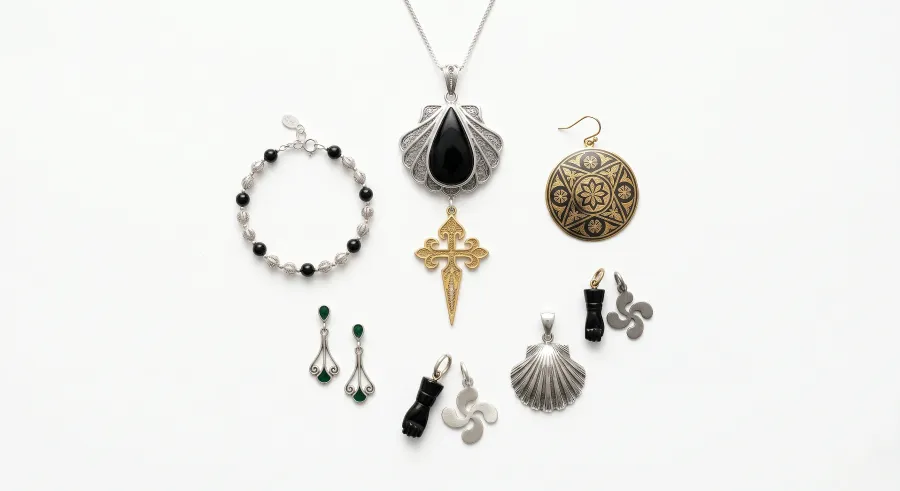
Damascene is one branch of a much wider tree. Before tracing it back to Damascus and the Moors, it helps to place it inside the broader Spanish jewelry tradition — alongside the filigree of Cordoba, Asturian azabache, and Basque lauburu work, all shaped by centuries of regional workshops.
Damascus and the ancient world
The word damascene comes from Damascus, the Syrian city that was one of the ancient world's great centers of metalworking. Techniques for combining precious metals with iron bases were developed there during the early centuries of the common era and spread along the trade routes of the Byzantine and Persian empires. Arab metalworkers of the sixth to eighth centuries brought the art to a high level of refinement: richly inlaid swords, helmets, and ceremonial objects survive in collections across the Middle East and Mediterranean.
The Moors bring it to Spain
In 711, a combined Berber and Arab army crossed the Strait of Gibraltar and within a decade controlled most of the Iberian Peninsula. With them came craftsmen, scholars, and techniques that were far in advance of anything in contemporary Western Europe. Córdoba, the Moorish capital, became the most sophisticated city in Europe. Its metalworkers produced intricately inlaid swords, helmets, and ceremonial objects throughout the ninth, tenth, and eleventh centuries. Surviving pieces from Córdoba's golden age, held in the Museo Arqueológico Nacional in Madrid, show the technique in its early maturity: geometric arabesques in gold against deep black, mathematically precise.
Toledo after the Reconquista
Christian forces under Alfonso VI retook Toledo in 1085. Crucially, the Arab craftsmen were not expelled. They stayed, continued working, and passed their skills to a new generation of mixed heritage. Toledo's swords were already renowned across Europe, described by medieval chroniclers as the sharpest and most resilient available. The damascene work on the hilts and scabbards made them objects of art as much as weapons. This cultural continuity produced mudéjar, the uniquely Spanish hybrid in which Islamic artistic tradition operated within a Christian context. Damascene became one of its principal expressions.
Toledo in the twelfth and thirteenth centuries was one of the few cities in Europe where Arab metalworkers, Jewish goldsmiths, and Christian armorers worked alongside each other. They borrowed techniques, merged ornamental systems, and produced a style that does not belong to any single tradition but is recognizably and specifically Toledan.
Jewish goldsmiths in Toledo played a specific role as cultural intermediaries: they worked with Moorish ornamental principles but served Christian patrons, and their pieces often show unexpected hybrid elements that resist easy classification. Some pieces from this era contain geometric Moorish lattices framing unmistakably Christian symbols — a fusion that could only have come from a city where the three cultures were in genuine daily contact.
The Habsburg golden age
Under the Spanish Habsburgs in the fifteenth to seventeenth centuries, Toledo damascene reached its technical peak. Charles V and Philip II commissioned ceremonial armor, swords, and caskets decorated with damascene work as diplomatic gifts and symbols of imperial prestige. The finest surviving pieces are now in the Prado and the Royal Armory in Madrid. This was the period when all the major styles were established: geometric Moorish, floral Renaissance, and Christian Baroque with crosses and religious imagery.
The practice of diplomatic gifting pushed the craft to its highest level. A casket decorated with damascene sent to a foreign court carried multiple messages: the cultural sophistication of the giver, the quality of Spanish craftsmanship, the richness of the Spanish lands. It was applied diplomacy through objects, and the Spanish state was willing to pay the best craftsmen accordingly.
British travellers and the Grand Tour
British interest in Toledo was part of the broader Romantic rediscovery of Spain in the nineteenth century. Where the eighteenth-century Grand Tour had taken young Englishmen to Italy, the Romantic generation turned south-west. Washington Irving had published his "Tales of the Alhambra" in 1832; Richard Ford's "Handbook for Travellers in Spain", first published in 1845, was the practical companion that made Spain navigable for Victorian visitors.
Toledo figured prominently in both. Ford described the damascene workshops in terms that suggest he considered them among the most remarkable survivals in Spain: a technique unchanged since the Moorish period, still producing objects of genuine quality in a city that had otherwise been left behind by the industrial age. British visitors brought pieces home as souvenirs, and some of the more ambitious examples entered private collections. The Victoria and Albert Museum in London holds examples of Toledo damascene from this period that illustrate both the quality of the best workshops and the variety of styles available to Victorian buyers.
Near extinction and revival
Firearms gradually made the ceremonial sword irrelevant. By the eighteenth century the number of working damascene masters had fallen dramatically. The craft survived almost by accident: when the Romantic movement in the nineteenth century made Toledo a fashionable destination for European travelers, local workshops found a new market in souvenirs. Brooches, earrings, small boxes, and letter openers replaced sword hilts. The craft survived into the twentieth century because tourists wanted something to bring home. The tourist boom of the 1960s and 1970s created another surge in demand and brought new generations of apprentices into the workshops.
The same boom also created the problem of imitations. High demand attracted producers of cheap aluminum pieces with printed surfaces that approximate the look of damascene at a fraction of the price. Understanding how to tell genuine from fake became necessary knowledge for anyone buying in Toledo.
Today: protected heritage
Toledo damascene is now formally recognized as intangible cultural heritage by the regional government of Castilla-La Mancha. Several dozen workshops continue to operate using traditional methods. The finest pieces take many hours to complete and are priced accordingly.
The technology in detail
Understanding how damascene is made matters for two reasons: it explains why genuine pieces cost what they do, and it makes imitations immediately legible.
Preparing the steel
The steel or bronze blank is cut and shaped. The surface is abraded to remove burrs, then given an initial oxidation treatment. This "blackening" step prepares the surface chemically and provides the first indication of the eventual contrast.
Most contemporary damascene pieces use low-carbon steel or bronze. Steel with higher carbon content is harder and oxidizes to a deeper black, but is more difficult to work with a burin. The choice of base material is the craftsman's first professional decision.
Cutting the channels
The craftsman transfers the design to the surface and begins cutting channels with a burin. In traditional workshops, design templates are passed down through generations, but the actual engraving is done freehand. The channels are cut at a slight inward angle so the walls grip the wire once it is hammered in. In the older cross-hatching method, the entire surface is roughened with a chisel grid, and the wire is pressed directly into this texture rather than into individual channels.
A skilled craftsman keeps the entire pattern in mind and works in logical sections, all lines in one direction first, then the perpendicular set. This is not just methodical: it protects against errors. One misaligned channel can destroy the symmetry of an eight-pointed star built on repeated precise angles.
Hammering the wire
Gold or silver wire is cut into short lengths. The craftsman lays a piece of wire across a channel and taps it in with a small hammer. Gold is exceptionally ductile: it deforms on impact and fills the channel walls. The work proceeds in sections across the piece, horizontal lines first, then vertical, then diagonal. Under magnification, the individual hammer marks are visible. This is one of the clearest signs of authentic work.
Working with very fine wire demands a particular kind of focus. Craftsmen say they do not work on damascene when tired or distracted: one extra hammer stroke can displace wire or damage an adjacent strand that is already set.
Polishing
Once all the wire is set, the surface is polished with a series of increasingly fine abrasives until the wire is flush with the steel. At this stage the piece looks almost monochrome: the gold and steel are at the same level, and the background is not yet fully black. This is the point in the process where the piece looks simultaneously at its worst and its best: everything is in place but the defining contrast has not yet appeared.
Final oxidation
The completed piece is treated with acid or heat to bring the steel background to its final deep black. Gold and silver are chemically inert in comparison to steel and do not oxidize. The result is the sharp contrast that defines damascene: luminous metal lines on an absolute black ground.
Different workshops use slightly different formulas for the oxidation bath. These recipes are often passed within families and not disclosed. The quality of the blackening — depth of tone, evenness, absence of patches — is one of the indicators of craftsmanship that an experienced eye notices immediately.
Finishing
After oxidation, the piece may receive a protective coat of lacquer or wax to stabilize the oxidized layer. This step is not universal: many craftsmen consider that high-quality damascene needs no additional protection with proper care. Findings — pendant bails, earring posts, bracelet clasps — are typically made in silver or gold-plated silver that does not conflict with the base metal.
Traditional motifs in damascene work
The ornamental vocabulary of damascene built up over a thousand years. Each type of motif has its own history and carries specific meaning.
Geometric arabesques
Interlocking eight-pointed stars, lattices of rhombuses, chains of angular forms. This is the direct inheritance of Islamic artistic tradition, which avoided representing living beings and built beauty on mathematical precision. In Arab culture, geometry was not simply decoration: it was a reflection of the order of the world. Repetition, symmetry, and infinite extension were philosophical as much as aesthetic principles.
Moorish craftsmen pushed the precision of pattern repetition to an extreme: one wrong angle would break the entire scheme. Geometric patterns required the craftsman to hold the whole structure in mind at once. This is why such patterns were transmitted through templates: each template was accumulated knowledge encoded in a physical object.
This type of motif is the most visually austere and reads particularly well in professional or formal contexts. A single piece with tight geometric work needs nothing else to complete it.
Birds
Birds appear in damascene later, within the Spanish Christian tradition. Peacock, eagle, dove. The Moorish canonical restrictions on representing living beings were no longer operative after the Reconquista, and Christian workshops added the animal world to the ornamental vocabulary.
Birds in damascene often carry heraldic meaning: the eagle as a symbol of power, the dove as a Christian sign. In some pieces the bird is set within a geometric grid, creating an interesting hybrid effect of two traditions in a single surface. This is characteristic of pieces from the Habsburg era, when royal heraldry encountered Moorish geometry in the same workshop.
Floral motifs
Roses, vine leaves, olive branches, pomegranates. Floral damascene developed in Christian workshops after the Reconquista. This is the most versatile type: pendants and earrings with floral motifs move across ages and occasions, from a business meeting to a wedding. The rose is associated with the Virgin Mary in Spanish Catholic tradition; the olive and vine carry biblical meaning; the pomegranate is a national symbol and gives its name to the city of Granada.
In late Renaissance and Baroque damascene, floral garlands often frame a religious or heraldic center: a crown, a cross, an initial. This compositional structure was standard in court commissions of the sixteenth and seventeenth centuries.
Heraldic and religious symbols
Crosses, the Virgin, saints, crowns, and family coats of arms. This style reached its height in the sixteenth and seventeenth centuries when the Spanish Church and state were significant patrons of Toledo's workshops. Religious damascene is still made for devotional gifts at baptisms, first communions, and weddings.
Custom heraldic pieces with initials or family symbols are made by several Toledo workshops to this day. The crown, lion, and castle — standard elements of Spanish heraldry — translate well into damascene line work. Their visual clarity and symbolic weight make them ideal material for inlay.
Combined motifs
The most interesting pieces are those in which two traditions meet on one surface. A geometric Moorish lattice as background, over which a Christian cross or Spanish coat of arms is set. This is mudéjar in its fullest visual expression: two ornamental languages, one surface. This kind of composition requires the craftsman to manage hierarchy — the main motif must read on the ground, not sink into it — which is a compositional problem, not just a technical one.
Styles of damascene work
Geometric Moorish (Mudéjar)
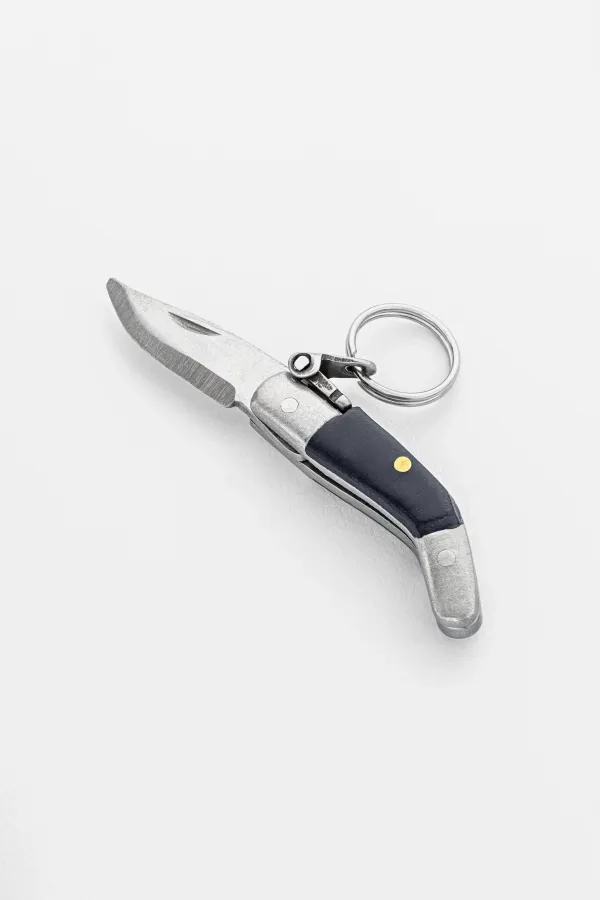
The oldest and most directly connected to the craft's origins. Interlocking eight-pointed stars, lattices of rhombuses, chains of angular forms. Islamic artistic tradition generally avoided representational imagery, and the mathematical rigor of the geometric style reflects this. Visually, it is the most austere and works particularly well in professional or formal contexts. The same Arab-Spanish engineering thinking that produced damascene also produced the Spanish navaja's history — geometry, lock mechanisms, and inlay traveled together from blade to ornament.
Floral Renaissance
Roses, vine leaves, olive branches. This style developed after the Reconquista as Christian workshops adapted the craft to Spanish taste. Where geometric work is mathematical, floral work is organic. It is also the most versatile: floral damascene pendants and earrings translate across ages and occasions.
Christian Baroque
Crosses, the Virgin, saints, architectural motifs such as cathedral facades. This style reached its height in the sixteenth and seventeenth centuries when the Spanish Church and state were significant patrons of Toledo's workshops. Religious damascene is still made for devotional gifts at baptisms, first communions, and weddings.
Neo-Moorish (nineteenth to twentieth century revival)
When Romantic travelers rediscovered Toledo, the workshops consciously revived Moorish geometric motifs. The neo-Moorish style has a richer, denser character than the medieval original: more ornament filling more space, reflecting the Victorian taste for elaboration.
Contemporary minimalist
Several modern Toledo craftspeople work in a simplified aesthetic: a single clean line, a geometric form without filling ornament. This style is closest to contemporary jewelry sensibility and appeals to buyers who want damascene without an explicitly historical character. Paradoxically, minimalist damascene is often technically the most demanding: with a sparse composition, every line is visible, and a single unsteady stroke is immediately apparent.
Types of damascene objects
Pendants
The most common jewelry form. Small round or oval pieces, typically two to four centimeters across. A good entry point: accessible in price, easy to wear, and clearly displaying the craftsman's skill. The pendant is also the most convenient format for comparing geometric and floral styles side by side.
Earrings
Studs or drops, usually in matched pairs. Producing a pair requires two nearly identical pieces, which increases difficulty and time. Drop earrings offer more surface area and allow for more elaborate compositions than studs.
Brooches
Historically significant and still popular, particularly as gifts. In the nineteenth century, when American and other visitors first flocked to Toledo in numbers, brooches were among the most commonly purchased pieces. A large brooch provides space for complex ornament that cannot fit on a pendant without becoming too large to wear comfortably.
Cufflinks
The classic men's damascene jewelry. Small paired pieces with geometric or heraldic motifs. Some workshops will engrave initials within the damascene pattern on request. In a business context, damascene cufflinks read as knowledgeable and understated rather than showy.
Bracelets
With damascene links: each link individually inlaid, then connected. More complex to produce than a pendant and priced accordingly. A bracelet is the most visible piece and carries the most ornamental area.
Rings
With a damascene insert in the setting. Rings are subject to more wear than other pieces, so the quality of the inlay matters more. Men's rings with heraldic or geometric motifs are a living tradition in Toledo.
Decorative objects
Beyond jewelry, damascene appears on boxes, trays, mirror frames, decorative plates, and letter knives. Collectors often prefer decorative objects to wearable pieces: they provide more surface area for complex ornament, can be examined at leisure, and are not subject to daily wear. A damascene box on a desk is a permanent piece of visual pleasure.
Historical sword decoration
The original context for damascene: hilts, guards, scabbards, and armor. This is now a museum and collector category rather than a commercial one. The finest historical pieces are in the Royal Armory in Madrid. A damascened sword hilt from the sixteenth century is neither weapon nor jewelry in the conventional sense: it is applied art.
How to tell a genuine Toledo piece from an imitation
Toledo's status as a tourist destination means the market has its share of imitations. Knowing what to look for is straightforward.
The certificate
Authentic Toledo workshops issue a certificate from the Cámara de Comercio de Toledo. It identifies the workshop and the piece. No certificate is not automatically a disqualifier for small pieces, but its presence is a strong signal.
The "Hecho en Toledo" label
Genuine workshops mark their work "Hecho en Toledo" (Made in Toledo). Imitations often use "Toledo style" or simply print a Toledo-themed image on the packaging.
Weight
Genuine damascene work is on steel or bronze. It feels noticeably heavier than a comparably sized piece of silver or gold. Imitations are often made from lightweight aluminum with a printed surface.
The magnet test
Real damascene steel is either non-magnetic or only weakly attracted. Many cheap imitations are made from highly magnetic steel.
Wire relief and pattern quality
In a genuine piece, the inlay is done by hand. The lines vary slightly in width, there are visible tool marks under magnification, and the pattern has a liveliness that printing cannot reproduce. An imitation pattern is uniform, perfectly regular, and flat in a way that looks mechanical.
Oxidation quality
On a genuine piece the black ground is matte and deep, with no surface sheen. Printed aluminum has a subtly different reflective quality.
Price
Real damasquinado cannot be sold for what a cup of coffee costs. A small authentic pendant starts at a price comparable to a reasonable restaurant meal and rises from there according to size, complexity, and the prestige of the workshop. Anything priced below that threshold in a tourist shop is almost certainly a printed aluminum souvenir.
Known Toledo workshops
- Lozada -- one of the oldest, established in the eighteenth century.
- Hijos de Mariano García -- five generations of the same family.
- Damasquinados Suárez -- well regarded for contemporary designs.
- Joyería Damasquino -- wide range, good for comparing styles.
The keepers of the craft today
Several dozen workshops in Toledo operate using traditional methods. Most are clustered in the historic center near the cathedral. Some allow visitors to watch the process at no charge: watching a craftsman hammer gold wire into engraved steel is one of the more memorable experiences Toledo offers.
This is not a performance staged for tourists. The craftsman is genuinely at work, surrounded by tools, templates, and small coils of wire in different gauges. An hour in such a workshop tells you more about damascene than any photograph can.
Soria, a second historical center of damascene on the peninsula, maintains a smaller number of active workshops, though it is less well known to visitors.
The Museo de Damasquinado in Toledo holds examples of the technique across the centuries and displays the tools of the trade. It is a small museum but an instructive one.
Recent years have brought renewed international interest in Toledo damascene. Collectors and craft enthusiasts in Western Europe, Japan, and the United States have discovered it through online sales, which has changed the situation for the workshops: pieces that once sold primarily to tourists in Toledo now reach a wider audience that expects higher execution standards and more complex compositions.
Younger craftspeople have emerged who work at the intersection of traditional damascene and contemporary jewelry design. They apply the same technique — burin, wire, hammer, oxidation — to modern forms: asymmetric pendants, single bold elements, deliberately spare compositions where negative space does as much work as the gold lines. This is not a departure from tradition but an extension of it, using the same tools for a different visual language.
Buying damascene in Toledo
If you are visiting Toledo, knowing where to look matters. The best workshops are concentrated in two areas: around the cathedral and in the lower old city toward the Alcantara bridge. Both are within walking distance of the main tourist routes. Signs are often small and windows modest: the best workshops do not need flashy advertising.
Tourist kiosks near bus parking areas and on the main squares are not the best places to find authentic work. High turnover, mass-produced goods, and sellers who often cannot name the workshop that made the piece are the signals.
The best approach is to visit several workshops, compare pieces, hold them, and ask about the technique. A craftsman who is proud of his work will be happy to explain what distinguishes it from the neighboring shop's output. That conversation is itself part of the experience.
If time is short, favor workshops where the working area is visible: where people are actually working behind glass or in the shop itself, the risk of encountering a fake is low. Real craftspeople have nothing to hide and a good deal to show.
Caring for damascene jewelry
Damascene is durable when treated correctly. The rules are simple.
Do not use silver or gold polish. These products are formulated for different chemistry. On damascene, they can remove the thin oxidation layer from the background and destroy the contrast. The damage is irreversible.
Store separately. Contact with other metal objects scratches the surface. A soft pouch or a separate compartment in a jewelry box works well.
Avoid prolonged wetting. Wiping with a damp cloth is fine. Sea water and chlorinated swimming pool water damage the steel substrate and can work into the edges of the inlay.
Wipe dry after wearing. Remove traces of skin oil and salt. A soft cotton or chamois cloth is ideal.
Keep out of direct sun. Prolonged ultraviolet exposure gradually affects the oxidised layer.
With these rules observed, damascene will keep its appearance for decades. The nineteenth-century pieces in museum collections confirm what the technique is capable of when left undisturbed.
If silver inlay begins to darken more than desired, a soft cloth with a drop of neutral oil can gently remove surface film and restore a soft luster. This is not polish — no chemistry, no abrasion. Gold inlay needs no specific maintenance at all.
Choosing a damascene piece as a gift
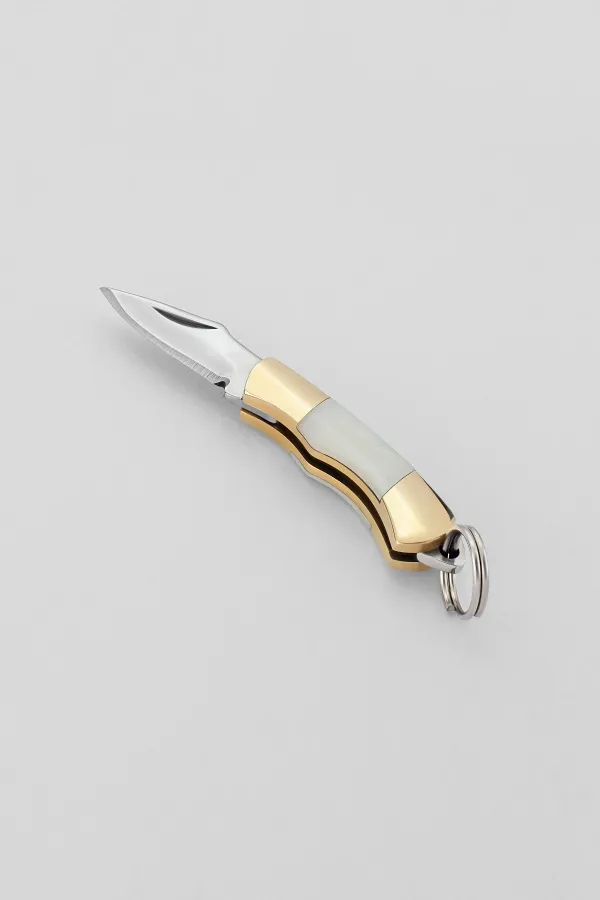
If you like the idea of a Spanish craft object but want something with a different character, consider the Albacete navaja as jewelry — a different craft, but the same Spanish tradition of multi-century workshops passing tools and motifs from one generation to the next.
A floral pendant
A reliable choice for almost any recipient. Works across ages and styles. Prices vary from mid-range to premium depending on complexity.
Geometric earrings
The Moorish aesthetic at its most concentrated. A strong visual statement that appeals to those who know the history. Mid-range price point for a pair.
A heraldic bracelet
For someone who appreciates historical symbolism or has a connection to Spain. Mid-range to premium depending on size.
Cufflinks with an engraved motif
Men's damascene at its most refined. Some workshops will engrave initials within the damascene pattern on request. Mid-range to premium.
A decorative box
Strictly speaking not jewelry, but a piece of damascene work that will sit on a desk or dressing table and be admired for decades. Premium segment.
Wearing damascene jewelry
Damascene is a high-contrast piece. The combination of black and gold is visually strong enough to hold its own against plain, dark, or neutral backgrounds, but it competes with patterns and strong colors rather than complementing them.
Works well with:
- Black clothing: the gold lines read as part of the same tonal world.
- White shirts or blouses: the contrast becomes the focal point.
- Vintage and classic tailoring: the historical associations reinforce each other.
- Business or formal dress: damascene reads as composed and considered.
- Neutral tones: gray, navy, camel all give the piece room to speak.
Less suited to:
- Brightly colored prints: two strong visual elements in conflict.
- Pastel or pale tones: the contrast of the piece becomes too dominant.
- Other heavily worked or ornate jewelry: the effect becomes cluttered.
One pendant or one pair of earrings with damascene work is a complete style statement. Nothing else needs to compete with it. The piece has enough visual weight to carry an outfit on its own.
Silver, gold, wedding rings, symbolic jewelry, and paired sets.
Who wears damascene
Those interested in Spanish history and culture. The piece carries the history of three civilizations — Moorish, Jewish, and Christian — in a small object you can wear on your wrist or lapel.
Collectors of craft objects. Every genuine piece is unique: two pieces from the same workshop with the same pattern will be subtly different.
Travelers who have been to Toledo. A souvenir with a thousand years of context behind it. Knowing the history changes what the object means when you give it.
Those who prefer dark, dramatic jewelry. The black and gold combination is distinctive without being ostentatious.
Business and professional contexts. Damascene worn at work reads as knowledgeable and understated: it signals taste rather than display.
Frequently asked questions
Is damascene only used for jewelry?
No. Boxes, cutlery, trays, and decorative plates are all made using the same technique. Jewelry is the most widely sold category, but collectors often prefer the larger decorative pieces.
Does the black surface fade over time?
The black is the result of controlled oxidation of the steel substrate. It does not fade further. Gold inlay does not tarnish at all. Silver inlay may develop a slight patina over many years, which most people consider an enhancement rather than a defect.
Can damaged damascene be repaired?
If the inlay wires are pulled out or damaged, restoration requires a damascene specialist, not a standard jeweler. Several workshops in Toledo offer restoration services. It is not a simple repair but it is possible.
What is the difference between damascene and Damascus steel?
Damascus steel, the material used for certain sword blades, is a pattern-welded alloy in which different steels are folded together to create a visible wave pattern in the blade itself. Damascene work, by contrast, is a surface decoration technique in which gold or silver is inlaid into the surface of steel or bronze. The two share a common word because both were associated with the city of Damascus, but they are entirely different things.
Can I wear it in the sea or swimming pool?
It is not advisable. Salt water and chlorinated water both damage the steel substrate and can work into the edges of the inlay. Damascene jewelry is made for city and formal environments, not beach holidays.
Is damascene jewelry appropriate for men?
Historically, the technique was used primarily for men's objects: swords, armor, helmets. Men's damascene jewelry includes cufflinks, rings with heraldic or geometric motifs, and heavy bracelets. It is, in every sense, a masculine tradition.
What is the difference between genuine and stamped work?
In genuine damascene, the wire is hammered in: the relief is faintly perceptible to the touch, and the lines are slightly variable in width. In stamped imitations, the pattern is uniformly regular and perfectly flat, because it is printed or embossed rather than inlaid. The difference is visible to the naked eye once you know what you are looking for.
Where should I buy authentic Toledo damascene?
From the workshops directly, or from reputable shops in Toledo's old city. Larger cities in Spain sometimes carry authenticated pieces from named workshops. Avoid vending machines, station kiosks, and any seller who cannot name the workshop that made the piece.
How long does it take to make one piece?
It depends on size and complexity. A small pendant with a simple geometric pattern takes several hours. A large brooch with elaborate floral ornament, or a bracelet with multiple links, takes a full day or more. This is why genuine damascene cannot be cheap.
Can I order damascene online?
Several Toledo workshops have online stores and ship internationally. This is a practical option for those who cannot visit Toledo. Choose workshops with a certificate and with actual photographs of the working process, not just product images.
Why isn't damascene made industrially at scale?
Because the core process — hammering wire into engraved channels — cannot be replicated by machine with the same result. Industrial presses can stamp relief patterns onto metal and paint them to look like damascene, but the resulting object is a different thing: an imitation. It is precisely the mechanical irregularity of hand-hammering that produces the visual liveliness of genuine work.
Is there a difference between gold and silver damascene?
Gold inlay creates a warm, high-contrast look against black steel. Silver is subtler: the contrast is softer and more refined. Some craftsmen combine both metals in a single piece — the central motif in gold, the border detail in silver. This creates a layered depth within a small object.
Conclusion
Damascene from Toledo has outlasted everything that might have ended it: the decline of the ceremonial sword, the Industrial Revolution, two world wars, and the mass-market souvenir industry. It survives because the technique itself is irreplaceable. No machine can drive a gold wire into an engraved channel and produce the result that a craftsman's hammer does.
Every authentic piece is also a document of an extraordinary cultural convergence: Moorish metalworking tradition, Spanish Christian craftsmanship, and centuries of Toledo's peculiar role as a city where different worlds met and worked alongside each other. A thousand years of history held in something you can carry in a pocket.
If you visit Toledo, spend an hour in one of the workshops. Watching the process is entirely free and entirely unforgettable. If you cannot visit, buy from a named workshop online — sellers of genuine work have nothing to hide and are used to answering questions about technique and provenance.
About Zevira
Zevira makes handcrafted jewelry in Albacete, Spain. Albacete and Toledo are both historic centers of Spanish metalworking and share a common heritage. Zevira does not produce damascene jewelry, but the Spanish craft tradition that created it is the same tradition the studio works within.
What you can find at Zevira that connects to this world:
- Jewelry with geometric and botanical motifs related to Moorish and Mudéjar aesthetics
- Navaja pendants, Albacete's own answer to the Toledo blade tradition
- Sterling silver with oxidized blackening applied using techniques descended from the same Eastern sources
- Engraving with patterns that echo damascene design principles
- Spanish symbolic pieces including the Cross of Santiago and other regional emblems
All pieces are made by hand, with personal engraving available on request. Materials: sterling silver 925 and gold 14-18k.