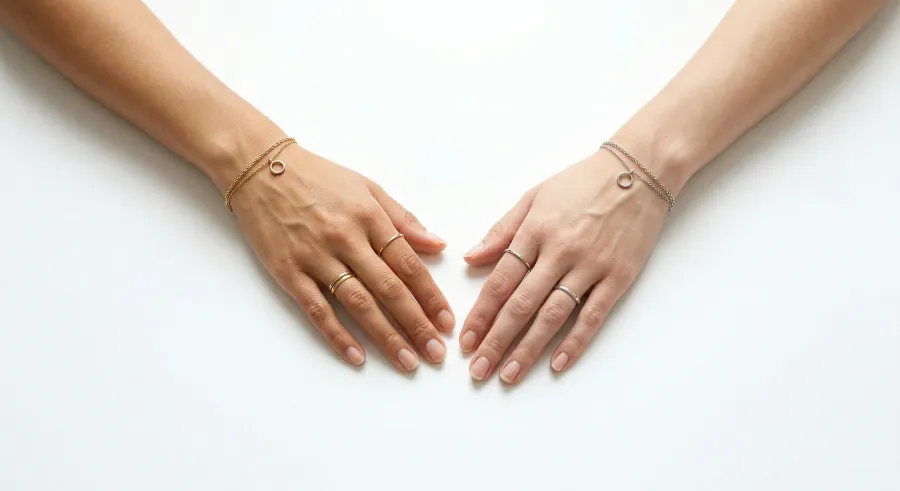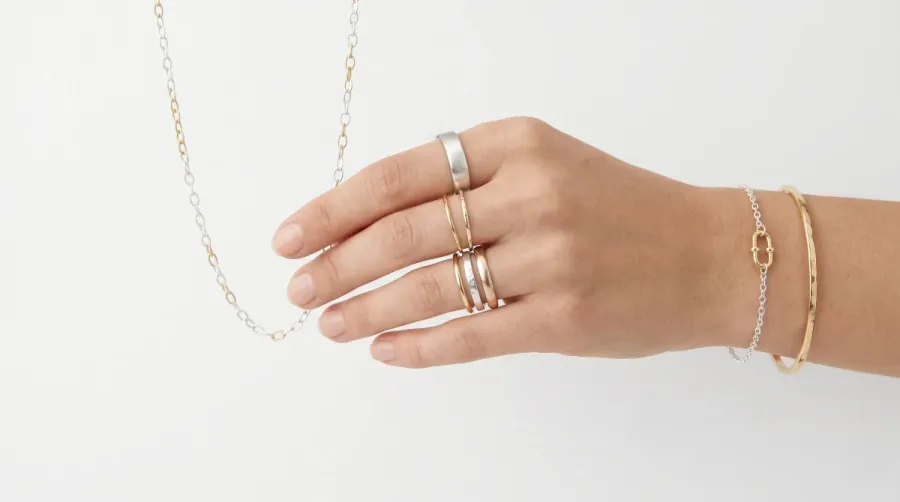
Mixing Metals in Jewelry: The Complete Guide
Introduction: The rule that no longer applies
For most of the twentieth century, the advice was consistent: never mix gold and silver jewelry. One woman, one metal. If you wore a gold chain, every other piece had to match. Silver earrings with a gold bracelet was, according to etiquette books of the era, simply not done.
That rule is gone. It dissolved gradually through the 1990s and collapsed entirely by the mid-2010s. Today, mixing metals is read as confident personal style, not a lapse in taste. This guide explains how the shift happened and, more practically, how to make a mixed-metal look work.
The topic matters beyond style. The American jewelry market has expanded consistently over the past decade, and mixed-metal designs now represent one of its fastest-growing categories. Knowing the visual logic behind the combination lets you build a jewelry wardrobe that holds together across pieces you have collected, inherited, or bought at different points in your life.
The longer history: mixing metals was always normal
Before examining why the twentieth-century prohibition existed, it is worth noting how unusual that prohibition was in the broader sweep of jewelry history. For most of recorded time, working with more than one metal in a single piece was a sign of skill, not confusion.
Roman bicolor: gold and silver inlay as craftsmanship
Roman jewelers of the second and third centuries used bimetal inlay techniques as a mark of expertise. Gold set into silver, silver details on gold bases, alternating metals within a single brooch or ring. The technical challenge of bonding two metals together was a demonstration of the goldsmith's ability. Wearing such a piece signaled the quality of the craftsman, not any ambiguity in taste.
Archaeological finds from sites across the Roman Empire confirm how widespread this practice was. Mixed-metal fibulae, neck rings, and arm cuffs appear in collections from Britain to Syria. The visual effect of warm and cool metals against each other was clearly understood and deliberately exploited.
Medieval reliquaries and Byzantine champlevé
Medieval goldsmiths working on reliquaries, the decorative containers for sacred objects, routinely combined metals. Gold for the facing, silver for the backing, gilt silver for the body, bronze for structural elements. The mixing was functional and aesthetic simultaneously.
Byzantine champlevé enamel, which involved setting colored glass into recessed metal surfaces, frequently combined gold bases with silver or niello inlay for contrast. These pieces survive in museum collections across Europe and look entirely contemporary in their combination of warm and cool metals.
The medieval craftsman had no rule against the combination. The rule against it would have struck a thirteenth-century goldsmith as baffling.
The Russian three-band wedding ring of the nineteenth century
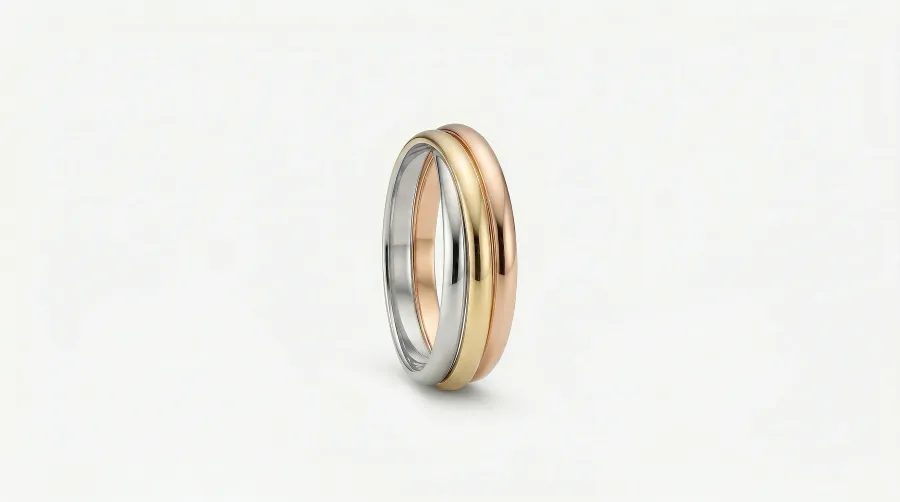
In Russian jewelry tradition of the nineteenth century, a wedding ring composed of three fused bands in different metals was widely known. Yellow gold, white gold or silver, and rose gold in a single ring, each band representing a different value, often associated with the Trinity. This object was not experimental. It was a recognized form in the jewelry trade, bought by merchants and prosperous tradespeople who had clear aesthetic opinions.
The existence of this ring, produced and sold across generations, is a direct refutation of any claim that mixing metals was always considered tasteless. In the Russian context, it was considered beautiful.
The 1920s trinity ring and its symbolism
The three-band ring created in Paris in the 1920s, with three interlocked bands in yellow, white, and rose gold, became one of the most recognized jewelry designs of the twentieth century. Each band stood for a different value: friendship, love, and fidelity. The design was intentional about its three metals. The combination was not accidental variety; it was the point.
The ring was copied, reinterpreted, and produced in quantity across the following decades. Its cultural status made the single-metal rule look arbitrary. If three metals in one ring were admired, the logic of refusing two metals across two pieces became hard to sustain.
The Bauhaus period and functional aesthetics
The 1920s workshops of the Bauhaus movement in Germany explicitly experimented with multiple metals in single objects. Silver, brass, and chrome-plated steel appeared together in jewelry and decorative objects. The principle was functional: each material did a different job. The visual consequence was a mixed-metal aesthetic that influenced design for decades.
Where the rule came from
The prohibition on mixing metals was strongest in mid-twentieth century America, where a clear social logic underpinned it. A woman who wore only gold signaled she could afford to do so. Mixing gold with silver implied she lacked a full matched set and was filling gaps with a cheaper metal. The etiquette manuals of the period reinforced this reading.
The rule was also practical in a simpler era of jewelry design. Most pieces were made in a single metal, so mixing was unusual by default. When mixing was unusual, it read as unintentional. Unintentional mismatches were read as a lapse.
By the 1980s, professional women in major American cities followed the guidance closely. Silver for casual wear, gold for formal, never combined. The rule functioned as a kind of professional uniform code, like knowing whether to wear heels to a meeting.
The social logic depended on a specific relationship between gold and status. As gold became more accessible, mass-produced jewelry became more diverse in materials, and professional dress codes loosened, the foundational logic of the rule weakened. The rule survived for a while on inertia.
How the rule began to break down
Several developments in the late twentieth and early twenty-first centuries undermined the prohibition.
1990s: multi-tone fine jewelry. European fine jewelry houses began producing pieces that combined yellow, white, and rose gold within a single object. The explicit argument was craft: three alloys, each with its own warmth, working together. This made the idea of combining metals aesthetically legitimate within the most expensive tier of the market. If the best pieces combined metals deliberately, the rule against mixing looked provincial.
Early 2000s: the tri-color ring revival. The three-band ring of the 1920s, each band in a different gold alloy, became a widely recognized cultural reference. Its existence as an admired design made the old single-metal rule look arbitrary. American buyers began requesting versions of it, and the design appeared across every price tier.
2010s: two-tone bridal demand. American bridal jewelers reported consistent demand for mixed-metal engagement and wedding ring sets. Many buyers wanted a white gold diamond engagement ring alongside a yellow gold wedding band. The combination stopped being an anomaly and became a mainstream product category stocked in bridal departments across the country.
2015-2017: social media and ring stacking. Influencers photographing stacked rings with mixed metals made the combination visible at scale across Instagram and Pinterest. A generation of younger buyers saw it normalized before they ever encountered any rule against it. The rule was not repealed; it simply never reached them.
Now. Mixed-metal jewelry is a standard category in every market tier. Two-tone wedding bands are mainstream bridal inventory. Mixed stacks are the default in most jewelry photography. The question is no longer whether to mix; it is how.
Types of metal combination: what works with what
Not all metal pairings produce the same visual result. Understanding what each combination does helps you choose deliberately.
Yellow and white gold: the classic contrast
The most common pairing in fine jewelry. Yellow gold is warm-toned; white gold reads as cool. They sit at opposite ends of the metal color range, which is precisely why the combination works: the contrast is clear but not aggressive.
This pairing is particularly effective in engagement and wedding ring sets. A white gold diamond ring next to a yellow gold wedding band reads as a deliberate design decision rather than an accident. The contrast visually distinguishes each ring instead of merging them into an undifferentiated mass of metal.
The 9-carat and 10-carat versions of yellow gold are slightly paler than 18-carat, which affects how strong the contrast reads. At 18-carat, the yellow is saturated enough that the contrast with white gold is strong. At lower caratages, both metals drift toward a lighter palette and the contrast softens.
Yellow and rose gold: double warmth
Both metals sit in the warm range, but at different positions within it. Yellow gold is purer in color; rose gold carries a copper softness. The combination produces a subtle tonal harmony without sharp contrast.
This reads as the romantic pairing of the three combinations. Yellow and rose together feel warm, cohesive, unhurried. For stacked rings, three or four bands in these two metals produce an effect that looks almost monochromatic from a distance but reveals its variation on closer inspection.
The combination suits warm and olive skin tones particularly well because it plays into the warm undertone of the skin rather than contrasting with it.
White and rose gold: the modern combination
Cool white against warm rose produces contrast, but softer than yellow-versus-white. There is no aggressive temperature clash. This combination reads as contemporary and slightly understated.
It suits people who want something unusual without an obvious color drama. The combination is associated with more restrained contemporary jewelry rather than the classic warmth of yellow and rose.
All three: the trinity
The three-band ring of the 1920s presented yellow, white, and rose gold as a symbolic trio, each metal representing a different value.
In contemporary practice, the trinity stack is built from three separate slim rings in different metals. The requirement is that the rings share everything except color: same width, same finish, same proportion. The metal colors are the variation; everything else is consistent.
This combination works well for people who have difficulty committing to one metal. The choice is made structurally: you have all three, and the design contains that fact elegantly.
How mixed metals work visually
Understanding the basic visual mechanics prevents combinations that look accidental rather than chosen.
Contrast vs harmony
Contrast: silver (cool-toned) next to yellow gold (warm-toned) creates a strong visual tension. It draws the eye and reads as deliberate. Works for evening wear and combinations where you want presence.
Harmony: yellow gold next to rose gold sits in the same warm family but at different depths. Less tension, more cohesion. Works for everyday wear when you want pieces to feel connected rather than at odds.
Choose contrast when you want an effect. Choose harmony when you want integration.
The 70/30 principle
A split of roughly 70 percent one metal and 30 percent another reads as intentional. An even 50/50 split creates visual indecision. The dominant metal sets the tone; the secondary metal provides accent.
Practical example: three silver rings in a stack, one gold ring. The gold reads as the punctuation, not the statement.
Another example: a yellow gold necklace and earrings, one silver ring on the hand. The silver is a note. If you add two more silver rings, you have shifted toward 50/50 territory. At that point, consider whether you need to drop one silver piece or add more gold elsewhere to reestablish the hierarchy.
Repetition creates intention
If you wear both metals, let each appear at least twice across the look. Silver earrings and a silver ring. Gold chain and a gold bracelet. This signals choice rather than accident.
When only one piece of a second metal appears, it can read as an oversight. When two pieces appear, it reads as a system. The repetition makes the combination look designed.
Scale and weight cohesion
Pieces in different metals that share a similar visual weight hold together. A delicate 14-carat gold chain next to a chunky oxidized silver cuff creates a mismatch that the metal difference amplifies. The scale difference reads as disorder.
When mixing metals, give extra attention to matching the visual weight of pieces. Slim with slim. Statement with statement. The metals can differ; the scale should be consistent.
Mixed metals in a single piece
The simplest entry point is a piece that already combines metals in its design, so the balancing work is done for you.
Two-tone rings. Yellow and white gold in a single band. The pairing is a long tradition in American bridal jewelry, where a yellow gold wedding band sits alongside a white gold engagement ring.
Three-band rings. Three slim rings in different gold alloys, worn as a set or combined in a single piece. The 1920s original has been re-interpreted by independent jewelers and larger brands continuously since.
Alternating-link chains. Links in yellow gold and white gold, or silver and rose gold, alternating along the length. The mixed quality is built in. No assembly required.
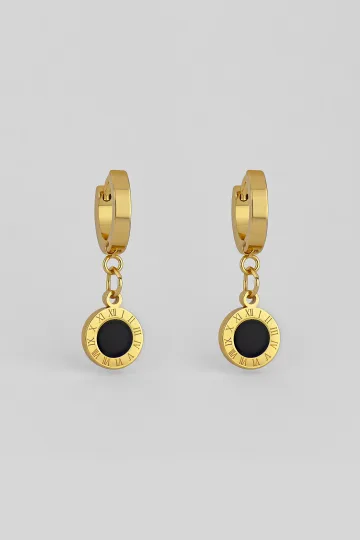
Two-tone earrings. One half of the earring in one metal, the other half in a second. The asymmetry can be vertical, the top of the ear cuff in one metal and the drop in another, or lateral, the front face in one metal with a contrasting reverse.
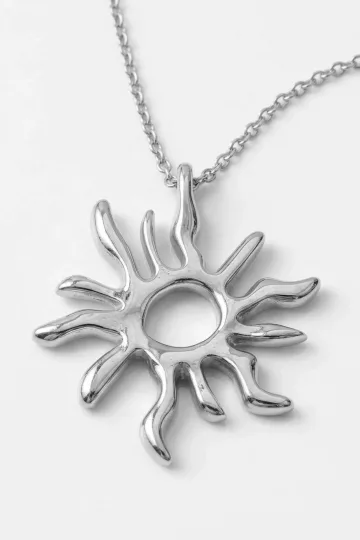
Pendants with metal accents. A silver pendant with a small yellow gold bail or decorative detail. The contrast is subtle but present. A useful way to introduce a second metal to an otherwise single-metal chain and pendant combination.
Mixed-link bracelets. Cable-style bracelets that alternate yellow gold and silver or rose gold and white gold links. The combination is balanced by the design itself rather than requiring any external calibration.

Mixed metals in ring stacking
Ring stacking and metal mixing are closely connected in contemporary American jewelry culture. Some reliable combinations:
Silver and yellow gold (the classic American combination)
Three rings: a plain silver band, a fine yellow gold thread ring, a silver band with a small stone. The cool silver against warm gold contrast gives the stack energy. Widely photographed across American jewelry accounts.
A useful variation: one wider silver band as the anchor, two thin rings in yellow gold as accents. The width hierarchy reinforces the 70/30 metal hierarchy.
Rose gold and yellow gold (warm scheme)
Three or four rings in the same warm family at different shades. No tension, strong cohesion. Works particularly well with warm and olive skin tones. This stack photographs well in natural light because both metals pick up warmth from the same light source.
All three (silver, yellow gold, rose gold)
The most deliberate stack. Each ring in a different metal. Works when the rings share a design language: all slim, all plain, all the same width. The metal colors are the variation; everything else is consistent. A stack of five rings in this system, with repetition of some metals, gives depth without confusion.
Oxidized silver and yellow gold
A darker combination. The blackened patina of oxidized silver against warm yellow gold has a strong visual contrast. Associated with contemporary craft jewelry and alternative aesthetics. The combination has an industrial quality that sets it apart from the more classical warm pairings.
For stacks in this combination: keep the oxidized pieces larger and let the yellow gold appear in slim accent rings. The dark scale anchor with a warm gold thread creates a compelling hierarchy.
Textured silver with polished gold
The finish difference amplifies the metal difference. Hammered or brushed silver next to high-polished yellow gold creates a dual contrast: cool versus warm, matte versus mirror. The combination works when the pieces have similar visual scale.
Wedding and engagement rings: the practical question
One of the most common practical questions: what to do if the engagement ring is white gold and the wedding band is yellow, or vice versa?
The answer is straightforward: a white gold engagement ring alongside a yellow gold wedding band is one of the most common American bridal combinations. There is no rule requiring both rings to be in the same metal. The contrast visually distinguishes each ring instead of merging them.
If visual unity is important, a two-tone wedding band that incorporates both yellow and white gold in a single piece resolves the question entirely. You get both metals, no conflict.
A third option is a ring with metal-contrast detailing: a white gold ring with a yellow gold edge, or vice versa. This reads as a single considered object rather than two pieces that happen to coexist.
The practical consideration for stacking wedding and engagement rings: the two rings will rub against each other daily. Gold-on-gold rubbing is fine. Gold-on-platinum rubbing can wear the gold. If you are pairing a platinum ring with a gold band, ask a jeweler about a fitted spacer or a slightly harder alloy for the band.
When the matching impulse takes over
Many couples feel pressure to have matching engagement and wedding rings. This pressure comes from social convention, not from any visual principle. Two rings in the same metal can look beautiful. Two rings in contrasting metals can look equally beautiful. The combination reads as a design decision rather than an oversight.
Some couples choose to match the inner metal. A yellow gold wedding band with a white gold inner sleeve, paired with a white gold engagement ring, reads as coordinated from the outside in both directions while giving both metals a presence.
The psychology of mixing: why it works now
There is an interesting psychological dimension to why mixed metals became popular when they did. The old rule required commitment to a single type. You were a gold person or a silver person. That identity framework depended on uniformity.
The contemporary approach is different. Mixed metals communicate that you are not a single note. The combination says something layered is happening. It reads as deliberate complexity rather than indecision.
From a practical standpoint, mixed metals are simply more convenient for people who collect jewelry over time. You do not have to choose between the silver bracelet you inherited and the gold ring you bought. Both can coexist without any stylistic apology.
The shift also reflects a broader change in how Americans understand personal style. The idea that you belong to a fixed category, gold or silver, formal or casual, classic or modern, has lost cultural authority. Mixed metals are partly a visual expression of that shift.
Layering rules: building a mixed-metal look
When wearing multiple pieces in different metals, some structure helps.
Start with an anchor. Identify the dominant metal in the look. This does not mean the most pieces; it means the metal that sets the register. A yellow gold chain with a pendant is a strong anchor because it sits at the center of the body and holds visual weight.
Add the second metal as accent. If the anchor is gold, silver appears in one or two pieces: a ring, a bracelet, one pair of earrings. Not everything at once. Let the anchor establish before the accent appears.
Three tones maximum. Silver, yellow gold, rose gold is the ceiling. A fourth metal introduces noise unless there is a very clear system that unifies them.
Let each metal appear twice. Silver in earrings and one ring. Gold in a chain and a bracelet. Repetition creates the sense of a system rather than a coincidence. One appearance of a metal can read as an oversight; two appearances read as intention.
Match finish within a metal family. If your silver pieces include both polished and oxidized silver, the tonal variation within that category adds complexity. This is fine at one level of difference but can read as disorder if multiple finish variations appear simultaneously across multiple metals.
Engraving and metal tone. On yellow gold, engraving reads as warm and classic. On white gold or silver, it reads clean and contemporary. On rose gold, it is soft and lyrical. In a stacked set of engraved rings in different metals, the variation between them adds another layer of texture to the combination.
Caring for mixed-metal pieces
Different metals oxidize differently and need different care. When you wear multiple metals daily, the care routines need to work for all of them without one cleaning method damaging another.
Silver tarnishes relatively quickly, particularly on contact with air, perspiration, perfume, and certain cleaning products. Use a silver-specific polishing cloth. Mild soapy water is safe. Ultrasonic cleaners are generally fine for plain silver, but not for silver that is set with stones.
Yellow gold does not oxidize in normal conditions. It dulls from oils: skin oil, creams, perfume residue. Wipe with a soft cloth; rinse with warm water and mild soap if needed. Gold needs cleaning less frequently than silver but benefits from it regularly.
White gold is coated with rhodium plating, which wears away over time and reveals the slightly yellowish base alloy beneath. Re-plating by a jeweler every few years restores the bright white finish. The timeline depends heavily on how often the piece is worn and against what surfaces.
Rose gold is a gold-copper alloy. The copper component can darken subtly over years of wear. Care is the same as yellow gold. The darkening can be polished out, but it tends to re-emerge over time as part of the character of the metal.
The key rule for a mixed collection: use separate polishing cloths for silver and gold. Silver-cleaning compounds can damage gold plating. Store different metals separately, or at minimum in divided compartments, to avoid scratching. A jewelry box with fabric-lined compartments is the standard solution; it separates pieces and prevents the scratching that occurs when metals rub against each other during storage.
Ultrasonic cleaners and mixed-metal pieces
A home ultrasonic cleaner is useful for plain metal rings and chains but should be avoided for pieces with stones, glued settings, or rhodium plating. If you own pieces in each category, clean the sturdy plain metal pieces ultrasonically and clean the others by hand.
Mixed metals in watches
Watches are a particular case because many American and Swiss designs already combine metals internally, making the logic of mixed metals visible on the wrist before any additional jewelry is considered.
Steel case with yellow gold dial details. A long-established combination in watchmaking. The steel reads as modern and technical; the gold details give warmth. This combination has been present in mainstream American watch design since at least the 1970s.
Two-tone bracelets. Alternating steel and gold links. The combination has been a staple of bracelet watch design for decades. The alternating-link two-tone watch is so familiar that it no longer reads as unusual in any context, from business to casual.
Rose gold case with steel or silver accents. A more contemporary combination, associated with lifestyle watch designs from the 2010s onward. The rose gold reads as warm and personal; the steel accents give it technical credibility.
If you already wear a mixed-metal watch, you have implicit permission to mix in your other jewelry. The watch sets the logic. A steel and gold two-tone watch sitting on the wrist already signals that you operate in a mixed-metal register.
The practical alignment: if the watch is steel and gold, the rings and bracelets can pick up both metals. If the watch is entirely one metal, the other jewelry can introduce the second. The watch functions as a foundation for the rest of the look.
Skin tone considerations
Earlier guidance was absolute: warm skin tones wear yellow gold, cool skin tones wear silver or white gold. This has softened considerably, although the underlying logic is still useful and is laid out in detail in the guide on which metal suits your skin tone.
Warm undertones (greenish veins, olive or peachy complexion). Yellow and rose gold complement warm skin. Silver can read cooler than you want. But it is not incompatible. In a mixed look, silver next to gold moderates the warmth without eliminating it.
Cool undertones (bluish veins, fair or pink complexion). Silver, white gold, and platinum reinforce cool tones naturally. Yellow gold creates more contrast. In a mixed look, adding silver alongside yellow gold softens the contrast between the yellow gold and the cool undertone.
Neutral undertones. Any metal works. In a mixed-metal combination, one metal moderates the effect of the other, making it easier to wear metals that would be less flattering solo.
The skin tone guidance is most relevant when choosing a single metal. In a mixed combination, the metals moderate each other, which makes the skin tone effect less decisive.
Mixed metals for different occasions
Office and professional settings
Restrained mixing. A silver or platinum wedding ring alongside a fine gold chain and small gold or silver studs. The combination reads as composed, not careless. The 70/30 principle is especially useful in professional settings. One metal dominant, the other present but not competing.
Evening events and dinners out
Deliberate contrast is appropriate. A stacked hand with two metals, earrings in one, everything else in the other. Contrast works in lit environments where jewelry is noticed. An evening occasion is where you can push toward the bolder end of the visual spectrum.
Weddings as a guest
If the occasion is traditional, keep one metal dominant and use the second sparingly. One contrasting ring, or contrasting earrings, is enough. At a formal wedding, the details of your jewelry will be noticed and remembered, so the combination should be clear rather than exploratory.
Casual and everyday
The easiest register. Watch in one metal, rings in another, no fixed rule. Daily wear is where mixed metals became normalized first in the American market. The same combination you put on in the morning without thinking is the combination that sets your baseline.
Outdoor and active wear
Keep it simple. When you are active, pieces rub against each other and against surfaces. The mixed-metal distinction matters less. Stick to one or two pieces total, and choose the metals based on durability rather than aesthetics.
Mixed metals and jewelry gifting
If you are buying jewelry as a gift for someone who already owns pieces in a specific metal, a piece in a second metal is not a problem. You do not need to match their existing collection. A yellow gold piece given to someone who primarily wears silver is a complement, not a conflict.
The practical note: if you are buying for an engagement or wedding ring pairing, check what metal the existing ring is in before choosing the complementary piece. The combination is a design decision, but it should be a considered one.
Building a mixed-metal jewelry wardrobe over time
Most people do not build a jewelry wardrobe all at once. Pieces accumulate over years: gifts, purchases made at different points in life, inherited items. The result is almost always a mix of metals, regardless of any intention to mix.
The question then is not whether to have a mixed collection, but how to wear it cohesively. Some practical principles for managing a collection that spans metals.
Identify your anchor pieces. Every collection has two or three pieces that you wear consistently: a chain, a ring that never comes off, a watch. Identify what metal these are in. That metal is your dominant and will shape how everything else works.
Group the rest by visual weight. Among your remaining pieces, divide roughly by scale. The large, statement pieces in one group. The slim, everyday pieces in another. When you build a daily look, choose from one weight class at a time.
Let the occasion guide the ratio. For work, lean more heavily on the dominant metal. For evenings, you can shift the ratio toward 60/40 or use the second metal more prominently.
Keep a few bridge pieces. A two-tone ring or an alternating-link chain is useful not because it solves a design problem but because it literally contains both metals. When you wear it, it connects the two parts of the collection visually.
Give yourself permission to retire pieces. A piece you have grown away from, stylistically or emotionally, does not have to stay in rotation. A mixed collection benefits from curation. Retiring a piece that no longer fits the system is not wasteful; it is editing.
The specific case of silver-heavy collections
Many people start with silver, often because it is more accessible at entry price points and because silver works well with everyday casual wear. As careers progress and tastes evolve, gold enters the mix. The collection shifts from entirely silver to a combination.
The transition period can feel awkward. You have silver pieces you love and gold pieces you are acquiring, and the combination seems unresolved.
The practical move is to identify one silver piece and one gold piece that feel similar in spirit. They do not have to match; they need to resonate. A slim silver band and a slim gold band. A silver chain and a gold chain of similar weight. Wear those two together consistently for a few weeks. The combination will start to feel resolved, and from there you can add additional pieces with more confidence.
The transition is not a single decision. It is a sequence of small additions, each one building on the previous.
Chain and necklace combinations across metals
Layering necklaces is a distinct challenge within the mixed-metals topic because chains and pendants are close to the face and highly visible.
Two chains, one metal each. The simplest approach: a silver chain and a gold chain at different lengths. The length difference matters. At least two inches of separation keeps the chains from tangling and lets each read independently.
One chain, mixed pendant. A silver chain with a gold pendant, or a gold chain with a silver pendant. The pendant as the point of interest in a contrasting metal is a simple and effective way to introduce the second metal.
Trinity necklace stack. Three chains at different lengths, each in a different metal. This works when the chains are similar in style and weight. The logic is the same as the trinity ring stack: same form, different material.
For necklaces, the 70/30 principle applies as much as for rings. If you wear two chains, one should be clearly more prominent. A heavier gold chain paired with a delicate silver chain positions the gold as dominant and the silver as detail.
Bracelets and the mixed-metal wrist
The wrist is where a watch, bracelets, and potentially bangles all converge. Managing the metal mix at the wrist requires attention to both the watch and the jewelry.
Watch-first approach. Let the watch set the wrist's dominant metal. If the watch is steel, bracelets in silver or white gold work naturally. If the watch is yellow gold-cased, a yellow gold bracelet reads as a continuation.
The opposite approach. A steel watch with a yellow gold bracelet. The contrast is intentional and strong. This works when the contrast is the point, when you want the wrist to read as a composed mixed-metal moment.
Mixing bracelet types. A slim gold chain bracelet with a beaded silver bracelet introduces both material and texture differences. The texture difference moderates the metal difference; the eye processes several variables simultaneously and finds the combination interesting rather than confused.
Single-wrist rule for bold combinations. If you are wearing a bold mixed-metal combination at the wrist, keep the other wrist simpler. One wrist with a complex mix, one wrist with nothing or one plain piece. The asymmetry gives the mix space to read.
Common mistakes
Equal split. Half silver, half gold. Looks unresolved. Use 70/30 or 80/20. The equal split is the most common error among people new to mixing metals, and the fix is simple: add or remove one piece to establish a clear dominant.
No shared aesthetic. Heavy oxidized silver paired with delicate fine gold. The pieces need something in common: scale, style, finish quality, or theme. When the aesthetic difference is too large, the combination reads as wardrobe randomness rather than considered variety.
Too many metals. Silver, yellow gold, rose gold, black steel, and platinum simultaneously is visual noise. Three metals maximum in one look. Beyond three, the eye cannot establish a hierarchy, and the combination reads as undefined.
Mismatched metal quality within a type. Different gold karats have different shades. In a ring stack with some space between, the difference between 10-carat and 18-carat is acceptable. In a single piece, the difference is visible and can look inconsistent.
Forgetting the watch. If you wear a watch, it is the most visible metal on your wrist. Ignoring the watch metal when building a ring stack means the most prominent piece is working against rather than with the rest of the combination.
Frequently asked questions
Can I mix metals in a wedding ring set?
Yes. Two-tone wedding ring sets are a standard American bridal offering. A yellow gold wedding band worn alongside a white gold engagement ring is one of the most common combinations in the country. If you want the mixing built into a single ring, two-tone and three-band designs are widely available.
Is the rule against wearing yellow and white gold together outdated?
Completely. Yellow and white gold together is now a classic combination. The American bridal tradition of mixed-tone sets has been mainstream since the early 2000s and is now the default rather than the exception.
How do I combine different metal tones on different fingers?
Freely. There is no rule requiring all rings on a hand to share a metal. A stack across multiple fingers in silver, yellow and rose gold works when the rings share a common design language.
How do I combine watch metal with jewelry metal?
Use the watch case as a guide. A steel case matches with silver and white gold. A yellow gold case with yellow gold jewelry. A two-tone watch gives you permission to mix freely in the rest of your jewelry.
I work in a conservative environment. Is mixed metal appropriate?
Yes, with restraint. Keep one metal as the dominant. Use the second in a single piece: one ring, one pair of studs. At that level, the combination goes unnoticed as a rule-breaking choice and is simply read as thoughtful jewelry selection.
Is it better to buy a two-tone piece or mix separate pieces?
If you are new to it, start with a single two-tone piece. The balance is built in. Once you have a sense of how the combination feels on you, assembling your own stack is straightforward.
Is platinum the same as silver?
Visually close, but different in weight, durability, and cost. Platinum is heavier and more durable than silver. Mixed next to silver, the difference in quality of surface and heft may be noticeable. The full comparison is in the article on platinum vs white gold.
Can I mix 10-carat and 18-carat gold?
In a single piece, the shade difference is visible. In a ring stack with physical separation, it is acceptable. The 10-carat piece will appear slightly paler.
Does mixing metals reduce the value of the jewelry?
No. Mixed-metal designs are a standard jewelry category. A piece that combines metals is valued on its own design and craft quality, not penalized for the combination.
Do men wear mixed metals?
Yes. A steel watch with a yellow gold wedding band is a standard American male combination. The mix is familiar in every register from formal to casual and has been for decades.
What percentage of each metal?
70/30 is the safe starting point. 80/20 is more conservative. 50/50 is the combination most likely to look unintended.
How do I start if I currently only wear one metal?
Add one piece in a second metal. If you wear mostly silver, add one gold ring or a gold chain. Wear the combination for a week and see how it feels. If it works, continue building. If it doesn't, you have spent relatively little. The single-piece addition is the lowest-risk way to test the combination.
What about mixing sterling silver and vermeil?
Vermeil is silver base with a thick gold plating. Next to solid gold, it reads similarly at first glance but the color may be slightly different. Next to plain silver, the gold surface reads correctly. Vermeil mixes easily with both pure silver and solid gold in a stack. The distinction matters more in a single piece than across separate rings.
Conclusion
The prohibition on mixing metals was always a social convention rather than an aesthetic law. When the social logic that underpinned it shifted, the rule lost its authority.
Today, mixing metals in jewelry is about understanding how contrast and harmony work visually, and applying a few practical principles: a dominant metal, a secondary accent, repetition across the look, and pieces that share at least some design language.
The history of the craft bears out this approach. From Roman bicolor inlay work to the 1920s trinity ring to the two-tone bridal sets that now fill American jewelry departments, working with more than one metal has always been present in the tradition. The twentieth-century rule against it was the anomaly.
Start with one addition. If you wear mostly silver, add one gold piece. If the combination works for you, continue building from there.
Silver, gold, wedding rings, symbolic jewelry, paired sets.
About Zevira
Zevira is a handmade jewelry studio based in Albacete, Spain. We work simultaneously in silver and gold, and regularly produce two-tone pieces where the combination of metals is a design decision, not an afterthought.
What you can find in the catalog:
- Two-tone rings combining silver and yellow gold in a single piece
- Silver chains with gold pendants, designed as a mixed-metal pair
- Rose gold collections that sit alongside both silver and yellow gold
- Matched chain and bracelet sets in complementary metals
- Sterling silver 925 and 14-18 karat gold throughout
Each piece is made by hand, with the option of personalized engraving.