PVD Coating vs Gold Plating: What the Difference Actually Means
Introduction: Two Very Different Technologies Behind One Word
You walk into a jewellery shop. The assistant points to a pendant and says "gold-coloured." The price is in the budget range. A month later, green patches, worn patches, a slightly sour smell from the metal. Disappointing.
In another shop, a similar-looking pendant costs more. The assistant says "PVD-coated stainless steel." You can't tell them apart by sight. The difference becomes obvious after a year, when the first piece is long gone and the second still looks as it did in the box.
Britain has a long relationship with precision engineering, from the steel mills of Sheffield to the instrument-makers of Birmingham. PVD is not a marketing word. It is a specific industrial process, and the gap between it and conventional electroplated gold is substantial. It is worth understanding exactly why.
What PVD Coating Actually Is
PVD stands for Physical Vapor Deposition. The name sounds technical, but the principle is straightforward.
A metal blank, typically 316L stainless steel or titanium, is placed inside a sealed vacuum chamber. A small quantity of the target metal, gold, rose gold, black titanium nitride, or another alloy, is also placed in the chamber.
Energy is applied inside the vacuum. The target material vaporises into a cloud of individual atoms. Those atoms travel across the chamber and bond to the surface of the blank at the atomic level, not as a film sitting on top, but as a layer chemically fused to the base material.
The result is a coating typically between 0.5 and 3 microns thick. Thin, yes, but extraordinarily hard, because the bond is chemical rather than mechanical.
The Process Step by Step
Understanding the sequence helps clarify why PVD behaves so differently from conventional plating.
Step 1: Surface preparation. The blank is degreased and cleaned to a high standard. Any contamination on the surface will interrupt the atomic bond. This cleaning stage is one reason why PVD facilities are more capital-intensive than galvanic lines.
Step 2: Vacuum. Air is pumped out of the chamber until pressure drops to near-space levels, typically around 0.001 pascal. At that pressure, atoms of the target material can travel in straight lines without being scattered by gas molecules.
Step 3: Vaporisation. The target material is either bombarded with high-energy argon ions (magnetron sputtering) or struck by an electric arc (arc evaporation). In both cases, atoms are dislodged from the target and become a vapour cloud inside the chamber.
Step 4: Deposition. The freed atoms travel to the surface of the blank and form chemical bonds at the atomic level. They do not sit on the surface as a separate film; they become part of the outermost layer of the material.
Result. A layer typically 1 to 3 microns thick with a Mohs hardness of 8 or above. Diamond sits at 10 and corundum at 9. Most metals used in jewellery sit between 2.5 and 4. A PVD coating is harder than the metal it covers.
What Metals Go into a PVD Target
The colour of the finished surface depends on the target composition and the gas atmosphere inside the chamber:
- Titanium nitride (TiN): classic warm yellow-gold, the most common.
- Zirconium nitride (ZrN): similar yellow, slightly warmer in tone.
- Titanium carbon nitride (TiCN): produces the rose gold shade.
- Chromium carbide (CrC): used for silver-tone and dark coatings.
- Diamond-like carbon (DLC): deep black with very high hardness, standard in watch cases and men's jewellery.
These compounds are chemically stable and biologically inert, which is the foundation of the hypoallergenic claim for PVD jewellery.
How PVD Differs from Electroplated Gold
To appreciate the difference, it helps to understand what conventional gold plating involves.
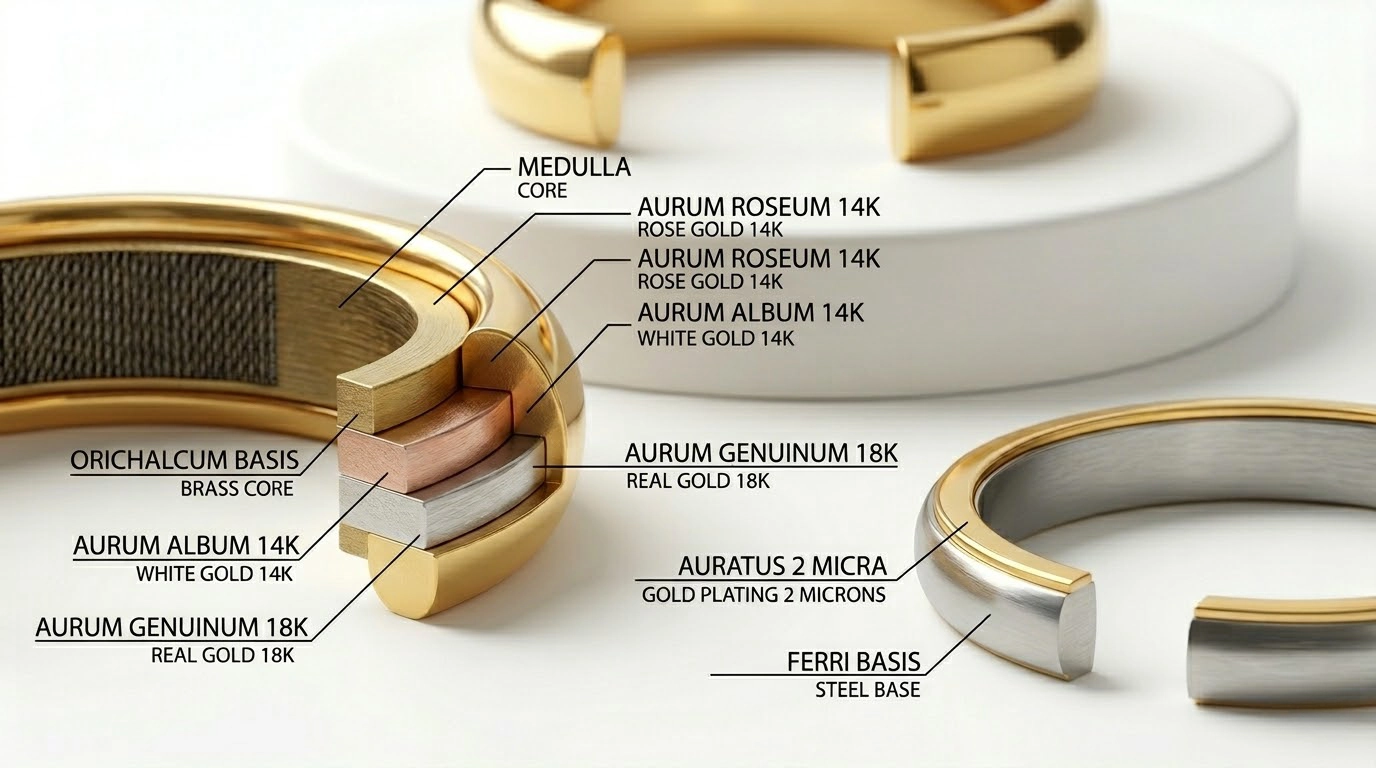
Electroplating. The blank, often brass or a low-cost alloy, is submerged in a solution containing gold salts. An electrical current drives gold ions from the solution onto the surface of the blank. The process is analogous to electropaint: a thin skin forms on the outside of the object.
Electroplated layers typically run between 0.1 and 0.5 microns. That is a film resting on the surface, not bonded to it. It can be scratched away, dissolved by acids in perspiration, and attacked by alcohol-based fragrances.
PVD. The atomic-level bond changes everything. A PVD layer of comparable thickness resists daily wear, perspiration, and most household chemicals. The coating does not peel; it abrades slowly over years rather than months.
The base metal matters too. Electroplated jewellery is frequently applied to brass, which itself oxidises and can stain skin green. PVD is almost always applied to 316L stainless steel or titanium, both of which are stable, even if the coating wears through.
Sheffield became synonymous with cutlery steel precisely because metallurgical discipline, the right base material, the right surface treatment, extends the useful life of a piece far beyond what a decorative coating alone can achieve. The same logic applies in jewellery.
Electroplating Grades: Not All Plating Is the Same
Electroplated gold comes in several grades, and the distinctions matter:
- Flash plating: approximately 0.05 microns, a molecular-thin layer. Lasts weeks rather than months.
- Standard gold plating: 0.5 to 3 microns. The range most budget jewellery falls into. Service life measured in months.
- Vermeil: by US FTC definition, at least 2.5 microns of 10-carat-or-higher gold on a 925 silver base. A recognised category with a legal definition in the United States and established usage in the United Kingdom.
- Heavy gold plate: 7 microns or more. The most durable galvanic option, significantly more expensive to produce.
Even heavy gold plate is a mechanical film; it does not fuse to the base at the atomic level. This is the fundamental structural difference that no amount of extra plating thickness can bridge.
Labelling and Regulation
Different markets set different thresholds for how coatings may be described:
United States (FTC). "Vermeil" has a strict legal definition. "Gold plated" without qualification can mean any thickness.
European Union. EU jewellery directives require gold alloy markings by fineness. A single minimum thickness for the term "gold plated" is not universally mandated across all member states, but industry associations recommend no less than 2.5 microns of 24-carat gold.
United Kingdom. Trading Standards treat gold plating labelling similarly to EU norms. "Gold filled" (at least 5 percent of total weight in gold) and "gold plated" are distinct terms with different requirements.
PVD has no dedicated jewellery standard yet. Responsible manufacturers specify the target material, coating hardness, and guarantee period.
Comparison Table
| Parameter | Electroplated Gold | PVD |
|---|---|---|
| Process | Electrolytic deposition from solution | Atomic deposition in vacuum |
| Thickness | 0.1-0.5 microns (up to 7 for heavy plate) | 0.5-3 microns |
| Bond to base | Mechanical (film) | Chemical (fused) |
| Hardness (Mohs) | approx. 2.5 | 8 and above |
| Service life | 6 months to 2 years | 3 to 5 years and beyond |
| Response to water | Often deteriorates | Stable |
| Response to perspiration | Often deteriorates | Stable |
| Response to fragrance | Often deteriorates | Stable |
| Scratch resistance | Visible immediately | Protected by hard surface layer |
| Base material | Often brass | Stainless steel, titanium |
| Skin safety | Depends on base | High |
| Price segment | Budget (cost of a coffee) | Mid-range (cost of a restaurant meal) |

Where PVD Technology Came From
PVD was not developed for jewellery. Its origins are industrial, rooted in the same engineering tradition that produced turbine blades and precision cutting tools.
From the 1940s onwards, aerospace and defence engineers needed coatings that could withstand extreme temperatures and abrasion. PVD answered that requirement. The gold-coloured finish on professional drill bits is titanium nitride applied by PVD; the coating reduces friction and heat, extending tool life dramatically.
By the 1980s the process had reached the watch industry. Early PVD-coated watch cases appeared from German and Swiss manufacturers, initially for professional and military specifications, where a scratch-resistant, non-reflective black case was a functional requirement rather than a style choice.
During the 1990s, civilian watch markets adopted the technology. By the mid-2000s, falling equipment costs brought PVD within reach of mid-range jewellery production. Today it is a mature, established process, not an innovation.
The Chemistry of Adhesion: Why PVD Does Not Peel
The distinction between a film sitting on a surface and a layer that has become part of it is not marketing language; it is a structural fact with measurable consequences.
When atoms from the PVD target arrive at the blank's surface, they carry enough kinetic energy to displace surface atoms slightly and embed themselves in the crystalline lattice of the base material. The result is an intermixed transition zone at the interface rather than a clean boundary. This is called diffusion bonding at the nano-scale.
Electroplating works by precipitation. Gold ions in solution are pulled to the surface by the electrical field and settle there, one layer at a time, like sediment. The bond is between adjacent metal atoms on the surface, not through them. Run a finger along the edge of a worn galvanic piece and the coating is visibly distinct from the underlying metal, because it always was.
The practical consequence of diffusion bonding in PVD is that the coating has no mechanical interface to delaminate along. To remove PVD from stainless steel, you must abrade or chemically etch the surface itself. Conventional replating of galvanic coatings is routine; PVD removal requires specialist equipment.
This also explains the edge behaviour difference. In electroplating, the coating is thinnest where the electrical field is weakest during deposition, which tends to be at sharp edges and recesses. In PVD, the vapour cloud reaches edges and recesses with comparable uniformity, since atoms travel in straight lines inside the vacuum. An electroplated ring shows bare metal at the outer edge first. A PVD ring wears evenly across its entire surface.
Surface Finish and PVD: Polished, Brushed, and Matte
The surface texture of the blank before coating has a direct effect on the appearance of the finished piece, and this is where jewellery design and coating technology intersect.
Polished (mirror) finish. The blank is progressively polished to a mirror surface before entering the vacuum chamber. PVD preserves this surface precisely, because the atomic-scale deposition does not alter the macro-topography of the surface. The result is a high-gloss gold, rose gold, or black with genuine reflective depth. Electroplated gold can also achieve this, but the thicker deposit slightly softens very sharp reflective contrasts.
Brushed finish. A directional grain is applied with abrasives before coating. The PVD layer follows the grain exactly, producing the characteristic satin-gold or brushed-black look that has become standard in contemporary jewellery design. The directional grain also has a practical side effect: fine surface scratches acquired during wear are less visible against a brushed ground than on a mirror surface, which makes brushed PVD rings and bracelets more forgiving in daily use.
Matte or sandblasted finish. A fine, non-directional texture is achieved by sandblasting or chemical etching before coating. This produces a soft, low-gloss surface that appears almost powdery in the case of black DLC. The matte surface hides micro-abrasions effectively and is a common choice for men's pieces.
Combination finishes. PVD makes it straightforward to apply a coating over a blank that has both polished and brushed areas, creating the two-tone contrast between, for example, a mirror-polished face and a brushed shank on a ring. The coating follows the prepared surface throughout, and the finish on each zone is preserved independently.
Electroplated jewellery can also combine finishes, but the coating thickness variation across the polished and brushed zones is harder to control, and both zones age at different rates as the plating wears.
What Colours PVD Can Achieve
One underappreciated advantage of PVD over electroplating is colour range. By varying the target material and the gas atmosphere inside the chamber, manufacturers can reliably produce:
- Yellow gold classic warm tone
- Rose gold highly popular over the past decade
- White gold less common in PVD; rhodium plating is usually preferred for this tone
- Black titanium nitride, widely used in men's jewellery and sports watch cases
- Blue titanium oxide
- Bronze and brown specific alloy combinations
- Rainbow / multicolour layered PVD processes
Each of these finishes carries the same durability as the base PVD process. Electroplating cannot match this colour range without significant quality trade-offs.
Hypoallergenic Properties and Skin Safety
Skin reactions to jewellery are more common than many buyers expect. The culprit is almost always nickel, which leaches from alloys in contact with perspiration and skin oils.
316L stainless steel, the standard base for PVD jewellery, contains roughly 2 to 3 percent molybdenum, which binds the nickel within the alloy structure and prevents it from leaching in meaningful quantities. The EU Nickel Directive sets a release limit of 0.2 micrograms per square centimetre per week for items in prolonged skin contact; 316L consistently meets this threshold.
The PVD coating itself, whether titanium nitride, zirconium nitride, or DLC, is biologically inert. These compounds do not react with skin acids, do not leach ions, and do not trigger allergic responses in standard patch-test protocols.
This combination, inert coating over a stable base metal, is why PVD jewellery is frequently recommended for people with known metal sensitivities who still want a gold-tone finish.
Contrast this with typical electroplated fashion jewellery: the base is often a brass alloy with a significant nickel content, and the plating is thin enough that perspiration reaches the base within weeks of regular wear. The green staining seen on skin is copper oxide from the brass. The itching and redness, when they occur, are a nickel reaction.
Sweat Chemistry and Long-Term Wear
Sweat is mildly acidic, with a pH typically between 4.5 and 7.5 depending on activity level and individual biochemistry. This acidity is enough to accelerate the dissolution of exposed base metals in electroplated jewellery significantly.
PVD coatings are rated for pH stability across a range far wider than human sweat can produce. Titanium nitride, for instance, begins to show chemical attack only at extremely aggressive acid concentrations, well outside anything the human body produces. This is the same material used on surgical instruments that are repeatedly autoclaved and exposed to blood chemistry.
The practical consequence for daily wear: where an electroplated ring begins to show a mottled surface or green traces on the finger within weeks of humid summer use, a PVD ring on the same finger in the same conditions will look unchanged. The acids in perspiration simply have nothing to react with.
How to Tell PVD from Electroplated Gold
The two can look identical in a shop. Reliable indicators exist, however.
Price. If a pendant costs roughly the same as a cup of coffee, the coating is almost certainly electroplated, likely on brass. PVD on steel starts in the range of a casual lunch and rises from there.
Base material. Ask what the piece is made from. "316L stainless steel with PVD finish" or "titanium with PVD" is a clear positive. "Brass, gold-plated" or simply "gold-tone" suggests electroplating.
Durability claims. Reputable sellers state expected lifespan. "Two-year guarantee on PVD finish" is a useful signal. "Retains colour with proper care" is usually the language of electroplated jewellery.
Marking. Look for the terms "PVD," "ion plating," "IP gold," or "vacuum coating." These point to PVD. "Gold plated," "electroplated," or simply "plated" indicate galvanic coating.
Magnet test. Stainless steel is weakly magnetic. If a piece is attracted to a magnet, the base is likely steel. Brass and copper are not magnetic. The test is not definitive, but it is useful when all other information is absent.
Edge behaviour. On a worn piece, galvanic plating typically fails first at edges and raised areas, where the coating is thinnest. PVD holds at edges as well as on flat surfaces, because the atomic deposition is even across all geometries. If you are examining a second-hand piece, the edges tell the story.
Advantages of PVD
Value for wear. A PVD piece that costs roughly the same as a restaurant meal will look well for three to five years of regular wear. The equivalent in solid gold would cost considerably more.
Hypoallergenicity. 316L stainless steel, the standard base for PVD jewellery, is one of the most skin-neutral metals in common use. Even if the coating wears through, the base does not provoke reactions in most people.
Water and perspiration resistance. Washing hands, light rain, day-to-day physical activity: PVD handles all of these without issue. Long immersion in chlorinated or sea water is still best avoided.
Colour stability. Electroplated gold fades and patches. PVD holds its colour for the majority of its service life.
Skin safety without compromise. No nickel in the finish. No green staining from the base metal reaching the skin.
Colour range. Black, rose gold, yellow gold, blue: a range that electroplating cannot reliably match at equivalent durability.
Surface finish preservation. Brushed, polished, matte, or combination finishes are preserved exactly as prepared, with no thickening or softening of edges. This matters for pieces where the designed texture is part of the aesthetic.
Disadvantages of PVD
Repairs are not straightforward. If the coating is damaged after several years, re-coating requires specialist vacuum equipment. A high street jeweller cannot do this.
Resizing is not possible. A ring with PVD coating cannot be resized by a jeweller without destroying the finish. The size you buy is the size you keep.
Less flexible than solid metal. If the piece is deformed, the coating will crack. This is rarely a practical concern for jewellery worn normally.
Not a heirloom in the traditional sense. A solid gold piece can be worn for generations. A PVD piece will need replacing within ten to fifteen years, and it carries no material value on the secondary market.
The colour tone is slightly different. Titanium nitride gold is slightly more saturated and warm than solid 18-carat gold. This matters to buyers for whom exact colour fidelity is important. Vermeil electroplating gives a truer gold tone because the deposited layer is actually gold.
When to Choose PVD, When to Choose Solid Gold
PVD is the right choice when:
- You change jewellery frequently and follow current styles
- Budget is a genuine constraint, but durability matters
- You need a piece for daily wear without anxiety about damage
- You have sensitive skin and want to avoid alloys that may contain nickel
- You want rose gold, black, or blue finishes: PVD gives far more options
Solid gold is the right choice when:
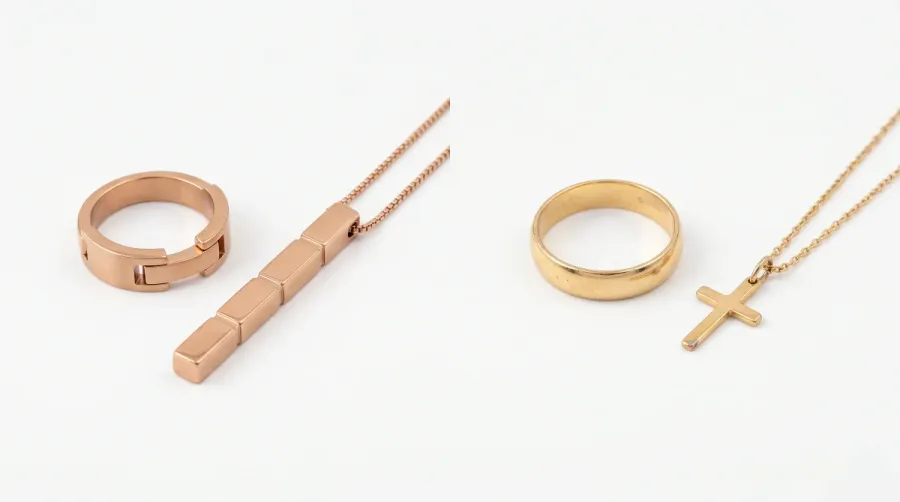
- The piece is intended to last a lifetime: a wedding ring, a christening locket, a family heirloom
- You want something that can genuinely be passed down
- Budget allows, and you see jewellery as a store of value
- The material value of the metal matters to you
PVD in Watches vs PVD in Jewellery
It is worth noting that PVD behaves differently depending on application. A watch case takes impacts against doors, desks, seat buckles, and steering wheels throughout the day. The coating on a watch case is under far greater mechanical stress than a pendant hanging at the collar or a ring worn on a finger.
PVD watch cases in intensive daily use typically show wear after five to ten years, concentrated at the points of highest contact: the caseback, the bracelet links, the crown.
PVD on jewellery, where abrasion is lower and impacts are fewer, tends to last longer in proportional terms. A pendant may hold its finish for the full five-year expected service life without visible wear.
Rings occupy a middle position. Fingers come into contact with surfaces all day: keyboards, door handles, metal surfaces. A PVD ring worn daily will show gradual dulling at the highest-contact points, typically the outer face, after three to seven years. Worn carefully, it will last longer.
A bracelet at the wrist behaves more like a watch: friction against cuffs, knocks against surfaces. Expected service life of four to eight years, depending on lifestyle.
Earrings and Pendants: The Low-Wear End
Earrings and pendants represent the most forgiving category for PVD. A pendant at the collar is in contact only with fabric or bare skin, both of which are far less abrasive than keyboard surfaces or door handles. The principal wear mechanism is the neckline of a shirt or a jacket collar rubbing the bail of the pendant over time.
In practice, a pendant with PVD coating can retain its original finish for well over five years if stored correctly between uses. The clasp mechanism of an earring, where metal contacts metal repeatedly, may show wear before the visible surface does, though this applies to any coating technology. For necklaces, the most vulnerable point is the clasp and the final link before it, where contact pressure concentrates.
Temperature Tolerance and Limits of PVD
PVD coatings are rated for use across a temperature range that comfortably exceeds anything jewellery experiences in normal life. Titanium nitride retains its properties up to approximately 600 degrees Celsius. Diamond-like carbon is somewhat more sensitive to oxidising environments at high temperature, but the threshold at which either coating degrades begins several hundred degrees above what a sauna, a hot shower, or a heated car interior can produce.
The practical limit for jewellery is not high-temperature damage but thermal cycling. Moving frequently between very cold and very hot environments causes the steel substrate and the PVD layer to expand and contract at slightly different rates. Over decades of such cycling, this can contribute to micro-cracking at the coating boundary, though this is rarely a practical concern within the five-to-ten-year service window of a PVD jewellery piece.
What this means in practice: you can wear PVD jewellery in a sauna or a steam room without chemical risk, though prolonged exposure to high-humidity heat and eucalyptus oils is best kept short. It is not the temperature that poses a risk but the combination of humidity and mineral content in steam that can accelerate surface dulling.
Electroplated jewellery by contrast has no meaningful temperature tolerance; the gold layer can begin to loosen from a brass base at temperatures far below those in a sauna, because the brass expands faster than the thin gold film.
Where PVD Is Used Today
Watches. Black PVD on steel cases is the standard for professional, military, and sports watch specifications. The finish holds for decades in normal use without the colour shift that affects painted or lacquered surfaces.
Jewellery. Rose gold and yellow gold on steel, produced by PVD, is the foundation of the accessible premium segment. Independent workshops working with steel bases use PVD extensively.
Industrial tooling. Drill bits, milling cutters, and precision instruments. The gold-coloured coating on professional tools is titanium nitride PVD.
Cookware. Certain high-performance cookware uses PVD-related hard coatings for their extreme abrasion resistance, a property that transfers directly from the tooling industry.
Medical and surgical instruments. Titanium nitride PVD is used on surgical cutting tools and implant components because of its hardness and biocompatibility.
If a seller does not state the coating technology on the product page, electroplating is the more likely explanation. Manufacturers who use PVD tend to say so.
Types of PVD Process
PVD is an umbrella term covering several specific techniques.
Magnetron sputtering. The most common in jewellery. Ions bombard the target material, freeing atoms that travel to the blank surface. Produces an even, stable layer. Standard in professional watch production for PVD cases.
Arc evaporation. An electric arc vaporises the target. A more aggressive process that produces very high adhesion coatings. Used in industrial tooling and premium jewellery applications.
Thermal evaporation. The simplest and oldest method. The target is heated to vaporisation point. Less common in jewellery today.
Ion plating (IP). A hybrid process combining evaporation with pre-deposition ion bombardment of the surface. "IP Gold" on product tags is almost always this. Technically a subcategory of PVD.
For the end buyer, the difference between these processes is rarely visible in the finished piece. Brand reputation and guarantee terms are more useful guides than the specific process name.
The History of PVD: From Aerospace to the High Street
PVD was developed during the mid-twentieth century for aerospace and defence applications. Turbine blades, engine nozzles, and structural components required coatings that conventional processes could not provide.
During the 1960s and 1970s, the technology moved into civilian manufacturing. Chromium-look finishes on automotive parts, and the gold-coloured titanium nitride coating on professional cutting tools, are both products of this transition.
The watch industry adopted PVD during the 1980s. Early black-case professional watches, made to military and aviation specifications, were among the first commercial consumer products to feature it.
Mass-market jewellery access followed after 2005, when equipment costs dropped sufficiently to make mid-range production viable. PVD in jewellery is now an established standard, not an emerging technology.
Environmental Considerations
Electroplating uses solutions containing cyanides, acids, and heavy metal salts. The process generates contaminated wastewater. At poorly managed facilities, discharge into the environment remains a documented problem, and occupational health risks for workers are higher.
PVD operates inside a sealed vacuum chamber. No liquid chemicals are involved, and there is no wastewater. The process is energy-intensive, requiring vacuum pumps and high-voltage power supplies, but its environmental footprint from chemical contamination is significantly lower.
The energy cost of PVD is higher per unit than basic electroplating, but the longer service life of PVD jewellery means fewer pieces produced and discarded over a given period, which partially offsets this.
Where two pieces are otherwise equal, PVD is the cleaner process.
What Happens at End of Life
Electroplated jewellery on brass presents a recycling challenge: gold recovery from thin flash-plated brass is rarely economically viable at small scale, so the piece is typically landfilled. The contaminated plating bath solutions must be treated as hazardous waste.
Stainless steel with PVD is a more recyclable proposition. Steel is one of the most recycled materials on earth, and the PVD coating, at one to three microns, represents a negligible contamination of the steel's mass. Scrap processors accept 316L stainless steel routinely. The end-of-life picture for PVD jewellery is therefore cleaner than for electroplated brass, both in terms of what goes into landfill and in terms of what can be recovered.
How to Care for PVD Jewellery
Basic precautions extend service life:
- Remove before showering. Steam and cleaning products accelerate wear.
- Apply fragrance and skincare before putting the piece on, not after.
- Store in a soft pouch or a lined compartment to minimise contact scratches.
- Clean only with a soft cloth or mild soap and water. No abrasives.
- Remove before intense physical activity involving impact or heavy perspiration.
PVD is more tolerant than electroplated jewellery, but the coating is finite. Treating it with some care adds years to its service life.
How to Care for Electroplated Jewellery
The rules are stricter:
- Remove before any water contact: washing hands, showering, swimming.
- Apply perfume, hairspray, and skincare products before wearing the piece, never after.
- Store in a dedicated soft compartment, separated from other pieces.
- Clean with a dry, soft cloth only. No liquids, no cleaning agents.
- Do not use ultrasonic cleaners, which can loosen the plating at its edges.
Following these rules can extend the life of a well-plated piece to two or three years. Ignoring them will reduce that to weeks.
Frequently Asked Questions
Can I shower or swim with PVD jewellery?
Occasional contact with fresh water is not a problem. Prolonged exposure to chlorinated pool water or seawater is not recommended. For regular swimming, remove the piece beforehand.
Does PVD wear away from friction?
Slowly, yes. A pendant that rubs against a knit fabric at the neckline may show reduced lustre after three to five years at that specific contact point. Electroplated gold will show the same wear in weeks or months.
What does "18K PVD gold" mean?
It means the target material used in the vacuum chamber was 18-carat gold. The deposited coating contains gold of that purity. The base of the piece remains steel; the coating itself is 18-carat gold.
How does PVD differ from IP (ion plating)?
Ion plating is a subcategory of PVD. The distinction between terms is sometimes a matter of marketing rather than process. Both refer to vacuum deposition with strong adhesion.
Can I wear PVD jewellery with fragrance?
Yes, but apply fragrance before putting the piece on. Prolonged direct contact between alcohol and the coating surface is best avoided over the long term. The same recommendation applies to any fine jewellery.
Is there any risk of allergic reaction to PVD?
Rarely. The PVD layer itself is biologically inert. If a reaction occurs, the cause is usually in the base material becoming exposed through coating damage.
Can an existing piece be re-coated with PVD?
Technically yes. In practice, most jewellery workshops do not have PVD equipment, and the cost of specialist industrial re-coating often exceeds the value of the piece. Purpose-made replacement is usually more practical.
Does PVD turn dark over time?
A well-applied PVD coating does not discolour. If a piece darkens quickly, the cause is usually inadequate coating quality. Genuine PVD, correctly applied, is stable in colour for years.
What does Zevira use: PVD or electroplating?
We use PVD coating on 316L stainless steel for our everyday collections, where durability and gold appearance at an accessible price point are the priorities. For bespoke and bridal pieces, we work in solid 925 silver or gold. Every product page specifies the exact material.
Does PVD scratch?
PVD is harder than the metals it coats, which means it resists surface scratches far better than electroplated finishes. A steel tool or a sharp key will not mark it easily. However, an abrasive surface, such as concrete, sandpaper, or rough stone, will eventually abrade it. The practical durability for jewellery in normal use is high.
Is PVD safe for piercings?
Implant-grade titanium with a PVD finish is used in some body jewellery for precisely this reason: the base metal is biocompatible and the coating is inert. For healed piercings, PVD stainless steel is generally considered acceptable, though titanium is preferable for fresh piercings. Always check with a professional piercer for new or sensitive piercings.
Why does PVD gold look slightly different from real gold?
The colour in PVD comes from titanium nitride or zirconium nitride, compounds whose optical properties produce a warm, saturated yellow. Real gold reflects in a somewhat less saturated, cooler tone by comparison. The difference is subtle enough that most people cannot identify it by sight alone when the piece is worn, but side-by-side with an 18-carat solid piece it becomes apparent. If exact colour matching to solid gold is a priority, high-quality vermeil electroplating is closer; if durability is the priority, PVD wins clearly.
Can PVD jewellery be worn in a sauna?
Short visits are not harmful to the coating itself. The titanium nitride or DLC surface is stable at sauna temperatures. The concern with saunas is prolonged exposure to high humidity and heat cycling, which can accelerate very gradual surface dulling. Occasional sauna use is unlikely to produce visible effects within the normal service life of the piece. It is nonetheless advisable to remove jewellery in saunas and steam rooms as a general practice, regardless of coating type.
Does the PVD colour fade uniformly or in patches?
PVD fades gradually and uniformly through abrasion rather than peeling or spotting, because the bond with the base is chemical rather than mechanical. The areas that contact surfaces most often dull first. There are no sudden patches of exposed base metal the way electroplated jewellery shows when the film breaks. The transition is gradual, from full lustre to a softer sheen, which is the main visual sign that a piece is approaching the end of its expected service life.
Conclusion
PVD is an industrial process adapted for jewellery, and it changed the accessible end of the market significantly over the past fifteen years. It is not solid gold, but it is also not the thin film of electroplated jewellery that fades in months. For daily wear at a reasonable outlay, PVD offers a durability that conventional plating cannot match.
If you are choosing between budget electroplated jewellery and a PVD piece at a similar appearance, PVD is almost always the more considered decision. If you are comparing PVD with solid gold, that is a question of purpose: everyday wearability versus a piece made to outlast you.
Silver, gold, wedding rings, symbol jewellery, and matching sets.
About Zevira
Zevira makes jewellery by hand in Albacete, Spain. PVD coating is used in our everyday collections, where durability and gold appearance at a fair price are the priorities. Bespoke and wedding pieces are made in solid 925 silver or gold.
What you will find:
- Everyday rings and bracelets with gold-tone PVD finish
- PVD in black and rose gold tones
- Solid 925 silver as a longer-lasting alternative
- 14 and 18-carat gold for wedding and bespoke work
- Clear material specification on every product page
Each piece is made by hand, with personalised engraving available.