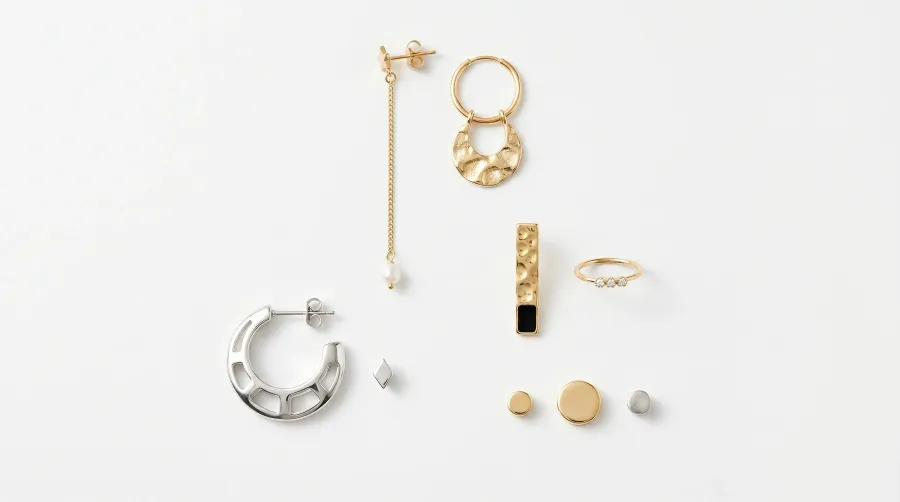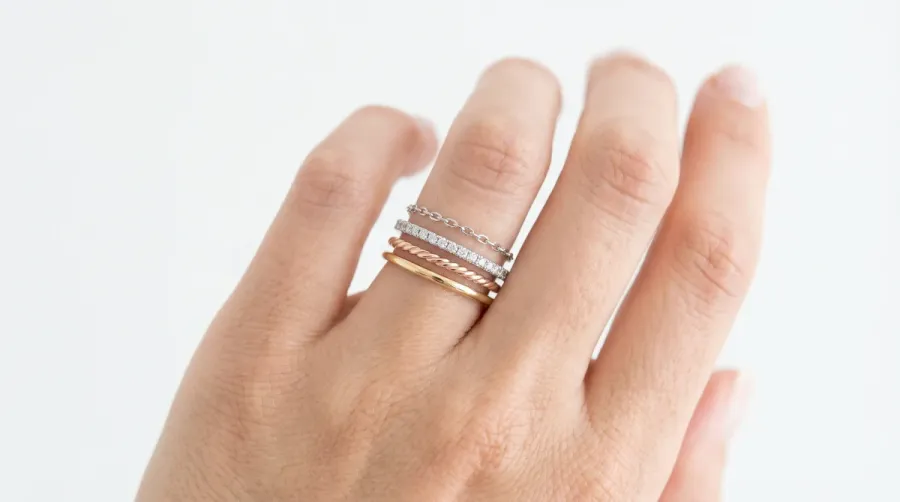
Ring Stacking Guide: How to Wear Multiple Rings on One Finger
Introduction: thin rings that work together
One bold ring makes a statement. Three slender rings on a single finger say something else entirely -- something more layered, more personal, more considered. That is ring stacking, and it has been going strong since the 2010s for a simple reason: the idea is too good to fade.
Stacking is about a collection, not a single piece. Each ring carries a moment: a first promotion, a wedding anniversary, the birth of a child, a journey that changed something. Worn together they become a visual diary on your hand -- and a rather beautiful one at that.
This guide covers how to build a stack from scratch, which combinations work, which mistakes to avoid, and how the tradition fits into British jewellery culture, where layering rings has its own quiet history going back to at least the Tudor period.

A brief history: stacking is older than you think
The idea of wearing several rings on a single finger is not a trend invented by social media. In Britain it has roots that run several centuries deep.
Tudor posy rings and keeper rings
In Tudor England the practice of wearing multiple rings on a single finger was common among those who could afford it. Posy rings -- bands engraved on the inside with short lines of verse or devotion -- were exchanged as wedding and love tokens from at least the fifteenth century. A husband might give a plain gold wedding band and a posy ring together, worn one above the other. The outer ring was visible to the world; the words inside were only for the wearer.
By the seventeenth century, the keeper ring had become established practice: a plain band worn either side of the wedding ring to protect it from slipping and from wear. The keeper ring was functional first and aesthetic second, but it created the habit of multiple rings on one finger long before anyone called it stacking.
Victorian eternity rings and the anniversary tradition
The Victorian era formalised a pattern that would become the template for modern stacking. After the birth of a first child, a husband would present an eternity ring -- a band set with stones all the way around, symbolising unending affection. This sat alongside the wedding band and, if there was one, an engagement ring.
By the late nineteenth century it was common for a British woman of middling or higher means to wear three rings on her ring finger: the engagement ring with its stone, the plain wedding band, and the eternity ring from the first significant anniversary or birth. That three-ring arrangement is what the stacking movement of the 2010s rediscovered and democratised.
The single solitaire engagement tradition
The British engagement ring tradition settled, by the Edwardian and inter-war period, on the single solitaire: one stone, one band, clean and legible. The restraint of the engagement ring meant the wedding band beside it needed no competition. Adding an eternity ring later introduced a third element without overloading the hand. This logic -- each ring earns its place by marking something specific -- is the same logic behind a considered modern stack.
Ancient foundations
Long before the Victorian era, multiple rings on a single finger carried meaning. In ancient Rome it was common to wear two or three rings on the same finger, each serving a distinct purpose: a seal ring for documents, a vow ring for a deity, a status ring signalling civic rank. These were not decorative whims. Each ring had a defined function, and wearing them together created a visible record of who a person was and what they had sworn or achieved.
This same logic sits at the heart of the modern stack: not excess, but accumulated meaning.
What is ring stacking
Technically speaking, ring stacking means wearing several rings on one finger -- usually slender bands between 1 and 3 mm wide, often in contrasting designs.
The four principles that define a true stack:
- Thin bands (multiple thick rings simply cannot sit together comfortably)
- One finger as the focal point (usually the ring finger, middle finger, or occasionally the index)
- Varied design (four identical gold bands is not a stack -- it is four identical gold bands)
- Built over time (a stack is accumulated, not purchased in one afternoon)
Building blocks of a stack
Several ring types play well together in a stack.
Plain polished bands
The backbone of any stack. A simple gold or silver band, sometimes with fine milgrain edging or a brushed finish. Unpretentious and essential.
A classic British approach pairs two or three bands in different metals -- yellow gold, white gold, sterling silver -- all of the same width. The contrast is subtle but intentional.
Rings set with small stones
A slender band carrying a single stone (a diamond, a sapphire, a garnet) or a continuous row of small diamonds all the way round -- what jewellers have long called an eternity ring. In the British tradition the eternity ring is given to mark the birth of a first child or a significant anniversary, and it sits naturally beside a wedding band.
Twisted and rope bands
Bands twisted into a rope or wave pattern. They introduce texture without needing a stone, and they hold their own between two plain bands.
Open rings
Bands with a deliberate gap -- the ends do not meet. One open ring in a stack introduces an element of asymmetry that keeps the eye moving.
Engraved bands
Bands carrying dates, initials, short words or symbols. Couples and families have used engraved rings in Britain for centuries. A date band sitting next to a plain wedding ring or a symbolic ring needs no explanation.
Botanical bands
Slender bands shaped as branches, leaves or small flowers. Common in Arts and Crafts jewellery from the late nineteenth and early twentieth centuries, and just as wearable now.
Accent rings
Thin bands with one deliberate focal element -- a small sphere, a star, a single raised stone. One accent ring anchors the eye within a stack of plainer bands.
Ring profiles: details that matter in a stack
Beyond a ring's decorative design, the cross-section of the band affects how rings sit beside one another and how comfortably they are worn all day.
Flat band: a rectangular cross-section with straight edges. Rings with flat profiles sit flush against each other -- the stack reads as precise and architectural. A good choice for the foundation ring and for rings that need to sit in close, even contact.
Domed band: slightly convex on the outer face. A softer, more traditional silhouette. Adjacent rings angle slightly away from the dome, which means a domed band in the middle of a stack gives a gentle layered separation.
Comfort fit: the inner surface is rounded rather than flat. Less pressure against the finger, particularly important for the bottom ring in a stack, which bears the weight of everything above it. Worth specifying when ordering if you plan to wear the ring daily for years.
Pavé set: the outer surface is covered with small stones set closely together. One pavé band in a stack introduces continuous sparkle without a single large stone. It does need more care -- softer prongs, more vulnerable to impact from neighbouring rings.
Eternity band: stones all the way around, no gap. The same as pavé in construction, different in name and tradition. A single eternity band in a stack of plain bands is one of the cleanest combinations there is.
How to build your first stack
A step-by-step approach keeps a stack from looking assembled rather than accumulated.
Step 1: Choose your finger.
- Ring finger (if you do not wear a wedding band there) -- the natural choice
- Middle finger -- more generous in width, holds more rings comfortably
- Index finger -- less common, works particularly well for a two-ring stack
Step 2: The foundation ring. Buy one plain, well-made band in your preferred metal. This is the ring everything else grows around. Do not economise here -- this ring will be worn every day and carry the weight of the whole stack.
Step 3: The contrast ring. A few weeks or months later, add a second ring that differs from the first. If the first is a smooth silver band, the second might be a yellow gold band with a small stone.
Step 4: The textural ring. When the time feels right, add a third ring that introduces texture -- a twisted band, an open ring, or a botanical design.
Step 5: Adjust. If the stack feels crowded or uncomfortable, remove one ring. A stack should not be a chore to wear.
From that point, add rings one at a time, when the occasion arises. Five to seven rings on a single finger tends to be the practical upper limit -- beyond that, it reads as excess rather than intention.
Finger by finger: which rings go where
Not every finger suits a stack equally. Each has its own character and limitations.
The ring finger is the most natural starting point, particularly if you do not already wear a wedding band there. On the right hand it is free from formal associations and suits a personal stack of any style. On the left hand it becomes the home of the classic bridal stack: engagement ring, wedding band, eternity ring -- each added at its moment.
The middle finger is the widest of the four fingers and comfortably holds five or six rings. It has no inherited jewellery tradition in Britain, which makes it an open canvas. A stack here reads as deliberate and personal.
The index finger is the least conventional choice for a stack. Two rings work well there, particularly in a more distinctive aesthetic. The index finger moves more than the others and rings on it get more attention, for better or worse.
The little finger has its own history in Britain -- the signet ring worn on the little finger was a mark of family, rank and affiliation for centuries. A small stack of two plain bands on the little finger is a quiet modern continuation of that tradition.
The thumb is large and holds wider bands easily. Stacking on the thumb is rare, but two or three flat bands together on a thumb create an understated, confident effect.
A practical note: carrying a full stack on one hand alongside a watch or bracelet is possible but busy. Many people find it easier to keep the stack hand and the watch hand separate.
The anchor ring concept
Every considered stack has an anchor ring -- the ring that everything else is chosen to complement. It is not always the first ring acquired, but it is the one that sets the terms.
The anchor ring determines:
Metal direction: if the anchor is silver, the surrounding rings work best in cooler tones -- silver, white gold, occasionally rose gold as a bridge. If the anchor is yellow gold, warmer tones follow naturally.
Width and weight: an anchor ring can be slightly wider than its neighbours (2 to 3 mm against 1 to 1.5 mm for the flanking bands). This creates a visual centrepoint without the anchor needing to be the most elaborate ring.
Decorative register: an anchor ring with a prominent stone calls for plainer neighbours. An anchor ring that is itself plain allows more freedom on either side.
Good candidates for the anchor role include a wedding or engagement ring, a ring with particular personal significance, an eternity ring, or any ring with a distinctive design.
Without an anchor, a stack risks looking random -- a collection of rings rather than a considered composition.
Mixing metals in a stack
Mixed metals in a single stack are well-established practice, but there is a logic to doing it well rather than accidentally.
Single metal: the simplest approach, and always coherent. All yellow gold, all silver, all rose gold. Easy to add to because any new ring in the same metal fits automatically.
Yellow gold and silver: the warm-cool contrast works naturally. The combination reads as intentional when the bands are of similar width. Alternating them -- gold, silver, gold -- creates more visual rhythm than grouping one metal at the bottom and another at the top.
Rose gold as the connecting element: rose gold sits comfortably between yellow gold and white gold or silver. If a stack has grown to include both warm and cool metals and feels disjointed, a rose gold band between them often resolves the tension.
Three metals: yellow, white and rose gold together. This combination has deep roots in the triple-band wedding ring tradition of central and eastern Europe, where three interlinked bands of different golds were used to symbolise different aspects of a union. In a modern stack it works well at narrow widths (1 to 2 mm per band).
Mixing widths and textures
Metal colour is the first layer of variety in a stack. Width and texture are the second, and they matter just as much.
The texture contrast rule: a smooth band alongside a twisted band alongside a milgrain band. Three different surfaces create rhythm without chaos. Three identical smooth bands in a row have neither rhythm nor interest.
The width principle: one slightly wider anchor band flanked by narrower rings reads as structured. All bands the same width reads as uniform, which can work beautifully or can look monotonous depending on the decorative variation elsewhere.
One statement element: only one ring in a stack should have a genuinely prominent element -- a large stone, a bold motif, a high raised element. Two statement rings competing in the same stack cancel each other out.
Texture against stone: a pavé band next to a matte plain band is one of the most effective combinations in a stack. The matt surface makes the stones read brighter; the stones make the matt surface read calmer.
Stacking with a wedding band
If you already wear a wedding band, stacking works within that constraint rather than against it.
Wedding band with keeper rings
A plain wedding band is traditionally protected by keeper rings -- thin bands worn either side that hold the wedding ring in place and prevent it wearing against itself. This is a practical British tradition that became an aesthetic one: two or three keeper rings form a natural small stack.
The engagement, wedding and eternity trio
The classic three-ring British bridal stack: an engagement ring (usually set with a stone), a plain wedding band, and an eternity ring added after a significant anniversary or the birth of a child. The three together have a coherence that any individual ring alone lacks. This combination has been worn by British women in various forms since at least the Victorian period.
Stacking without a wedding band
If you do not wear a wedding band -- by choice or circumstance -- a personal stack gives the same visual weight and the same sense of accumulation, without the formal context of marriage. Each ring marks something that mattered.
Wearing by occasion: every day versus a special event
A stack does not have to be the same every day. Varying it by context is practical and worth doing.
Work (restrained): two or three rings, no large elements, no open bands (they catch on fabrics and paper). Two plain bands and one with a small stone is a good working combination.
Everyday: the full stack of four to five rings. An open or twisted band can be included.
An occasion (bold): the full stack plus one accent ring with a more prominent element. Worn on one finger, with the remaining fingers plain.
This is particularly useful for anyone who works with their hands: the simpler combination goes on in the morning and the full stack is assembled in the evening. The same principle applies to earrings -- a guide to asymmetric earrings covers how to vary those by occasion too.
Balancing statement rings and plain bands
A stack of only thin plain bands looks refined but lacks a focal point. The eye moves across the rings without settling. One ring with more presence changes the whole reading of the hand.
A statement ring in a stack carries a larger stone, a wider band, significant decorative work, or an unusual form. The rule is one statement ring per stack. Two competing statement rings lose their individual weight.
Where to place the statement ring:
In the centre of the stack -- the statement ring divides the plainer bands on either side, which bracket and frame it. This works particularly well for engagement rings or any ring with a prominent stone.
At the base of the stack -- the statement ring as foundation, with lighter bands above. Common in bridal stacks where the engagement ring sits lowest.
At the top -- less common but effective when the statement element is best seen against the knuckle.
One thing that rarely works: a very tall ring placed directly above several very low plain bands, with a large height difference between them. The stack reads as accidental rather than chosen.
Ring sizing in a stack
All rings in a stack should be sized for the same hand, but position on the finger affects comfort.
A ring worn lower on the finger (near the palm) slips on and off easily. A ring worn higher must pass over the knuckle.
The practical rule: the bottom ring in a stack should fit the finger precisely. Rings above it can be half a size larger -- this allows them to layer without gripping one another. If all rings sit tightly and correctly sized, that also works, but the half-size approach is more forgiving.
On proportion: slender fingers carry five or six rings at 1 to 1.5 mm width very well -- there is finger to show between the stack and the hand. On a fuller finger, two or three slightly wider rings (2 to 3 mm) tend to read better than many very narrow ones, which can create a horizontal striping effect rather than a considered composition.
Swelling: fingers swell in warm weather, on long flights, and in the evening. The foundation ring of a stack should be sized for the widest typical state of the finger, not the narrowest. A ring that fits perfectly in the morning but will not come off by evening is a problem waiting to happen.
Stack aesthetics
The minimal British stack
Three to five plain bands, all in the same metal or in two metals (yellow gold and white gold is a classic pairing). No large stones, no elaborate shapes. It reads as quietly confident, suitable for the office or any formal setting.
The heirloom stack
A plain wedding band, an eternity ring given at a meaningful moment, one or two inherited or antique bands. Each ring has a provenance. This is the British jewellery tradition at its most straightforward: pieces that outlast fashion because they carry history.
The Arts and Crafts stack
Botanical bands, open rings, bands set with cabochon stones (moonstones, opals, garnets) in a mixed-metal arrangement. Draws on the British Arts and Crafts movement of the late nineteenth century, which rejected industrial uniformity in favour of handmade, nature-inspired design.
The contemporary stack
Bands in mixed widths and finishes -- some polished, some brushed, one or two set with small stones. No strict rule on metal colour. The stack is deliberately personal rather than coordinated.
The men's stack
Two or three heavier bands, often in sterling silver, occasionally with an engraved or textured finish. In Britain men have worn signet rings alongside plain bands for generations; extending that to a deliberate small stack is a natural continuation.
Rings with meaning: a personal record on the hand
The most compelling stacks are the ones where each ring has a specific origin.
Engagement ring, wedding band, ring from a first significant journey together. Three rings, three moments. Legible to the wearer; private to everyone else.
A grandmother's band, your own first ring, a ring from your mother. Three generations worn together. No amount of money can assemble this stack -- it already exists in the family and needs only to be gathered.
Annual self-gifts: one ring per year to mark something worth marking -- a move, a professional achievement, a difficult year survived. In a decade the hand carries a decade's history.
Rings for each child: a slender band after each birth, with a birthstone or an engraved date. Worn together, they form a quiet record of the family.
Caring for a stack
Several rings in daily contact with one another will wear against each other over time. This is normal and manageable with a small amount of attention.
Daily: remove the stack at night. If you wear rings in different metals, store them not pressed tightly together; different metals in prolonged contact can leave marks on one another.
Every few months: a light polish with a soft cloth. Silver tarnishes more readily than gold and benefits most from regular attention. A specialist silver cloth takes five minutes and makes a noticeable difference.
Once a year: professional cleaning from a jeweller. Important particularly for rings with set stones -- the prongs or bezel settings can loosen with wear. Better to catch a loose setting at a service than to lose a stone.
Rings with softer stones (opal, moonstone, turquoise) should be removed before contact with household chemicals -- washing up liquid, bleach, perfume applied directly. The stones are porous and absorb chemicals that dull or damage them over time.
Rings with enamel or oxidised finishes should not be cleaned in an ultrasonic machine. A damp soft cloth only.
Metal hardness and wear
Gold at 18 carat is softer than gold at 14 carat, because it contains more of the precious metal and less of the harder alloyed metals. Sterling silver is softer still. When harder and softer metals are worn in contact daily, the softer metal shows wear first.
For a heavily worn daily stack, 14-carat gold holds its polish better than 18-carat. Sterling silver next to gold will need more frequent polishing. This is not a reason to avoid mixing metals -- just something to be aware of when planning maintenance.
Pavé-set prongs are the most vulnerable part of any ring in a stack. An adjacent ring can catch on an exposed prong and bend it. The solution is to keep pavé bands at one end of the stack rather than sandwiched between other active rings, or to choose bezel-set stones which are fully enclosed in metal and significantly more resistant to damage.
Storing a stack
Several thin rings stored loosely together will scratch each other and tangle.
A jewellery roll with individual slots: each ring in its own compartment. Compact for travel, keeps rings from touching. The best option for anyone who travels with their stack.
A ring cushion or bar: rings are threaded onto a soft cylinder or bar in the order they are worn. Useful for keeping the stack in sequence and storing it on a dressing table.
A shallow divided tray: each ring in its own section. Simple and effective for everyday storage.
What to avoid: a general dish or bowl where rings sit in a pile (inevitable scratching), small zip-lock bags without padding (rings knock against each other and chip enamel or damage softer stones), humid storage (silver tarnishes significantly faster in a humid environment).
Stack by season and occasion
A stack is not a fixed object. Varying what you wear according to the time of year and the event makes the practice more interesting and more practical.
Autumn and winter are the seasons for cooler metals and deeper stones. White gold and sterling silver work particularly well against the dark palette of coats and heavier fabrics. Fingers are slightly slimmer in cold weather, which means rings that fit perfectly in summer may sit a little loose from October onwards. This is worth factoring in when choosing the foundation ring. Garnet, deep sapphire and dark amethyst stones read well in winter stacks.
Spring and summer shift the balance toward warmer metals and lighter stones. Yellow gold, which can appear heavy against winter clothing, comes into its own from March onwards. Botanical band designs, open rings, and pale stones -- peridot, aquamarine, pale pink quartz -- suit the longer light. In summer a lighter stack of two or three rings often serves better than the full arrangement; the contrast of metal against tanned skin already does a lot of the visual work.
For swimming, saltwater and chlorine both damage softer stones and open prong settings. Remove rings with porous stones (opal, moonstone, turquoise) and anything with exposed prong settings before going in the water.
Engraving in a stack
An engraved ring does something that no decorative element can replicate: it holds a private meaning that is entirely invisible to anyone who does not know what they are looking at. In a stack, one engraved band adds a dimension that cannot be seen from the outside.
What people engrave most often: a date, a set of initials, a short word or phrase, coordinates of a place, a simple symbol. The inside of a ring band is the most common location -- the text is against the skin, hidden from view, known only to the wearer.
Practical considerations: on a 1 mm band, engraving is limited to very small symbols or a very short sequence of characters. On a 2 mm band, ten to fifteen characters are typical. On a 3 mm band there is more room. Micro-engraving can fit longer text into narrower bands, but it requires magnification to read.
One engraved ring in a stack of five is a considered choice. Five engraved rings in one stack is usually too much -- the cumulative meaning becomes noise rather than signal.
Heirloom rings in a stack
When an inherited ring joins a stack, the whole logic of the arrangement shifts. An inherited ring almost always becomes the anchor, and the newer rings are chosen to work around it rather than alongside it as equals.
Whether to bring an inherited ring into active daily wear is a real question. A ring kept in a box is preserved but unused. A ring worn every day is subject to wear but fulfills its purpose as an object made to be worn. The honest answer is that most well-made rings from the nineteenth and early twentieth centuries were built to last, and most of them can handle daily wear with reasonable care.
The practical threshold: if the ring fits or can be resized without altering its design, and if the construction is sound enough for daily contact with neighbouring rings, wearing it is the right choice. If the setting is fragile or if the ring is so visually singular that nothing sits well beside it, it may work better worn alone.
Choosing new rings for a stack that includes an heirloom means choosing to complement rather than compete. A plain new band next to an ornate inherited ring gives the older piece room to be seen. A new eternity ring next to a Victorian engraved band is a conversation between periods rather than a competition between them.
The meaning behind the stack
Stacking works because it turns jewellery into a private record. Looked at honestly, a ring bought on impulse and worn without thought adds nothing meaningful to a stack. A ring given on a specific occasion, or chosen to mark a moment, adds something that compounds over time.
This is why the practice suits particular moments in life:
- A significant birthday, when one ring marks the decade
- After a major change -- a new chapter that deserves a visible note
- Annual purchases, one ring per year, so that in ten years the hand tells its own story
- Gifts between parents and children: some British families have a long tradition of passing thin gold bands down, and a stack is a natural extension of that habit
The stack is the opposite of impulse buying. It rewards patience.
Common stacking mistakes
Buying everything at once. Five rings purchased on a single afternoon and worn together look like a display rather than a history. Build slowly.
No variation in design. Four identical plain bands of the same width and metal is not a stack -- it needs a contrasting element.
No connecting thread. A random collection of unrelated rings looks chaotic. One connecting element -- metal colour, width, a recurring motif -- brings coherence without making the stack feel uniform.
All rings fitted too tightly. Rings that grip every finger simultaneously restrict circulation and cause swelling by evening. The stack should sit comfortably with a small amount of movement.
Too many fingers. Three rings on every finger overwhelms the hand. One or two fingers with a stack, the rest plain or with a single ring.
Ignoring the knuckle. On hands where the knuckle is notably wider than the base of the finger, thin rings slide and spin. A snug-fitting base ring prevents this; some rings include a small inner spring for exactly this reason.
Pavé bands next to sharp-edged or spiked rings. The prongs of pavé settings can be damaged by contact with textured or spiked neighbouring rings. Keep the two types separated in the stack, or choose bezel-set stones (fully enclosed) if the stack includes rougher-edged pieces.
An under-considered foundation ring. The foundation ring is worn every day and carries the weight of the stack. A cheap or poorly fitted foundation ring undermines everything above it, regardless of how good the other rings are.
Frequently asked questions
Can you mix metals in a stack?
Yes. Mixed metals -- yellow gold, white gold, sterling silver -- are entirely accepted practice, and have been for some time in British jewellery. The combination looks intentional rather than accidental if the widths of the bands are consistent.
How many rings is too many?
Five to seven on a single finger is a practical upper limit. Beyond seven the hand begins to look overloaded and wearing becomes genuinely uncomfortable. On slender fingers the upper end of that range is achievable; on fuller fingers, fewer and slightly wider rings tend to read better.
How do you care for a stack?
Remove the stack at night. Store the rings together on a small ring cushion or in a shallow tray. Clean sterling silver periodically with a soft cloth; gold requires very little. If rings are set with softer stones (opals, moonstones), avoid contact with household chemicals. Have set stones checked by a jeweller once a year.
Does stacking suit smaller hands?
Yes, provided the bands are narrow -- 1 to 1.5 mm. Wider bands scale poorly on smaller fingers and the stack becomes visually heavy rather than layered.
Is a stacked ring appropriate for formal or professional settings?
It depends on the environment. In a creative or informal workplace, a full stack is entirely appropriate. In a traditional professional setting -- law, finance, certain medical roles -- two or three plain bands sit better than a more elaborate arrangement.
Which ring makes the best foundation for a stack?
A plain polished band or a slender eternity ring with very small stones. Both are neutral enough to support almost any subsequent addition. A comfort-fit profile on the inner surface makes the foundation ring more comfortable to wear under the weight of the rings above it.
What combinations are best avoided?
Very heavy rings in the lowest position add disproportionate pressure to the finger when other rings are stacked above. Rings with sharp decorative spikes worn directly against pavé-set stones risk damaging the prongs. Rings with thin enamel work worn against heavily textured metal will see the enamel abraded over time.
Does stacking damage nail varnish?
No. If anything, many people find that a minimal or neutral manicure suits a stack better than an elaborate one, because the hand is already making a statement.
Is stacking only for women?
It began as a predominantly female practice, but men's stacking is well-established now. Men's stacks tend to be more restrained -- two or three heavier bands, sometimes with an engraved element.
What is the anchor ring and why does it matter?
The anchor ring is the visual centre of a stack, the ring that sets the tone for everything else. Identifying which ring plays this role -- and choosing the surrounding rings to complement it rather than compete -- is the difference between a stack that reads as considered and one that reads as a collection of rings that happen to be on the same finger.
How often should rings in a stack be cleaned?
Silver rings in a daily stack benefit from a light polish every two to four weeks. Gold needs much less, every month or two. A professional clean once a year is worthwhile for any ring with set stones, as it gives a jeweller the chance to check that the settings are sound and catch any wear before it becomes damage.
Can rings of different sizes work in the same stack?
A size difference of half to one full size between rings in a stack is manageable, because rings naturally settle at different heights on the finger. A ring that is a little too large tends to ride up toward the knuckle; one that fits more closely stays near the base. In practice, this can work well -- but it is unpredictable until you try it on your own hand.
Conclusion
A stack built over years says something a single expensive ring cannot. It is slow jewellery in an era of fast everything -- each addition deliberate, each ring earning its place by marking something real.
If you want to begin, buy one plain, well-made band in the metal you actually wear. Wait a few months. Add a second that contrasts with it. Let the rest arrive with the occasions that warrant them. In five years you will have something no catalogue image can replicate.
Silver, gold, wedding bands, symbol rings, paired sets.
About Zevira
Zevira makes jewellery by hand in Albacete, Spain. Our thin bands with flat, even profiles are designed to sit well together -- rings that layer cleanly without fighting for space.
For stacking you will find:
- Plain bands from 1 to 2 mm wide as a foundation
- Bands set with a single small symbol (star, crescent, eye)
- Twisted and braided bands for textural contrast
- Bands carrying one small stone
- Personal engraving for rings that mark a specific occasion
Each piece is made by hand, with the option of engraving. We work in 925 sterling silver and 14 to 18-carat gold.