Spanish Wedding Jewelry: Arras, Rings, Traditions and Bridal Pieces
Introduction: three days of celebration and a box of thirteen coins
A Spanish wedding is not a single event. It unfolds across several occasions: the engagement gathering, the civil registration, the church ceremony, the reception banquet, and the morning-after breakfast that keeps guests together a little longer. Each of these moments has its own atmosphere, its own dress code, and its own jewelry logic.
Thirteen coins the groom presents to the bride in a small casket. Wedding bands worn on the right hand, not the left. A grandmother's brooch pinned to the gown on the morning of the wedding. A mantilla held in place by an ornamental comb. A pendant or heirloom necklace resting at the throat.
This is not simply a collection of beautiful objects. It is a system, and it only makes sense once you understand the rules behind it.
For American couples planning a destination wedding in Spain, for those of Spanish heritage bringing tradition into a ceremony at home, or for anyone drawn to the depth of Iberian bridal culture, this guide covers every element: what to wear, what the arras ceremony means, which regional styles differ, and how to put together a complete bridal jewelry set.
What distinguishes a Spanish wedding from, say, a Tuscan destination wedding or a French chateau ceremony is the density of ritual. The arras are not ornamental. The right-hand ring carries a specific doctrinal meaning. The mantilla connects the bride to a continuous tradition stretching back centuries. Understanding why each piece exists makes the whole ensemble coherent rather than theatrical.
What the bride needs for a Spanish wedding
For the wider context of materials, regions and techniques, see the Spanish jewelry tradition; this guide focuses on the wedding-day set.
The wedding band (alianza)
The central piece. Several things distinguish the Spanish alianza from the Anglo-Saxon bridal jewelry tradition:
- Worn on the right hand, not the left (as in Italy, Germany, Greece and much of continental Europe). The left hand remains for other pieces.
- Often plain without stones: the classical Spanish preference is for a smooth gold band. Diamond-set rings are a modern influence from North America and the United Kingdom.
- Yellow gold 18ct is the dominant choice. White gold and platinum are a contemporary influence.
- Engraving inside: names, the wedding date, a short phrase.
The alianza is chosen early, often months before the wedding, so both bride and groom can wear them during the engagement period if the family follows an older custom of giving the ring at betrothal. In practice, most contemporary couples exchange rings only at the ceremony itself.
A note on width: men's Spanish alianzas tend to run narrower than the American standard. A 4mm to 5mm band is considered refined in Spain. Wider bands have become fashionable but are still considered the newer aesthetic rather than the classical one.
Price range: from mid-market (plain 14ct) to high-end (18ct with diamonds).
Bride's earrings
Three main types:
- Stud earrings (pendientes de botón): round studs with pearl or diamond. The classic choice for the church ceremony.
- Drop earrings (pendientes largos): longer pieces for the reception and banquet, often worn with the mantilla.
- Creole hoops (aros): large gold hoops, especially popular in Andalusia and increasingly worn at evening receptions across all regions.
The practical custom at traditional Spanish weddings is to arrive at the church in studs and change to drops for the reception. The church ceremony demands a certain stillness, and long earrings that swing when the bride turns her head can distract at the altar. By the reception, movement is the point.
Necklace or pendant
Unlike traditions where the necklace is the focal point of the bridal look, Spanish brides frequently wear something more restrained under the mantilla, since the mantilla itself provides the visual focus. Common choices:
- A fine gold chain with a cross (Catholic tradition, worn by the majority of religious brides)
- A family heirloom (grandmother's pearl strand, rethreaded for the occasion)
- A small religious medallion (the Virgin Mary, a crucifix)
If the bride forgoes the mantilla entirely and wears a contemporary veil or no headpiece at all, then a more prominent necklace becomes standard, the same visual logic that operates in most bridal contexts.
Brooch
A defining element of Spanish bridal style that has no real equivalent in American wedding culture. This is often a family heirloom, the so-called "grandmother's brooch." It can be worn:
- On the bodice (as a central accent)
- On a jacket (for winter or evening receptions)
- On the mantilla itself (pinned at the chest or shoulder, which creates a focal point on the lace)
- At the waist (as a focal point on the belt or sash)
The grandmother's brooch is an inherited object, usually mid-to-late 19th century in origin, often a large floral motif in yellow gold set with garnets or pearls. It arrives on the morning of the wedding, often delivered by the grandmother or mother of the bride, and is pinned in place before the procession. In many families this moment is as emotionally significant as the exchange of rings.
Bracelet
Not obligatory, but commonly:
- A single-strand pearl bracelet
- A slim rigid gold bangle (esclava)
- A charm bracelet with family keepsakes
Hair: the peineta comb
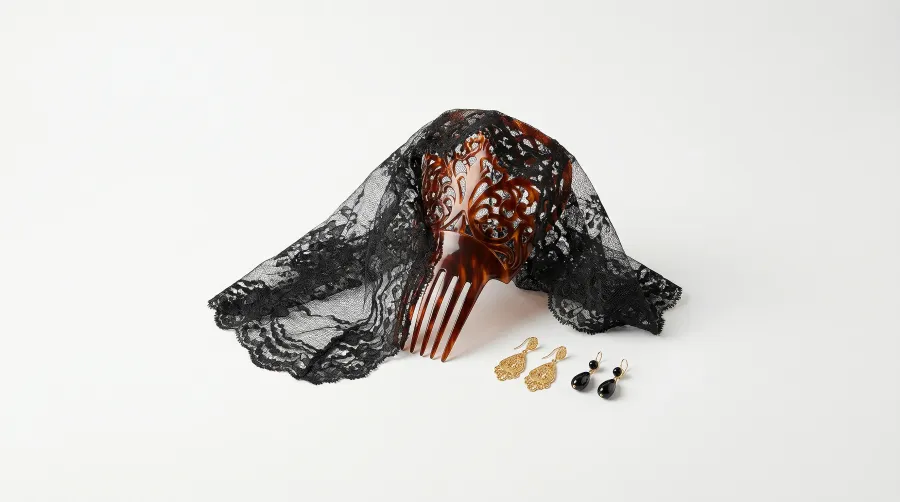
Essential when wearing a mantilla. A large decorative comb, traditionally tortoiseshell, jet, or modern resin, anchors the mantilla to the hair. The peineta is set high at the crown, and the mantilla drapes over it and falls down the back.
In formal Andalusian ceremonies the peineta can be enormous, rising eight or ten inches above the crown. In Madrid the proportions are more restrained. In Catalonia many brides now use a smaller comb purely functional in purpose, with the mantilla or veil chosen for its lace quality rather than its architectural drama.
Tiara or crown
This has grown more popular over the past decade, partly through the influence of high-profile royal weddings. It is not part of classical Spanish tradition, but it is widely accepted today. For American brides incorporating Spanish elements, the tiara tends to be the one addition that reads universally recognizable as "bridal."
Garter brooch (la liga)
The garter is the Spanish equivalent of the "something blue." A blue garter worn beneath the gown, often with a small brooch or charm attached. The charm is sometimes a religious medallion or a small cluster of garnet stones.
The arras de boda
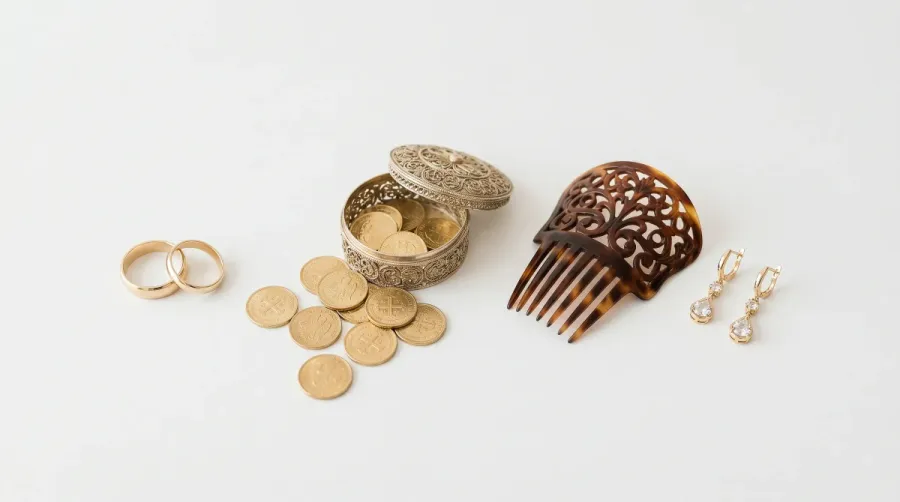
A tradition unique to Spain in its current ceremonial form. Thirteen coins in a decorative casket, which the groom presents to the bride during the ceremony.
What it symbolizes
The thirteen coins represent material provision. Historically, a woman held no property rights, and the thirteen coins were the groom's promise to share everything he had. The modern reading is equal partnership and shared financial responsibility. Some couples now exchange the coins mutually rather than the groom presenting them alone, a deliberate reinterpretation that carries its own symbolic weight.
The exchange happens at a specific moment in the Catholic ceremony, typically after the exchange of rings and before the nuptial blessing. The priest blesses the coins, the groom pours them into the bride's cupped hands, and she returns them to the casket. The coins pass between two sets of hands: this physical act is the point.
Why thirteen
Several theories exist:
- The twelve apostles plus Christ equals thirteen
- Thirteen months in the historical lunar calendar (a minority theory, but one that circulates widely)
- A dozen with one extra, signifying abundance beyond the standard measure
The most widely cited explanation in Catholic ceremony guides is the apostolic one. But the lunar calendar theory is interesting precisely because it suggests the tradition predates Christianity on the Iberian peninsula, which would place it in the ritual practices of Roman or earlier Iberian culture.
The coins themselves
Historically: Spanish escudos, reales, doubloons. These were genuine currency, which meant the arras carried actual purchasing power. Today:
- Decorative coins made for the purpose, not legal tender
- Often personalized with the couple's names, initials or date
- Gold or silver finish, sometimes both in a mixed set
- In some regions, a single coin is later made into a pendant keepsake
The quality of the coins matters less than their story. Families who possess original 18th or 19th century reales often use those for the ceremony, representing a tangible link to ancestors who performed the same exchange. When antique coins are not available, couples commission new coins that replicate the historical designs.
The casket
A special box for presenting and storing the coins:
- Velvet lining inside
- Gold or silver finish outside
- Sometimes engraved with the couple's names and wedding date
- May be a family heirloom passed down from parents
The casket itself has become a significant craft object in Spanish goldsmithing. Contemporary versions range from understated wooden boxes with silver clasps to elaborate goldsmith's work with enamel panels. The most meaningful caskets are the inherited ones, worn and re-engraved with each generation's names added alongside the original.
After the wedding
The coins are kept as a keepsake:
- Stored in the casket as a family archive piece
- One coin made into a pendant
- Passed to godchildren or grandchildren as an inheritance
In some families, the arras casket is placed on a specific shelf in the home and remains visible throughout the marriage, not stored away. The display is intentional: a material reminder of the exchange that opened the marriage.
Regional differences across Spain
One of the least-understood aspects of Spanish wedding culture for Americans approaching it from the outside is how much regional variation exists. Spain is not a monolithic culture but a collection of historically distinct regions with their own languages, patron saints, craft traditions, and aesthetic preferences.
Andalusia
The most ornate tradition and the one that most influences the international image of "Spanish wedding." Large creole hoop earrings, the mantilla is effectively obligatory in traditional families, the peineta is large, dresses feature flounced tiers. The flamenco aesthetic influences even non-flamenco weddings: movement, color, and scale are valued over restraint.
Andalusian bridal jewelry tends toward yellow gold, large pearl earrings, ornate brooches with regional flower motifs (orange blossom, carnation), and the garnet as the signature stone. A Sevillian wedding in a traditional family looks nothing like a contemporary wedding in Barcelona.
Catalonia and Barcelona
More contemporary in character. Modern Catalan design brands are popular, dresses lean toward fashion-forward cuts, and the overall aesthetic is closer to what you might see at a European design-capital wedding. The mantilla is optional and often replaced with a contemporary veil or sheer headpiece. Jewelry choices are more internationally influenced.
Catalan goldsmithing has a distinct history, with the Modernisme movement of the early 20th century leaving lasting influence. Brooches with cloisonné enamel and organic forms remain a Catalan specialty.
Basque Country
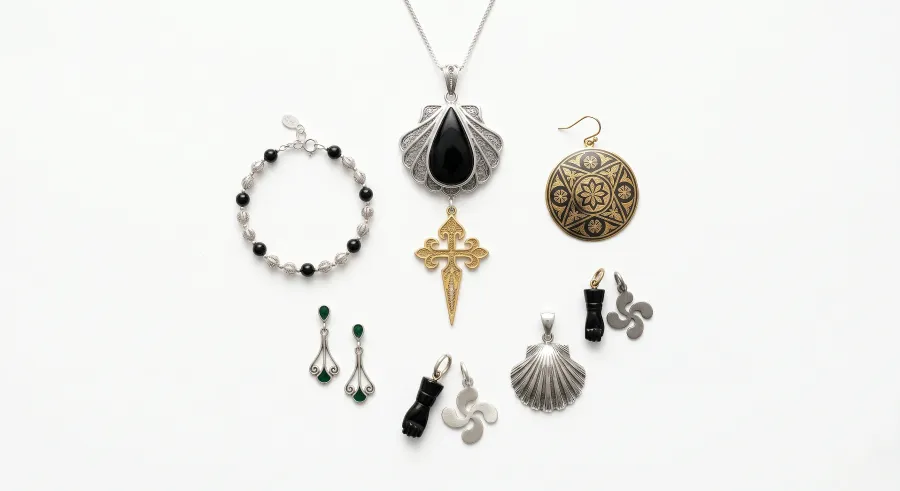
Distinctive Basque symbolism: the lauburu (Basque cross) appears in jewelry. The lauburu is a swastika-like four-armed figure with curved ends, ancient in origin and specific to Basque culture. Classic plain gold bands, often engraved with the lauburu inside the ring. Basque weddings tend toward understatement compared to Andalusian ones: less visible drama, more significance per object.
Galicia
Pilgrimage and Celtic aesthetic. The scallop shell of Santiago appears as a brooch or pendant, a direct reference to the Camino de Santiago that passes through the region. Azabache (black jet stone) is woven into bridal jewelry, as it has been for centuries. Jet from the mines near Oviedo was considered protective, and jet brooches and pendants appear in historic Galician bridal portraits.
Madrid
Classic royal-capital style. The traditional mantilla (especially the black mantilla negra for formal weddings), family heirlooms dominant, antique gold parures from established families. Madrid weddings at the upper end of the scale can look like events from a previous century, with the deliberate preservation of tradition as the aesthetic statement.
Canary Islands
A distinctive blend of Latin American and Berber influence reflecting the islands' geographic position. Flowers in the hair, local stones such as olivine from Lanzarote. The Canarian wedding has a brightness and warmth that distinguishes it from mainland traditions, with color playing a more active role in the jewelry choices.


Wedding gifts: jewelry in Spain
The gift-giving structure at a Spanish wedding is more formal and more layered than in American practice. Jewelry flows in multiple directions, not just from guests to the couple.
From the bride's family to the bride
- Family heirlooms: mother's pearl strand, grandmother's cross, great-grandmother's brooch
- New jewelry: the family often commissions earrings or a pendant specifically for the wedding
- A ring as inheritance: grandmother's wedding band resized and worn on the other hand
The commissioning of new jewelry from the bride's family for the wedding day is a practice that survives in traditional families across all regions. The piece will typically carry a stone of significance: the regional gemstone, a stone associated with the bride's patron saint's day birth month, or a stone chosen for its symbolic meaning within the family.
From the groom to the bride
- The arras: the thirteen coins (the most significant gift)
- A morning-of-the-wedding piece: a pendant with initials, earrings, or a bracelet
- An engagement piece: a ring or bracelet given at the time of the proposal
The morning gift from groom to bride is not a universal custom, but it is common in traditional families. It is typically a single piece of considered jewelry, worn for the first time at the ceremony or reception.
From the bride to the groom
- His wedding band: a matching pair is standard
- A signet ring: engraved with the family crest (where tradition exists)
- Cufflinks: for the formal banquet
From the couple's families to each other
In very traditional marriages there is sometimes an exchange of jewelry between the mothers of the bride and groom as a physical symbol of the two families becoming one. This is not universal, but it persists in established families in Andalusia and Madrid.
Jewelry for the groom
Often overlooked in wedding guides, but the groom also needs considered pieces. The Spanish groom at a formal wedding presents a complete picture, and the details matter.
Wedding band
- Yellow or white gold 14ct to 18ct
- Plain (classical) or with subtle texture (contemporary)
- Worn on the right hand
- Often engraved inside with the bride's name or wedding date
The engraving tradition for grooms' rings is at least as strong as for brides' rings in Spain. A smooth exterior ring with a deeply personal interior text is the classical model.
Cufflinks
For a formal shirt worn with a morning suit, dinner jacket, or lounge suit. Often:
- Family heirlooms from father or grandfather
- A gift from the bride on the morning of the wedding
- Monogrammed with the couple's initials or the family crest
Gold or silver cufflinks in a restrained design are appropriate for all levels of formality. The only error at a Spanish formal wedding is wearing no cufflinks at all, which signals insufficient attention to the occasion.
Signet ring
An engraved ring bearing the family crest. Common in established families with documented heraldry. Not obligatory, but traditional. When a father passes his signet ring to a son on his wedding day, it functions as a transmission of family identity in the same way the grandmother's brooch functions for the bride.
Tie pin
With a pearl, a small stone, or a monogram. Simple, but present.
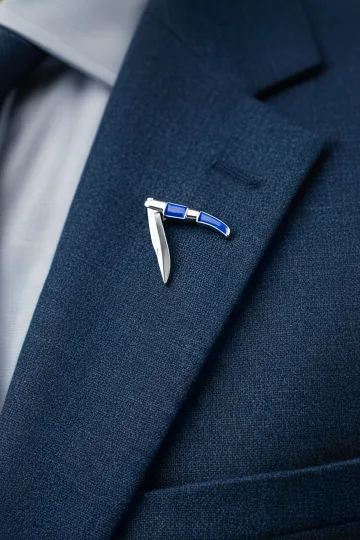
Boutonniere pin
A small brooch for the buttonhole flower. Often set with a modest garnet or diamond chip.
Traditional Spanish symbols in wedding jewelry
The Cross of Santiago
The red cross of the Order of Santiago, a symbol of the Christian Reconquista. Appears as a pendant or brooch at weddings, often executed in Toledo damascene, the gold-on-blackened-steel technique that became a classic of Spanish wedding gifts. The cross is the most recognizable Spanish religious symbol in jewelry form, present at weddings from the grandest Seville cathedral ceremony to small parish marriages in the countryside.
The Hand of Fatima (hamsa)
A protective symbol with roots in both Islamic and pre-Islamic North African culture, brought to the Iberian peninsula during the centuries of Moorish influence. Today more common as everyday jewelry than as a specifically bridal piece, but it appears in some Andalusian and Canarian weddings.
The crucifix
Central to Catholic ceremony. In a religious wedding it is usually worn on a chain or used as a brooch. The crucifix worn at a wedding is often the same one worn at First Communion and Confirmation: an object that tracks the religious milestones of a life.
Regional Virgins
The local incarnation of the Virgin (Virgen del Rocío in Huelva, Virgen del Pilar in Zaragoza, Virgen de la Paloma in Madrid) as a medal or pendant. The medallion of the local patron Virgin is among the most personal pieces in a Spanish bridal ensemble, because it locates the bride within a specific place and community.
The azahar (orange blossom)
The flower of the lemon or orange tree, symbolizing purity and marriage. Worn as a brooch or in a floral wreath. In jewelry, stylized blossoms rendered in gold or silver. The azahar has been associated with Spanish brides since at least the Moorish period, when orange groves were a feature of Andalusian palace gardens and the scent of the blossom was considered auspicious.
The fan
The Spanish fan is not jewelry, but it is part of the bridal ensemble at formal Andalusian and Madrilenian weddings. Occasionally a decorative brooch is pinned to the fan's handle or to the cloth itself.
The mantilla: fabric, history, and modern choices
No single object defines the Spanish bridal aesthetic for an outside audience more completely than the mantilla. It is worth understanding it in some depth.
What the mantilla is
A length of lace, historically silk bobbin lace, worn over the hair and shoulders. It is not a veil in the Anglo-Saxon sense. A veil obscures the face. A mantilla frames it. The mantilla lies over the peineta comb and falls in a broad sweep behind and sometimes to the sides of the bride.
Black versus ivory
The mantilla negra, black lace mantilla, is the formal choice for church ceremonies in Madrid, Seville, and Zaragoza. It has a gravitas that ivory does not. The association of black with mourning is suspended for weddings: at a Spanish church ceremony, a black mantilla is ceremonial dress, not funerary dress. Ivory or cream mantillas are worn at morning ceremonies, outdoor weddings, and by brides who prefer a less dramatic look.
Chantilly versus Alençon versus Spanish bobbin lace
The finest mantillas are made from Spanish pillow lace (encaje de bolillos), particularly from the lacemaking towns of Almagro in Castilla-La Mancha and Camariñas in Galicia. Chantilly from France and Alençon from Normandy are also used, particularly for contemporary pieces. The difference is visible to a trained eye: Spanish lace tends to heavier, more geometric patterning, with strong contrast between solid and open areas.
Alternatives to the mantilla
Many contemporary Spanish brides wear a standard cathedral-length veil, a sheer capelet, or no headpiece at all. The mantilla is a choice, not a requirement. A bride who wears a sleek contemporary gown and no mantilla is not doing anything wrong. She is simply following a different aesthetic.
Customs and superstitions
The four things
The Spanish version of "something old, something new, something borrowed, something blue" operates in much the same way, particularly at modern weddings. The "something blue" is typically fulfilled by the blue garter (liga).
Never lend the wedding ring
The wedding band should not leave the finger after the engagement. Removed only for sleeping (if necessary) or in specific circumstances. This applies in many European Catholic traditions, not only in Spain.
Pearls and tears
In some Spanish traditions pearls at a wedding are said to bring tears to the marriage. This is regional and minority; many brides wear pearl jewelry without any concern. The superstition is most commonly cited in older Castilian families. In Andalusia, pearl earrings and pearl strands are entirely standard at weddings.
The number thirteen
The thirteen arras coins make thirteen an auspicious number, inverting the usual superstition. However, thirteen guests at a table is still considered unlucky. Catering managers at Spanish wedding venues are accustomed to this and will quietly arrange seating to avoid the configuration.
Garnet
Garnet in bridal jewelry symbolizes fidelity and passion. The tradition is particularly strong in Andalusia, where garnet brooches and garnet-set alianzas appear frequently. The deep red color is associated with blood loyalty, a metaphor that runs through Spanish wedding symbolism broadly.
The orange blossom crown
The crown of azahar worn by the bride is not just decoration. It is a pledge of purity. In some traditional families the crown is made the morning of the wedding from actual orange or lemon blossoms cut from the family garden or obtained from a local florist who grows the trees specifically for this purpose.
Spanish wedding jewelry through the centuries
Medieval Spain
Aristocratic weddings featured gold chains, jeweled brooches, and rings of chivalric orders. The arras tradition already existed in this period, though the documentation is inconsistent before the 13th century. The rings exchanged at medieval Spanish aristocratic weddings were often inscribed with the names of the couple and the date, a practice that continues directly into modern alianza engraving.
The Age of Discovery, 16th to 17th century
Colonial gold and silver from Mexico and Peru became the foundation of Spanish bridal jewelry. Large crosses, heavy chains, pearl strands. Baroque pearls from the Philippines were a feature of this era, and the wealthiest Spanish brides wore multi-strand pearl necklaces that represented the material yield of an entire hemisphere. The excess was deliberate: Spanish imperial power was made visible through the body of the bride.
Velázquez's paintings give a detailed record of this aesthetic: the Infanta Margarita's portraits, for example, document exactly the kind of heavy gold collar, pendant earrings, and pearl clusters that aristocratic brides wore at court weddings.
Baroque and Rococo
Excess defined the period: aristocratic brides wore every piece simultaneously. The mantilla became obligatory in its current form. Creole hoops became a standard feature. The 18th century also produced the elaborate altar jewelry that appears in many Spanish church collections: massive gold and silver pieces donated by aristocratic families to local parishes as acts of devotion and social display.
Romanticism, 19th century
The modern form of the Spanish wedding crystallized in this period. Arras caskets became a commercial product available from silversmiths in every major city. Pearl necklaces from Mallorca entered mass circulation, making pearl jewelry accessible to middle-class brides for the first time. The grandmother's brooch tradition solidified: 19th-century pieces are now the most common "grandmother's brooch" passed down at contemporary weddings.
Francisco Goya's portraits of aristocratic women from this period document the shift: the heavy gold chains of the Baroque give way to fine chains, single pendants, and the elegant simplicity that characterizes the period. The Duchess of Alba portraits are the most studied documents of Spanish aristocratic bridal jewelry in this era.
Modernisme, early 20th century
The Catalan Modernisme movement brought a new aesthetic to bridal brooches, particularly pieces with cloisonné enamel. Lluís Masriera was the central figure: his enamel pieces depicting female figures, flowers, and insects in the Art Nouveau manner became the defining Catalan contribution to Spanish bridal jewelry. Masriera pieces from this period are now prized antiques that appear as grandmother's brooches at contemporary Catalan weddings.
After Franco (1975 onwards)
A revival of regional traditions. The mantilla returned as a deliberate statement of cultural identity rather than social obligation. The arras ceremony became a near-universal ritual, adopted even by non-religious couples in civil ceremonies as a secular symbol of mutual commitment. Regional symbols like the Basque lauburu and the Galician scallop shell re-entered bridal jewelry after decades of cultural suppression.
Today
The Spanish wedding has absorbed every layer: a traditional mantilla paired with a contemporary dress, a stone-free alianza alongside a social-media-influenced aesthetic, regional symbols worn by brides who may not speak the regional language but feel the pull of the heritage. The result is a richness of reference that most other wedding cultures cannot match.
The complete look: from head to fingers
The traditional Spanish bride dresses as a system, not as a collection of independently chosen objects. Each position on the body has its own logic.
The head
The peineta, the large decorative comb, is placed at the center or slightly toward the crown. The mantilla drapes over it and falls down the back. For the church ceremony the classic choice is the black mantilla or an ivory one for morning ceremonies. Contemporary brides often substitute a tiara.
The neck
The classic is a pearl strand in one or several rows. The alternative is a fine gold chain with a cross or a Marian medallion. If the mantilla is dense, the necklace is hidden, and many brides simply wear none. A family heirloom carries more meaning than any purchase: a great-grandmother's cross or a mother's pendant brings a history that no jewelry store can provide.
The ears
For the church: pearl or small diamond studs. Nothing long that creates movement when bending at the altar. For the banquet: long drop earrings. Changing earrings between ceremony and reception is completely standard practice.
The hands
On the right hand, the wedding band. On the left, sometimes the engagement ring or a family ring. The bracelet, if worn, goes on the left wrist to avoid competing visually with the alianza.
The bodice and waist
The grandmother's brooch, when present, is the central accent of the gown. Its position can shift based on the dress design: high on the bodice, at the waist, on a jacket lapel, or pinned to the mantilla at chest height.
The tradition of passing jewelry down
One of the most important and least-discussed aspects of Spanish wedding jewelry is the internal family gift economy. It operates in parallel with the arras ceremony and with the commercial gifts from guests.
From the groom's mother to the bride
The classic gift: a pearl set. Necklace and earrings. This is not simply a gift, it is the acceptance of the bride into the groom's family. The pearls are chosen by the groom's mother personally, and the moment of the presentation is often more emotionally charged than any part of the official ceremony.
From the bride's father
A gold cross or a medallion bearing the image of the local patron Virgin. In Seville this will be the Virgen del Rocío. In Zaragoza the Virgen del Pilar. In Madrid the Virgen de la Paloma. The medallion becomes a permanent piece worn after the wedding, not only a bridal accessory.
From the grandmother
A filigree ring or an antique brooch from the 19th century. The grandmother's ring often does not fit and is reworked by a goldsmith. Or it is worn on a chain as a pendant if sizing is not practical. The ring's history is the point, not the precise form in which it arrives.
Bride's checklist
Essential
- Wedding band on the right hand
- The arras casket with thirteen coins (held by the groom for the ceremony)
- A necklace piece (gold chain with cross, pendant or pearl strand)
- Earrings (studs for the church, drops for the reception)
Optional
- Brooch (often a family heirloom)
- Bracelet (pearl or slim gold bangle)
- Tiara or crown (contemporary influence)
- Mantilla with peineta (for a traditional ceremony)
- Garter with small brooch
Spare set
- A second set of earrings for the reception (drop earrings to replace the studs)
- A jewelry box that travels with the bride during outfit changes
Groom's checklist
- Wedding band on the right hand
- Cufflinks for the shirt
- Tie pin
- Signet ring (optional)
- The arras casket (thirteen coins, received from family or purchased)
Guest etiquette
- Women: avoid white (as in most countries), do not outshine the bride. Pearl, gold, and pastel tones are appropriate. Red is perfectly acceptable in Spain, unlike in some other cultures.
- Men: conservative suit, simple cufflinks, wedding band. Avoid crown-like accessories.
- Mantilla: if worn by a female guest, black for formal weddings or ivory/cream for morning ceremonies.
Frequently asked questions
Which hand do Spanish people wear their wedding ring on?
The right hand. This distinguishes Spanish couples (along with Germans, Greeks and many continental Europeans) from the American and British practice of wearing it on the left. Historically, the Catholic tradition associated the right hand with sacred oaths, not the left.
Is a mantilla required at a Spanish wedding?
Not in contemporary Spain. Many brides choose not to wear one. However, a traditional ceremony, particularly in Andalusia, Madrid or a devout family, often still expects the mantilla. It is a personal choice that carries cultural weight when made either way.
How much should the arras coins cost?
The value is not the point. This is a symbolic gesture, not a financial transaction. Decorative coins from family heirlooms, old Spanish reales if the family has them, carry more meaning than expensive new pieces. The casket matters more than the coins' monetary value.
Can we combine Spanish and international traditions?
Yes. Many mixed couples do exactly this: arras alongside vows in two languages, a mantilla paired with a contemporary gown. What matters is that both families feel their culture is represented.
What do we do with the arras coins after the wedding?
Keep them in the casket as a family heirloom. Or pass them to children and grandchildren. In some families, one coin is made into a pendant for the first child, and the remaining twelve are stored until the next wedding in the family.
Can we use a family wedding ring?
Yes, and this is genuinely valued. A grandmother's or great-grandmother's ring can be resized by a goldsmith. This tradition is particularly strong in established families, where the ring's history is as important as its design.
And what if the marriage ends, what do you do with the ring?
It's a separate topic, not specifically Spanish. The ring can be kept, melted down, resold or reworked into a standalone piece. The full set of scenarios is covered in our article on the divorce ring - meaning, trend and what to do with the old wedding ring.
Does the groom give a pendant?
Not obligatory, but common. Often set with a sapphire, garnet or pearl as a marker of the new life beginning. This is typically the morning-of gift, given before leaving for the ceremony.
What is the difference between confirmation jewelry and bridal jewelry?
Confirmation jewelry is simpler: a small cross, a fine chain. A wedding calls for more layered pieces, mantilla, peineta, family heirlooms, and the full set of pieces that connect the occasion to family history.
Gold or silver for a Spanish wedding?
Gold is traditional, particularly yellow gold 14ct to 18ct, especially for the wedding band. Silver appears in accent pieces such as brooches and earrings, but the alianza is almost always gold.
Should the wedding bands match?
It is not a strict rule, but matching bands in the same metal and style are the contemporary standard.
What is the significance of azabache at a Spanish wedding?
Azabache, black jet stone, is a protective material in Spanish folk tradition. It appears most prominently in Galician and Asturian bridal jewelry, where jet beads, pendants, and brooches have been part of the wedding ensemble for centuries. The jet mines near Oviedo supplied the material for centuries. A genuine antique azabache piece carries both historical and protective significance in the tradition.
Mallorca pearls: a story of their own
The pearls of Mallorca deserve special mention in the context of Spanish wedding jewelry. The town of Manacor on Mallorca became a center of artificial pearl manufacturing in the late 19th century, when natural Persian Gulf pearls were effectively priced out of reach for most families. Mallorcan craftsmen developed a coating technique that produced a pearl with genuine luster and surface texture, accepted by the market as an honest substitute.
Mallorcan pearls entered the Spanish wedding tradition as an accessible alternative to natural pearls, and by the mid-20th century they had become nearly inseparable from the image of the Spanish bride. Today, pieces from the 1950s through 1970s have become precisely the "grandmother's jewelry" passed down at contemporary weddings.
Identifying genuine Mallorcan pearls from other imitations is straightforward: authentic pieces have a slightly gritty surface texture detectable by lightly touching the tooth, and a depth of luster that reads as coming from within rather than sitting on the surface.
Spanish wedding jewelry for international couples
Several practical questions arise for couples where one partner is Spanish and the other is not.
The arras without the church. Many non-religious couples incorporate the arras into a civil ceremony as a secular ritual of mutual commitment. The officiating registrar will accommodate this. The couple simply reformulates the meaning of the coins in their own terms.
The mantilla without everything else. A bride who wants only the mantilla from the full traditional set makes a completely coherent choice. The mantilla is the most visually significant single element; the rest can be adapted freely.
Wedding rings on different hands. The Spanish partner wears on the right, the foreign partner on the left. Many mixed couples do exactly this and make no attempt to harmonize the custom. The asymmetry is simply noted and accepted.
Family heirlooms as a bridge. The grandmother's brooch is presented to the bride regardless of her origin. This works because the family is accepting the person, not just the tradition.
Finding an arras set abroad. Spanish jewelry specialists in most major American cities can source or commission arras sets. Alternatively, ordering directly from artisan goldsmiths in Albacete, Toledo, or Seville is straightforward with online communication, and the piece will arrive with more provenance than anything sourced locally.
Putting together a Spanish bridal set
The starting point
For a bride who wants clarity without complexity:
- One gold wedding band in 14ct
- Pearl stud earrings
- A fine gold chain with a small cross
- A brooch (a grandmother's piece if available)
Price range: mid to upper-mid market.
The complete traditional set
For a full classical ceremony:
- Wedding band in 18ct gold
- Stud earrings for the church
- Drop earrings for the reception
- Pearl strand or pendant
- Brooch (heirloom)
- Black mantilla
- Peineta (large, tortoiseshell or jet)
- Garter with brooch
Price range: high-end.
The heirloom-centered set
- Wedding band with diamond in 18ct gold
- Family pearl strand (heirloom)
- 19th-century brooch (antique)
- Hand-made mantilla de maha
- Antique jet peineta
- Collector's arras coins (recast from genuine historical pieces)
Price range: investment level.
Conclusion
Spanish wedding jewelry is not a shopping list. It is a system where each element carries meaning. The alianza on the right hand declares marital status. The arras with thirteen coins pledge shared material responsibility. The mantilla with peineta connects the bride to tradition, even in a fully contemporary wedding. The grandmother's brooch bridges generations.
Every couple decides which traditions to observe and which to set aside. That is precisely what makes the Spanish wedding more personal than a standard checklist.
Silver, gold, wedding bands, symbolic pieces and matching sets.
About Zevira
Zevira makes jewelry by hand in Albacete, Spain. We work from the heart of the Spanish artisan tradition and regularly create bridal sets, from wedding bands to arras collections.
For a Spanish wedding you will find at Zevira:
- Wedding bands for the right hand (the Spanish tradition)
- Arras de boda sets of thirteen coins in silver or gold
- Bridal brooches with regional motifs
- Drop earrings for wearing with a mantilla
- Matching bracelets for bride and groom
- Spanish wedding symbols (Cross of Santiago, rose, fan)
Every piece is made by hand by a craftsperson, with the option of personal engraving. We work in 925 silver and 14ct to 18ct gold.