Viking Jewellery: The Complete Guide to Symbols and Collection Building
The Norse legacy on British soil
Walk through the Jorvik Viking Centre in York and you are standing in the heart of what was once Jorvik, one of the most important Norse cities in northern Europe. The Vikings did not simply raid Britain and leave. They settled, traded, intermarried, and left a cultural imprint that reaches from the street names of York (Goodramgate, Gillygate, Micklegate, all with Old Norse roots) to the carved stones of Lindisfarne, to the thousands of artefacts now held in the British Museum's dedicated Viking collection.
The first raid on Lindisfarne in 793 is the event historians use as the opening of the Viking Age. The monks of that Northumbrian monastery wrote with evident shock about men arriving from the sea to attack a holy place. That raid was the first well-documented Norse strike on British soil. The period closed in 1066 at the Battle of Stamford Bridge, when the Norwegian king Harald Hardrada fell in Yorkshire. Between those two dates, the Norse presence in Britain was not a series of raids but an entire civilisation: the Danelaw, the Norse kingdom of Jorvik, the trading networks that linked York to Dublin to the Baltic to Constantinople.
The 1976-1981 excavation at Coppergate in York unearthed a silversmith's workshop from the tenth century. The tools, the scrap metal, the half-finished pieces: all pointed to craftsmen producing small silver pendants and amulets for a population that was half Norse, half Anglo-Saxon, and entirely comfortable blending both traditions. The Cuerdale Hoard, found in Lancashire in 1840, contained over eight thousand six hundred Viking Age silver objects, the largest Viking silver hoard ever found outside Scandinavia. These were not exotic imports. They were local pieces, made here, worn here.
That context matters when you wear Viking jewellery today. In Britain, this is not a foreign aesthetic borrowed from an alien culture. It is a strand of the country's own history, one that the Yorkshire Museum, the Museum of Scotland, and the National Museum of Wales all recognise as integral to the British Isles' story.
The Viking Age: 793 to 1066
Three centuries of expansion, settlement, and cultural exchange. Scandinavian peoples transformed from a force that terrified coastal monasteries into the architects of states across Ireland, England, Normandy, Sicily, and the eastern Mediterranean trade routes. They reached North America five centuries before Columbus. They served as the elite guard of the Byzantine emperor.
This matters for understanding their jewellery. Mjolnir pendants and runic rings were not the ornaments of poor raiders living in longhouses. They were worn by merchants who understood the value of silver along routes stretching from the Baltic to the Caspian, and by military commanders who received raw materials and finished goods from craftsmen working across a trade network that spanned the known world.
The runic alphabet: Elder and Younger Futhark
The Elder Futhark, twenty-four characters, developed by approximately the second and third centuries and was the dominant script of the migration period. By the ninth and tenth centuries, most practical runic writing in Scandinavia had shifted to the Younger Futhark with only sixteen characters, a simplified version. The Elder Futhark persisted in ritual and magical contexts, and it is the Elder form that underpins modern jewellery symbolism, because its richer character set allows each rune to carry a specific name, phonetic value, and set of associations: Tiwaz, Algiz, Othala, Sowilo, Ansuz, Wunjo.
Runic inscriptions survive on standing stones across Scandinavia, on sword blades and personal ornaments, and on wooden tablets from medieval Bergen. It was a written tradition that coexisted alongside Latin script in northern Europe for several centuries after the introduction of Christianity. What distinguishes the runes is their dual nature: every character was simultaneously a letter, a word, and a concept. Fehu meant "f" phonetically, but it also meant "cattle" and by extension "movable wealth." Uruz meant "aurochs," the massive wild ox that once roamed northern Europe, and carried the symbolic weight of brute strength. This layered meaning is why runes translated so naturally into jewellery. A piece inscribed with Algiz was not simply decorative. It carried a specific protective intention that the wearer understood and the maker had deliberately encoded.
Norse jewelry in history: silver, amber, and the warrior's ornament
Silver as wealth and symbol
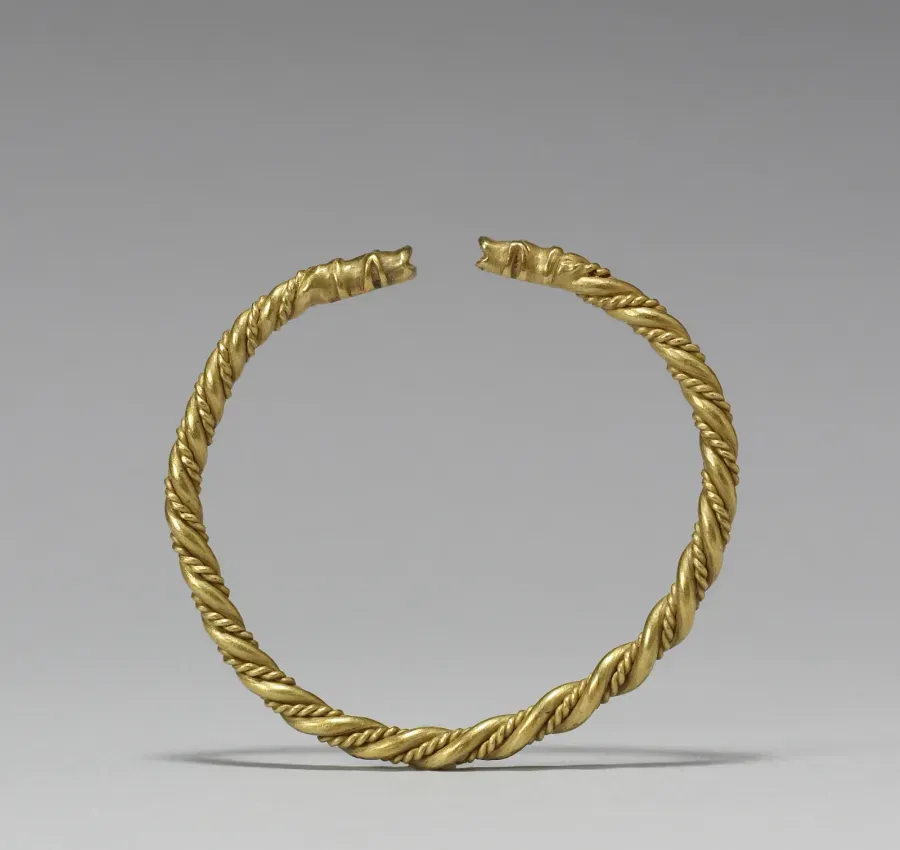
The Vikings did not separate jewellery from currency. Silver was silver: it was weighed, melted, cut, shaped into ornaments, and cut again for transactions when needed. The hacksilver economy, where chopped fragments of coins and broken pieces were weighed against standardised weights, ran parallel to the wearing of complete objects. A beautifully crafted silver ring on the arm was also an asset that could be liquidated by cutting it into pieces and handing them across a merchant's table.
This gives Norse silver jewellery a different character from what came before and after. Roman jewellery was primarily decorative, embedded in a coin-based economy where the two functions were separated. Medieval Christian jewellery was devotional, embedded in a church hierarchy. Viking silver sat at the intersection: it was aesthetic, spiritual, and financial all at once. The arm rings found in the Cuerdale Hoard are not delicate ornaments. They are substantial objects, weighty in the hand, made to be seen and felt. Their beauty served their function as portable wealth.
The practical consequence of this dual role is visible in the hoard archaeology. Pieces are found in stages of completion and incompletion, alongside tools and raw material. A craftsman's workshop is archaeologically indistinguishable from a merchant's store. The same crucible that melted down Arab dirhams to recover their silver might, an hour later, produce a finished Mjolnir pendant. There was no wall between making, storing, trading, and wearing.
Baltic amber and long-distance trade
Amber was the other key material. Baltic amber, fossilized tree resin found washed up on the shores of what is now Lithuania, Latvia, Estonia, and northern Poland, was among the most traded commodities in the ancient world. The "Amber Road" carrying it south toward the Mediterranean is documented as far back as the Bronze Age.
In the Viking Age, amber beads and pendants appear in graves across Scandinavia alongside imported glass beads from the Rhineland, cowrie shells from the Indian Ocean, and silk from Byzantium. These are not local ornaments for local people. They are evidence of the extraordinary reach of Norse trading networks. A woman buried in ninth-century Denmark with amber beads and a Byzantine silk textile had access to goods from two thousand miles away in opposite directions.
For jewellery today, amber retains this quality. It is warm to the touch, visually distinctive, and carries the weight of very deep time. Baltic amber pieces in a Norse-inspired collection are historically grounded in a way that almost no other material can match.
Bronze and the tier below silver
Not everyone wore silver. Bronze was the accessible material, cast into the same forms as the silver pieces but without the same monetary value. Bronze Mjolnir pendants have been found across Scandinavia and the Danelaw territories. The Pitney Brooch, a Scandinavian-style piece found in Somerset, was made in bronze rather than silver. Bronze gives a warmer color and a rawer surface quality: less refined, more ancient in appearance.
Animal motifs: serpents, wolves, and birds
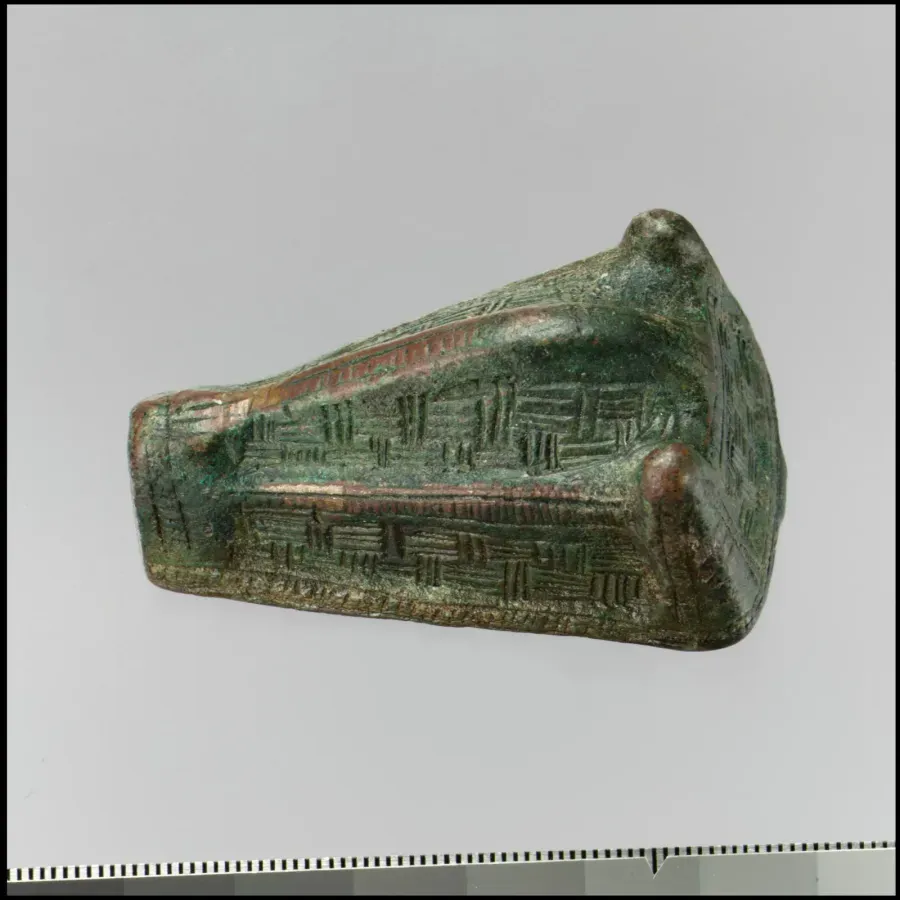
Norse metalwork was not abstract. It was densely figurative, populated with creatures that carried specific symbolic meanings. The serpent or dragon appears coiled on brooches and bracelet terminals, representing both Nidhogg gnawing at the roots of Yggdrasil and the more general idea of guarded treasure. The wolf appears on weapons and personal ornaments as an emblem of the warrior and of Odin's court. Ravens appear alongside nearly every major Odinic symbol, reminders of the god's omniscience and the inevitability of observation.
The Borre, Mammen, Ringerike, and Urnes styles are the four main artistic periods of Viking Age metalwork, each with its own characteristic handling of animal motifs. The Borre style, dominant in the ninth and tenth centuries, used ring-chain interlace and gripping beasts: animals whose limbs interlock with their own bodies and with each other. The Mammen style introduced more natural animal forms with elaborate surface decoration. Ringerike, contemporary with the late Viking Age, used elegant plant-and-animal combinations. Urnes, the final phase, reduced the animal to flowing lines so attenuated they become almost pure geometry. Each of these styles appears in contemporary Norse-inspired jewellery, and recognising them gives a piece its proper historical context.
The main symbols of the Viking collection
A brief overview of what makes up a Norse jewellery set. Each symbol has its own depth; here are the essentials and how each piece sits within a collection.
Mjolnir, Thor's Hammer
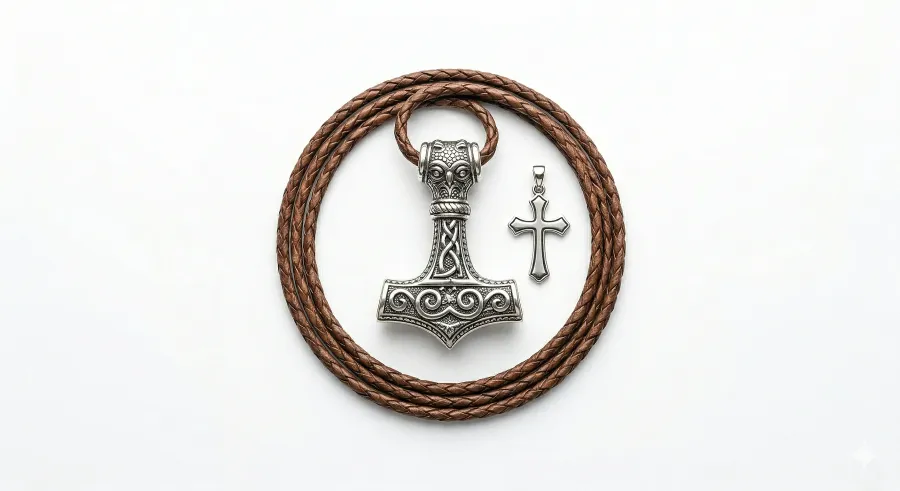
Mjolnir is the most recognised Viking symbol. Protection, strength, connection to thunder and fertility. It was worn by warriors, women, and children alike. The archaeological record across Scandinavia is consistent.
One of the clearest early examples, the Romsersdal Mjolnir from Denmark, dated to the tenth century, survived with its suspension loop intact: direct confirmation that it was worn around the neck. Around a thousand such pendants have been found across Scandinavia and in the territories where Norse settlers established communities. In Britain, finds from the Danelaw region confirm the pendant's widespread use across the Viking-settled east of England.
One telling detail: during the conversion period of around 950 to 1050, some craftsmen cast both symbols from the same mould, a Mjolnir on one face and a cross on the other. The market demanded flexibility. Some finds from Yorkshire carry exactly this ambiguity.
In any Norse collection, Mjolnir is the anchor piece. If you choose only one symbol, this is the one. The same oxidised silver and weighty presence that defines Mjolnir also runs through the wider dark and memento mori tradition, which shares Norse roots in its raven and skull motifs.
Vegvisir, the Viking Compass
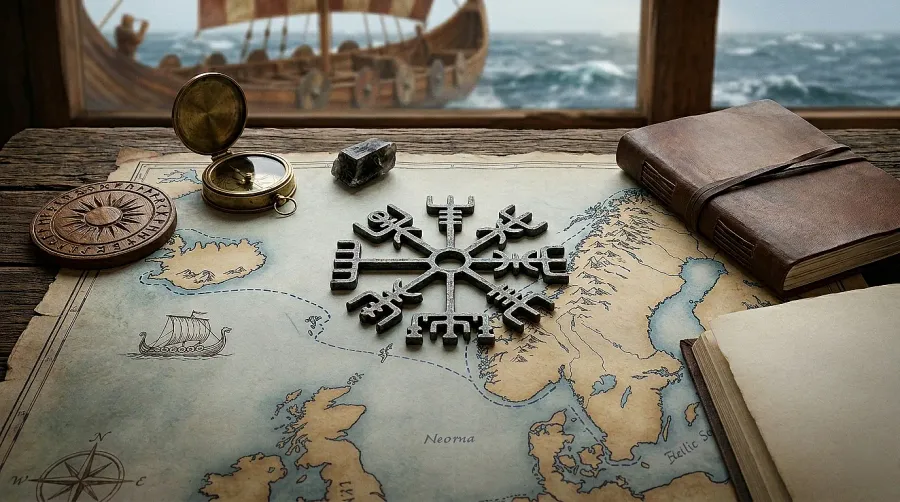
Vegvisir means "that which shows the way". Eight runic staves radiate from a central point, promising guidance through any storm.
Its oldest documented source is the Icelandic Huld Manuscript, which dates to the seventeenth and nineteenth centuries in its surviving forms, meaning its medieval credentials are questioned by academic historians. As a symbol of direction and clarity it remains profoundly resonant, particularly in a country with such a strong maritime tradition. Sailors, travellers, and anyone navigating a significant life change have long been drawn to it. Vegvisir sits comfortably alongside the wider vocabulary of maritime symbols, since the Norse were sea raiders and traders before they were anything else.
Aegishjalmur, the Helm of Awe
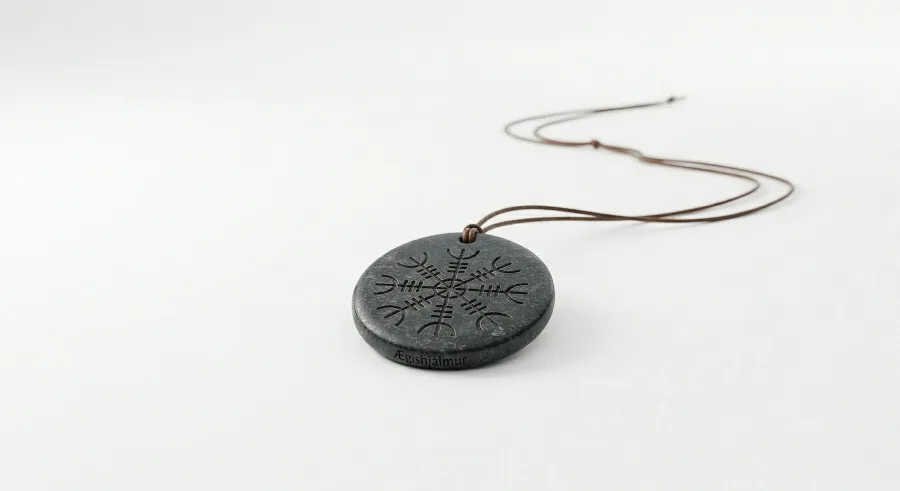
Aegishjalmur, the Helm of Awe, is a protective symbol built from eight trident-like arms extending from a centre. In the Eddic tradition it appears in the Saga of the Volsungs, where the dragon Fafnir wore it between his eyes to inspire terror in all who looked upon him.
As a standalone physical amulet it is rarer in the archaeological record than Mjolnir. It was more often used as a ritual mark or painted symbol. In contemporary jewellery it is highly recognisable and combines naturally with Vegvisir or Mjolnir in layered pieces.
Valknut
The Valknut, three interlocked triangles, is the knot of the slain. It is associated with Odin and with the fallen warriors welcomed into Valhalla. In Norse art it appears on the Gotlandic picture stones carved between the fifth and eleventh centuries, often alongside ravens and the imagery of death in battle.
The precise academic interpretation of the Valknut remains debated: not all researchers accept a direct connection to Odin. As a visual symbol it is one of the strongest in the Norse repertoire, carrying unmistakeable themes of memory, valour, and the warrior's death.
Yggdrasil, the World Tree
The ash tree Yggdrasil connects the nine worlds of Norse cosmology. Its roots reach into Niflheim, its trunk passes through Midgard, its crown touches Asgard. An eagle sits in the branches, the serpent Nidhogg gnaws at the roots, and the squirrel Ratatoskr runs between them carrying insults from one to the other.
In jewellery, Yggdrasil reads as a symbol of connection between different levels of existence: ancestors, the living, and the gods. Popular as bracelets with interwoven branch motifs and pendants with spreading crowns.
Odin's Ravens, Huginn and Muninn
Huginn (thought) and Muninn (memory), Odin's two ravens who flew the world each day and returned with knowledge. Symbols of intelligence, the wider world, and the invisible connections between things.
In jewellery the raven often appears in pairs, sometimes with the Ansuz rune (communication, Odin's wisdom). Popular as earrings and pendants.
The Triple Horn of Odin
Three interlocking drinking horns, a symbol of wisdom obtained through trial. In Eddic mythology, Odin obtained the mead of poetry in three draughts, filling three vessels named Odrerir, Bodn, and Son. A symbol of self-knowledge through endurance.
Sleipnir
Odin's eight-legged horse, swiftest of all creatures, capable of travelling between worlds. A symbol of surpassing speed, supremacy, and connection to the otherworld. In jewellery it appears as a small horse pendant or worked into runic compositions.
The Wolf, Fenrir
The monstrous wolf, son of Loki, who at Ragnarok will kill Odin. Symbol of raw, uncontrollable force. In jewellery the wolf head is popular as a standalone pendant, sometimes combined with the Fehu rune.
The Triskelion
Three rotating legs or arms from a central point. Associated with the Isle of Man and its direct Norse heritage, with Celtic traditions on Manx soil, and with the concept of perpetual motion. The Manx triskelion appears on the island's flag and traces directly to the meeting of Norse and Celtic cultures in the Irish Sea region, one of the most productive cultural encounters of the Viking Age.
Knotwork and interlace patterns
Norse knotwork, derived partly from earlier Celtic traditions and partly from native Scandinavian animal interlace styles, appears on jewellery, stone carvings, weapons, and architectural decoration throughout the Viking Age. The Urnes style, named for the stave church at Urnes in Norway, is the most refined expression of this tradition: sinuous animals rendered as interlocking lines, where the boundary between figure and ground dissolves into pure pattern. Knotwork in jewellery reads as continuous connection, the absence of a beginning or end. It appears on rings, bracelets, and as border decoration on larger pendant pieces.
The Runes, Elder Futhark
The Elder Futhark is the runic alphabet of twenty-four characters. Each rune carries a phonetic value, a name, and a symbolic meaning. Popular in jewellery as single pendants or as inscriptions on other pieces.
Key runes for jewellery:
- Tiwaz (T) - justice, victory, willingness to sacrifice
- Algiz (Z) - protection, connection to the divine
- Othala (O) - ancestral heritage, home, family
- Sowilo (S) - the sun, success, vital energy
- Ansuz (A) - communication, Odin's wisdom
- Wunjo (W) - joy, harmony, fellowship
- Fehu (F) - abundance, beginnings, primal energy
- Uruz (U) - strength of the aurochs, health, endurance
Viking hoards: history in silver
Viking jewellery has reached us not through legend but through the ground. Several major hoards give a concrete picture of what was worn, stored, and exchanged.
The Cuerdale Hoard (Lancashire, 1840)
Found by workmen on the bank of the River Ribble. Over eight thousand six hundred objects: silver ingots, coins, ornaments. The largest Viking silver hoard ever found outside Scandinavia. Now at the British Museum.
The composition speaks of trade rather than simple plunder: silver from multiple regions, coins from the Arab Caliphate, Carolingian coins, Anglo-Saxon minting. This was the reserve of a trading house, not the spoils of a single raid.
The Vale of York Hoard (2007)
Found by metal detectorists near Harrogate, now at the Yorkshire Museum. A decorated silver vessel filled with jewellery, coins, and ingots from five countries, wrapped inside what was once a linen cloth. The vessel itself is a Frankish liturgical cup, repurposed as a container. Inside: coiled silver armlets, a gold arm ring, ingots, and coins from as far as Samarkand in Central Asia. The hoard dates to around 927-928, the period immediately following the Norse expulsion from Northumbria. It has every appearance of emergency burial: someone with substantial wealth, expecting to return, who did not.
Jorvik, York
The Norse settlement at the heart of northern England. In 866 the Vikings captured Jorvik and made it the capital of a kingdom that persisted until 954. The Coppergate excavations of 1976 to 1981 opened a tenth-century jeweller's workshop: tools, silver off-cuts, half-finished pendants, crucibles with traces of metal. Norse and Anglo-Saxon jewellery traditions actively interpenetrated here.
The Isle of Man and the Triskelion
The Isle of Man carries one of the most visible Norse legacies in the British Isles. Norse settlers arrived in the ninth century and established a parliament, the Tynwald, that still meets today and claims to be the oldest continuous parliament in the world. The Manx triskelion, three running legs from a central point, appears on the island's flag and is directly descended from the meeting of Norse and Celtic traditions on Manx soil. It is a small but precise illustration of how thoroughly these cultures merged in the Irish Sea region.
Hedeby / Haithabu
The largest trading city of the Baltic region in the ninth and tenth centuries, located on what is now the German side of the Danish border in Schleswig-Holstein. Routes from Scandinavia, the Frankish lands, the British Isles, and eastern Europe all crossed here. Jewellers' tools, Mjolnir casting moulds, crucibles, and unfinished pieces confirm large-scale industrial production of amulets. This was not cottage craft. It was trade at scale.
Birka, Sweden
The trading settlement on the island of Bjorko in Lake Malaren, active from approximately 750 to 975. The largest Scandinavian trading settlement of its time. Excavations have yielded thousands of pieces: brooches, bracelets, rings, pendants in silver, bronze, and Baltic amber. Birka was the node of Baltic exchange, where amber traded for Arab Caliphate silver, and furs traded for Chinese silk.
Archaeology and famous finds: what the ground tells us
The academic understanding of Viking jewellery practice does not come primarily from written sources. The Eddas and sagas describe jewellery in passing, as gifts and tokens and symbols, but they were recorded centuries after the events they describe. The material record, the actual objects in the ground, is far more reliable.
The Galloway Hoard (Scotland, 2014)
Found by a metal detectorist in Dumfries and Galloway, the Galloway Hoard is the richest collection of Viking Age material ever found in Britain or Ireland. It is held at National Museums Scotland and includes gold and silver objects of extraordinary quality, a bird-shaped pin, encrusted brooches, armlets, a rock crystal jar, and a remarkable silver-gilt vessel containing a hoard-within-a-hoard of wrapped objects, each one individually cloth-bound. The care taken in the packing of these objects suggests they were treasured individually, each with its own identity and perhaps its own story, before being buried together.
The Galloway Hoard shows that the Norse approach to precious objects was not simply accumulative. The individual wrapping of items within the main hoard points to a practice of curation: specific objects held for specific reasons, maintained distinct even when stored together.
The Tarbat Find (Ross-shire, Scotland)
Tarbat Discovery Centre in Easter Ross holds material from a Pictish monastery site that was later occupied by Norse settlers. The layers of occupation show the successive symbolic systems: Pictish Christian carvings overlaid with Norse presence. The contact zone between Pictish and Norse culture in northern Scotland produced jewellery that is difficult to categorise cleanly as one tradition or the other, which is itself historically accurate. These cultures did not exist in separate containers.
Jewellery as wealth and status in Viking society
Arm rings and the oath
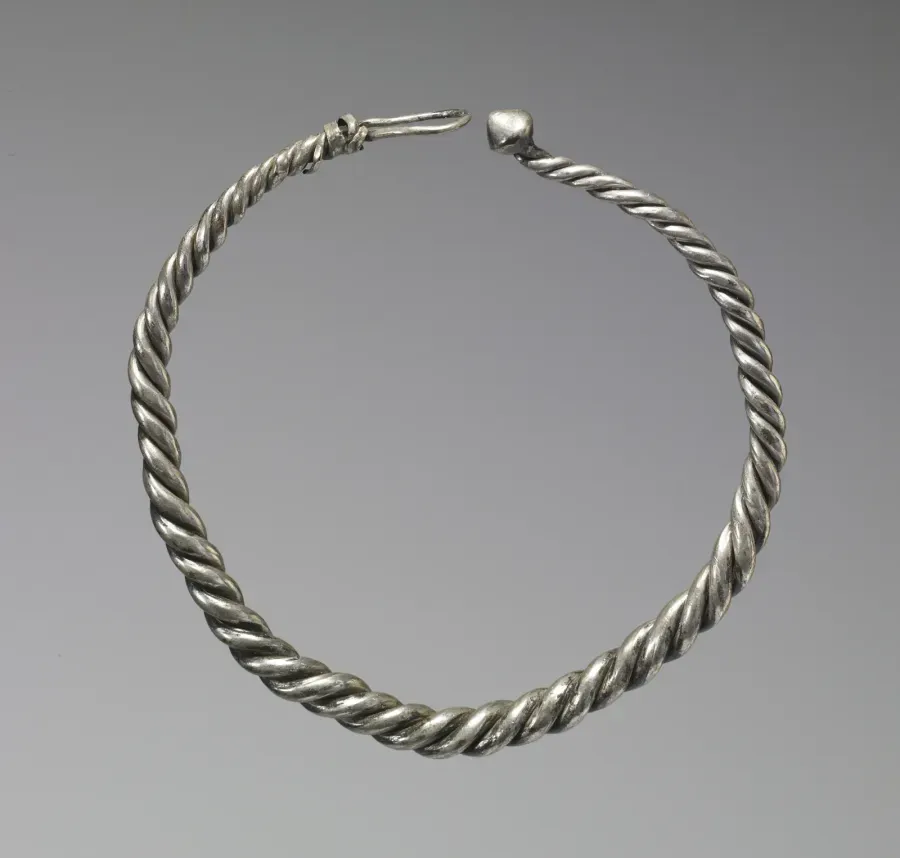
The silver arm ring holds a specific place in Norse culture that goes beyond decoration. In the Eddic tradition, oaths were sworn on arm rings. The Eyrarland figure, a small bronze statuette of Thor, holds what appears to be a hammer; other figures associated with oath-taking are shown with arm rings. Sagas describe chieftains and kings holding out their arm rings for followers to grasp when swearing loyalty.
The practice is documented in the Landnamabok, the book of settlements of Iceland, where the ritual of swearing on the ring at a temple altar is described in detail. This means the arm ring in a Norse context was not simply jewellery: it was a legal object, a binding instrument, an object that transformed spoken words into formal obligations.
Contemporary arm rings in the Norse tradition carry this weight even now. A silver arm ring given as a gift within a relationship has an older resonance than most people giving it are aware of.
The wealthy woman
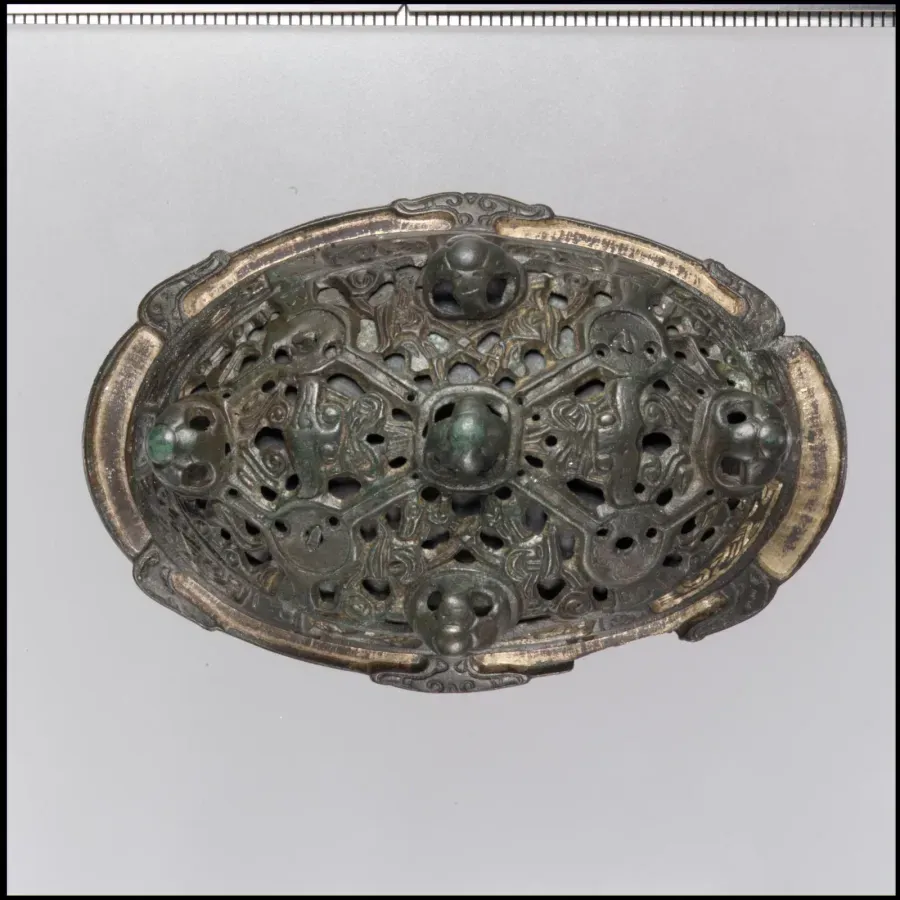
The archaeological record does not support the popular image of Viking culture as an exclusively male world. Female graves across Scandinavia have yielded some of the most elaborate jewellery finds. The oval brooch, a distinctively Norse form unknown in Anglo-Saxon England, was worn in pairs at the shoulders of a woman's dress, holding the shoulder straps together. Grave finds confirm that women wore these along with strings of beads, pendants, and personal amulets including Mjolnir.
The Oseberg ship burial in Norway, excavated in 1904, contained two women buried with extraordinary wealth: textiles, household objects, animals, and jewellery. The interpretation of who these women were remains debated, but the material evidence is unambiguous: Norse women of status were buried with as much care and as much symbolic material as the men.
Children and protective amulets
Small Mjolnir pendants, some only a centimetre or two in length, appear in children's graves. The protective function of the Mjolnir extended to the most vulnerable members of a community, and parents clearly understood it as a warding object to be given early. Several such finds from the Danelaw show that this practice was maintained in the Norse communities of northern England.
Materials and craft techniques
Metals
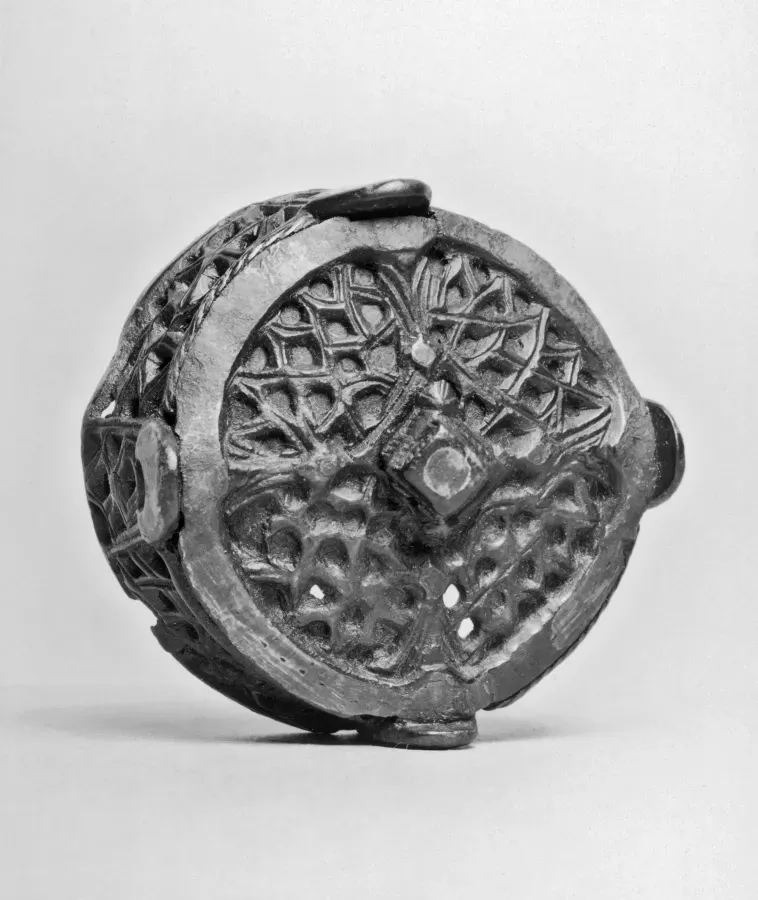
Vikings worked primarily in silver, which served simultaneously as currency, ornament, and amulet material. Hacksilver, chopped fragments of coins and broken jewellery, was weighed and accepted as payment. This explains why hoards often contain deliberately broken pieces: they were cut up for small transactions.
Gold existed but was rare, imported via Constantinople along the Varangian trade route. Bronze served for more accessible pieces.
Baltic amber was traded actively across Europe and the Middle East. Amber beads and pendants appear in Norse graves alongside imported glass beads, indicating long-distance trading connections.
Craft techniques
Granulation: tiny silver balls soldered to the surface of a piece, creating a textured decorative effect. Requires precision soldering. Vikings adopted this technique from Mediterranean craftsmen through trade.
Niello: a black inlay on silver that creates contrast between filled and unfilled areas. Common in Scandinavian brooches and belt fittings. The characteristic dark ground that throws runic or ornamental motifs into relief.
Twisted wire: several silver threads wound together, used for bracelets, rings, and chains. One of the most recognisable elements of Scandinavian metalwork. The process called Þórshamarinn in Old Norse refers more broadly to Mjolnir-form production, but twisted wire was central to Viking ring and bracelet making.
Lost-wax and stone-mould casting: most Mjolnir pendants and amulets were cast in two-part stone or clay moulds. Moulds found at Hedeby confirm serial production.
Repoussé and chasing: for more complex surface decoration, a silversmith would hammer the piece from the back to create raised areas (repoussé), then refine the surface from the front (chasing). This technique appears on larger brooches and ceremonial pieces.
How to build a Viking jewellery collection
If the subject has taken hold and you want more than one piece, there are several ways to think about building a set.
One symbol, many forms
Take a favourite symbol, Mjolnir for instance, and collect it across different formats: pendant, earring, ring, bracelet charm. The result is a coherent visual identity without repetition.
Different symbols, one theme
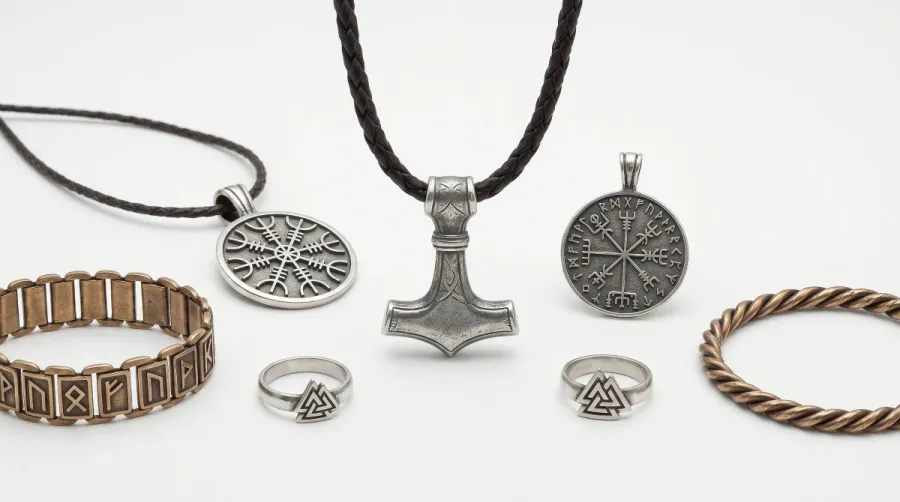
A protection set: Mjolnir, Aegishjalmur, Vegvisir, and the Algiz rune. All concerned with warding and guidance. Wear together or separately.
A warrior set: Mjolnir, Tiwaz, wolf, raven. The fighting tradition.
A memorial set: Valknut, raven, Fehu rune (ancestral wealth and legacy).
Layered composition
One substantial base piece, a Mjolnir pendant, with smaller rune charms on the same chain. This mirrors what archaeology tells us about how Vikings actually wore jewellery: multiple amulets together, layered and accumulated over time, not purchased as a coordinated set from a single source.
Paired pieces
Matching Mjolnir pendants for two people, or Mjolnir paired with a rune, one for each partner. The Jorvik finds include grave goods placed in pairs, suggesting Norse couples understood the symbolism of shared tokens.
Materials for a contemporary collection
Sterling silver 925 is the most historically grounded choice. It develops a patina with age, an asset rather than a flaw, the worn look of something recovered from the earth.
Oxidised silver begins with that patina already in place, giving an immediate archaeological quality. This is closest to how actual finds look after conservation.
Bronze or copper for a rawer, more ancient appearance. Works well with natural fabrics and leather.
Black steel for a modern interpretation with a tactical edge.
Gold works, but it is not the first choice for Norse aesthetics. The visual language of Viking jewellery is built on silver.
Men's and women's Viking jewellery
The question of whether Viking jewellery is "for men" or "for women" has a clear archaeological answer: it was always for both.
For men, the traditional forms are pendant Mjolnirs on heavy chains, arm rings, runic rings worn on the finger, and wolf or raven pendants. Heavy gauge, unpolished finish, minimal surface decoration beyond the symbolic motif.
For women, the archaeological record shows oval brooches, bead strings with amber and glass, Mjolnir pendants in the same forms as the male pieces, and more finely worked filigree rings. Contemporary women's Norse jewellery follows this divide well: rings with fine knotwork, smaller Mjolnir pendants on delicate chains, amber set in silver for earrings and necklaces.
The truth is that the symbolic language is universal and was always understood as such. A woman wearing an Algiz rune pendant is using an older and better-documented protective symbol than many modern alternatives. A man wearing an Urnes-style knotwork ring is wearing a form that Norse women wore comfortably for centuries.
Styling Viking jewellery with contemporary dress
Minimal, one piece
A single Mjolnir pendant on a fine silver cord or chain. Restrained, works for everyday life including professional settings.
Layered, multiple pieces
A heavy chain with Mjolnir, a rune bracelet, a rune stud earring, a ring. This is a statement, not suited to formal contexts.
With a tattoo
Viking symbolic tattooing has grown alongside the jewellery interest. The same symbol on skin and in metal creates a deliberate, reinforced identity.
With period or heritage clothing
If you are involved in historical re-enactment or living history, the jewellery integrates naturally as part of a complete presentation.
With contemporary clothing
Viking jewellery pairs well with dark clothing, leather, wool, and heavy knit. It sits less naturally with very formal or brightly coloured dress.
Silver, gold, symbolic pieces, and paired sets.
Who it suits
Fans of the Vikings and Vikings: Valhalla television series. The most direct route in.
Those drawn to Marvel-era Norse narratives. The broad cultural interest in Thor and Norse mythology generated over the past fifteen years has created a substantial audience for Mjolnir in particular.
Gamers drawn to Norse settings. Multiple major game releases in recent years have introduced Norse imagery and mythology to a generation who now want the physical objects.
Metal music followers. Folk metal and Viking metal audiences have long carried this aesthetic.
Historical re-enactors. Those engaged in living history or experimental archaeology.
People with Scandinavian ancestry. Particularly common in Scotland and the north of England, where Norse roots run deep through surnames, place names, and local tradition.
Researchers and historians. Those with an academic interest in the Viking Age.
People in transition. Vegvisir in particular draws those navigating change.
Those who value protection. Mjolnir as a protective amulet, Aegishjalmur for those who feel the need for a ward.
Gift buyers. A Mjolnir pendant for someone who has just moved, started something new, or needs marking out as protected is a better gift than another generic silver chain. The symbolism does work that a plain piece cannot. The Norse tradition of giving amulets at significant life moments, a birth, a departure, a recovery, is older than most gift-giving customs that survive in the modern world.
FAQ
Can I wear Mjolnir without being pagan or heathen?
Entirely. Today Mjolnir functions as a cultural symbol rather than a religious one. The majority of people who wear it are not practitioners of Norse religion. If it speaks to you through strength, protection, or aesthetics, there is no requirement attached.
I am not religious. Is this not slightly absurd?
No. Ancient symbols survive by changing meaning across time. Today Mjolnir connects its wearer to Norse culture, to a body of stories and history, to a visual tradition. No religious content need be imported.
Does it suit women?
Fully. The archaeological record is clear: Norse women wore Mjolnir pendants and runes as readily as men. The Victorian idea of Viking culture as exclusively masculine is not supported by the finds. Contemporary Norse-inspired collections for women are strong precisely because the originals were not gendered.
What does it not pair well with?
Very light aesthetics: pastels, floral motifs, delicate minimalism. Viking imagery carries visual weight. It works best against dark, textured clothing.
Is this suitable for children?
Yes. Small silver Mjolnir amulets were given to children in the Viking Age as protective objects. The same tradition holds today.
Some extremist groups use these symbols. Should I be concerned?
Unfortunately, some fringe groups have appropriated Norse imagery. The symbols themselves are neutral and historically documented. If distance from that association matters to you, combined pieces, Mjolnir with a rune or Vegvisir with a name inscription, read clearly as cultural rather than political.
What makes a piece historically authentic?
Authentic means silver with hammered or cast texture, clean forms without excessive ornamentation. Heavily polished, heavily styled versions are contemporary interpretations. Both are valid: you are not obliged to wear archaeology.
How do I care for oxidised silver?
Oxidised silver carries a deliberate dark layer that creates its characteristic antique effect. To preserve it: avoid abrasive cleaners and polishing cloths, wash only with mild soap and water, store in a dark place away from other jewellery. Where the patina wears at contact points with skin over time, this is part of the piece's natural history rather than a fault.
Is a Mjolnir a suitable gift?
For the right person, it is one of the more meaningful gifts available in this category. The protective symbolism is appropriate for transitions: a new home, a new chapter, a difficult period someone is moving through. The Norse understood the gift of an amulet as a specific statement of care, and that reading transfers intact to the present. Engrave it with a rune or a name to make it completely singular.
Does the weight of the piece matter?
For pendant Mjolnirs and arm rings, weight is part of the aesthetic. A heavier piece has more presence, moves differently, and reads differently to the eye. The archaeological originals were substantial objects, not delicate ornaments. If you want the authentic character, err toward weight.
Can I combine Norse pieces with jewellery from other traditions?
Yes. The Vikings themselves did exactly this. Norse graves have been found containing Byzantine pendants, Arab coins worn as ornaments, and Celtic-style brooches alongside Mjolnirs. The idea of a pure, unmixed Norse aesthetic is a romantic construction, not a historical one. A Norse Mjolnir alongside a Celtic knotwork ring is a combination with a thousand years of precedent.
What should I look for in quality craftsmanship?
Surface detail holds up under close examination. Rune characters should be crisp, not smeared. Knotwork should have clean crossings rather than blurred intersections. On cast pieces, the parting line where the two halves of the mould met should be cleaned up and invisible. Weight distribution should feel intentional. A good Mjolnir pendant sits correctly when hanging: the hammer head level and the handle pointing straight down.
How quickly does oxidised silver develop wear?
The rate depends entirely on how and where you wear it. A piece worn daily against skin, particularly around the neck or wrist, will show wear at the highest contact points within months. A piece worn occasionally, stored carefully, and kept away from moisture and other metals will hold its oxidation for years. Neither outcome is a problem. A piece that shows wear at its edges and patina in its recesses has exactly the look the archaeological originals carry.
Choosing your first piece
If you are new to Norse jewellery and uncertain where to start, the clearest framework is personal resonance over system. The symbolism works only if it means something to the person wearing it.
Mjolnir is the natural starting point for most people: universally recognised, historically documented, visually versatile, and appropriate for almost any context when worn in a restrained form. If protection is the primary interest, Mjolnir or Aegishjalmur. If direction and navigation, Vegvisir. If ancestry and family legacy, Othala rune or Yggdrasil. If strength through endurance, Uruz or the Triple Horn of Odin.
The question of size is partly practical and partly aesthetic. A pendant worn daily needs to be manageable at the neckline, light enough not to be noticeable, and durable enough to survive constant contact with clothing and skin. A pendant worn as a statement can be larger, heavier, and more visually dominant. Most people start with a mid-weight pendant and decide from experience whether they want something more substantial or more discreet.
For a first gift, a Mjolnir with a rune engraved on the reverse gives the piece a private dimension: the protective symbol is public, the rune is personal. The recipient can read into it what they choose. Algiz on the back of a Mjolnir for someone about to take a risk. Othala for someone reconnecting with their family roots. Wunjo for someone who needs reminding that ease and joy are legitimate states, not indulgences.
About Zevira
Zevira makes Viking jewellery by hand in Albacete, Spain. The Viking collection covers the full range of classical symbols in a consistent visual language: oxidised silver with a worked surface, deliberately unglossy.
What you will find in the Viking collection:
- Mjolnir in multiple sizes, from everyday wear to statement pieces
- Vegvisir as both pendant and ring
- Aegishjalmur for protection
- Valknut for those drawn to Odin and the theme of the fallen
- Yggdrasil, triskelion, raven, wolf as additional symbols for expanding a set
- Everything designed to work together so a collection can be built gradually
Each piece is made by hand with the option of personal engraving. Materials are sterling silver 925 and gold in 14 and 18 karat.